
MONROVIA – Post conflict Liberia’s democratic trajectory, once praised for its peaceful transfer of power in 2018 and 2023, now faces a defining stress test as controversy engulfs the leadership of its electoral body. What should have been a routine nomination has evolved into a national flashpoint, exposing deeper anxieties about institutional independence, political influence, and the integrity of future elections. With the stakes stretching toward 2029, opposition voices are growing louder, warning that public confidence—once broken—is difficult to restore. At issue is not merely who leads the elections commission, but whether Liberians can trust the referee of their democracy to remain neutral, credible, and above suspicion in moments that matter most, As THE ANALYST reports.
President Joseph Nyuma Boakai’s nomination of Jonathan K. Weedor as Chairman of the National Elections Commission (NEC) is fast evolving into a high-stakes political confrontation, with opposition groups, civil society actors, and segments of the public warning that the decision could fundamentally alter the trajectory of Liberia’s democracy ahead of the crucial 2029 elections.
What began as an announcement from the Executive Mansion has now spiraled into a broader national reckoning over trust, neutrality, and the limits of executive discretion in safeguarding democratic institutions.
The nomination follows the resignation of Davidetta Browne-Lansanah, but rather than signaling continuity, it has opened a new chapter of uncertainty—one that critics say could erode the fragile confidence painstakingly built since the end of Liberia’s civil conflict.
OPPOSITION’S CORE ARGUMENT: TRUST IS NOT NEGOTIABLE
Across the opposition spectrum, a unifying concern has emerged: the NEC must not only be independent—it must be seen to be independent beyond doubt.
The Alternative National Congress (ANC) has issued one of the strongest rebukes, cautioning that Liberia’s “fragile democracy cannot afford an electoral body whose leadership is perceived—rightly or wrongly—as politically compromised.”
This framing reflects a deeper opposition anxiety—that the rules of political competition must be protected from even the appearance of manipulation.
For opposition figures, the controversy is not about technical qualifications. It is about the structural integrity of the system itself.
They argue that allowing a figure perceived to have participated in the 2023 campaign of the ruling Unity Party to now preside over future elections creates what one opposition strategist described as a “conflict of democratic optics”—a scenario where fairness may exist procedurally but collapses perceptually.
THE LEGACY OF 2023: A TRUST DIVIDEND AT RISK

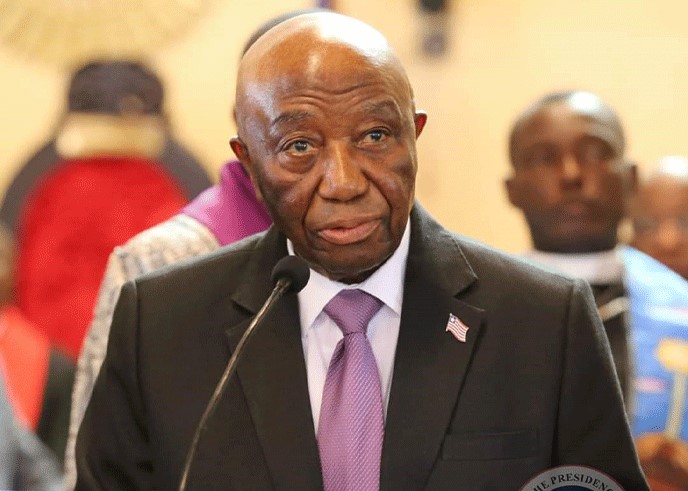
Newly Appointed NEC Chairperson, Jonathan Weedor
Liberia’s 2023 elections marked a historic milestone. The peaceful concession by the then-ruling Coalition for Democratic Change (CDC) was widely celebrated both domestically and internationally, reinforcing Liberia’s standing as a maturing democracy in a region grappling with instability.
That moment created what analysts now call a “trust dividend”—a rare political asset built on mutual acceptance of electoral outcomes.
Today, critics warn that this dividend is under threat.
“Democracy does not collapse overnight,” a Monrovia-based political analyst observed. “It erodes gradually—through decisions that chip away at confidence, normalize doubt, and make citizens question whether outcomes are pre-determined.”
CIVIL SOCIETY ESCALATES: FROM CONCERN TO WARNING
Civil society organizations have moved beyond cautious observation to direct warning, signaling a rare moment of convergence across Liberia’s governance advocacy space.
Philip D. Kingston, Executive Director of the Liberia Must Rise initiative, has articulated what many now see as the central dilemma: competence without independence is insufficient in electoral governance. In his view, Liberia risks normalizing a dangerous precedent where technical expertise is allowed to overshadow the equally critical requirement of public trust. “You cannot build electoral credibility on credentials alone,” he noted in a recent civic forum. “The legitimacy of the process rests on whether citizens believe the system is insulated from political influence—anything short of that invites doubt.”
Similarly, Solidarity and Trust for a New Day (STAND) has taken the extraordinary step of formally urging the Senate to reject the nomination—arguing that perceived bias alone is enough to undermine electoral legitimacy. The group maintains that Liberia must not wait for evidence of wrongdoing before acting, insisting that the threshold for electoral leadership must be preventive, not reactive.
In a move underscoring the gravity of the situation, STAND has reportedly engaged international partners, signaling that Liberia’s internal democratic processes are once again under global scrutiny.
Adding to the chorus, Anderson P. Peters, has sharpened the critique by reframing the issue as one of institutional risk.
While acknowledging the nominee’s technical strengths, he argues that independence is not a complementary value—it is foundational. “The question is not whether he can manage elections,” Peters emphasized in a radio appearance. “The question is whether every political actor, including those who may lose, will accept his decisions as fair. If that confidence is absent, the system itself becomes vulnerable.”
From the governance and accountability space a university lecturer, J. Solo Paygar, has warned that Liberia may be underestimating the long-term consequences of perceived bias in electoral leadership.
He points to the country’s post-conflict context, where institutions are still earning—not commanding—public trust. “In societies like ours, credibility is cumulative but fragile,” Paygar noted during a policy dialogue. “One controversial decision can undo years of progress in building confidence in electoral systems.”
Meanwhile, constitutional lawyer and governance commentator Moriah Yeakulah has introduced a legal-political dimension to the debate, cautioning that even where nominations meet constitutional requirements, the broader doctrine of democratic legitimacy must prevail.
“The Constitution sets the minimum threshold,” she argued in a panel discussion. “But democracy demands a higher standard—one that reassures the public that those who oversee elections are not only qualified, but unquestionably impartial.”
Collectively, these voices reflect a shift in tone—from advisory concern to urgent caution. For a country still consolidating its democratic institutions, such sustained and coordinated civil society pressure carries both symbolic weight and practical consequence, reinforcing the idea thatelectoral credibility is not merely administered—it is collectively defended.
THE “PLAYER TO REFEREE” PROBLEM
Perhaps the most potent and politically charged criticism emerging from governance experts is what has now crystallized into Liberia’s “player-to-referee dilemma”—a phenomenon where individuals perceived to have been active participants in partisan politics transition into positions expected to guarantee neutrality and fairness.
At the center of this concern are recent reports and widely circulated accounts suggesting that Jonathan K. Weedor played a technical role within the “war room” of the Unity Party during the 2023 elections—a space typically reserved for strategy, data analytics, rapid response communication, and internal projection of electoral outcomes.
While these claims have not been formally adjudicated, their persistence in public discourse has deepened skepticism, particularly among opposition actors who argue that such proximity to partisan operations raises unavoidable questions about future impartiality.
For critics, the issue is not whether such involvement was illegal—rather, it is whether it creates a perception of embedded loyalty that cannot easily be erased by formal disengagement.
Clergy advocate Clarence Pearson frames the concern in stark institutional terms: when a perceived “player” becomes the “referee,” every decision—no matter how procedurally sound—risks being interpreted through a partisan lens. In this framing, credibility is no longer determined by actions alone, but by prior associations that shape public judgment.
This dilemma is not unique to Liberia. Across parts of Africa, similar transitions—from political actors to electoral arbiters—have contributed to deepening mistrust, contested outcomes, and in some cases, post-election instability.
Analysts point to experiences in several countries where electoral commissions perceived as politically aligned struggled to command acceptance of results, even when processes met technical standards.
A regional governance analyst in Monrovia, reflecting on these patterns, warned:
“Once the referee is seen as having worn a team’s jersey, the game changes. Every call becomes suspect. Every outcome becomes negotiable. That is how democracies slide from competition into confrontation.”
Indeed, Liberia’s own history reinforces this caution. Periods of electoral dispute—particularly when institutions were viewed as compromised—have often triggered broader political tensions. In fragile democracies, the margin between acceptance and rejection of results is often determined not by facts, but by trust.
What makes the current moment particularly sensitive is the proximity to the next electoral cycle. With 2029 already on the horizon, opposition figures argue that appointing a figure clouded by perceptions of past partisan involvement riskspre-loading the electoral environment with suspicion, thereby increasing the likelihood that future outcomes—especially close ones—will be disputed regardless of their technical integrity.
Some political commentators describe this as the “pre-legitimacy crisis”—a situation where elections are not rejected after they occur, but are questioned before they even begin, based on the credibility of those overseeing them.
Even among neutral observers, there is growing recognition that Liberia must tread carefully. The country’s democratic gains—particularly the peaceful transfer of power in 2023—were built on a fragile but meaningful consensus that the system, though imperfect, was fundamentally fair.
That consensus, critics warn, is now under strain.
“The danger is not just bias,” one governance expert noted. “The danger is doubt. Because once doubt becomes the dominant narrative, even the truth struggles to stand.”
In that sense, the “player-to-referee” controversy is no longer about an individual nomination—it has evolved into a broader test of whether Liberia can safeguard the perception of neutrality that underpins democratic stability, or risk drifting toward the very patterns that have made electoral politics in parts of Africa increasingly contentious, unpredictable, and at times unsafe.
DIVIDED SUPPORT: NOT ALL OPPOSITION ALIGNED
Yet, the controversy is not without complexity.
The Liberia National Union (LINU), led by Clarence K. Moniba, has openly endorsed Weedor, citing his unmatched experience and institutional knowledge.
This divergence reveals a fragmented opposition landscape—one where strategic calculations, political alignments, and differing interpretations of risk shape responses to the nomination.
However, even among supporters, there is an implicit acknowledgment: public perception must be managed carefully.
LEGALITY IS NOT LEGITIMACY
Liberia’s laws provide clear criteria for NEC commissioners. By those standards, the nomination may pass constitutional muster.
But critics insist that legal sufficiency does not equate to democratic legitimacy.
Eddie D. Jarwolo emphasizes that electoral institutions derive their authority not just from law, but from public confidence.
“When citizens lose trust in the referee,” a governance expert noted, “the game itself loses meaning.”
CITIZENS SPEAK: FEAR OF A PRE-DETERMINED FUTURE
Beyond formal institutions and elite political exchanges, the debate is resonating deeply among ordinary Liberians—those whose lives are most directly affected by the outcomes of elections, yet who often have the least influence over how those systems are shaped.
Across radio platforms, community discussions, and social spaces—from Duala to Gbarnga, from Buchanan to Zwedru—a recurring fear is emerging: that future elections could become contested not because of evidence, but because of perception. In a country where trust in institutions is still being rebuilt, perception alone can be powerful enough to shape acceptance or rejection of results.
At a busy taxi park in Paynesville, commercial driver Emmanuel T. Harris reflected a growing unease:
“If people already believe the system is leaning one way, then even if the process is clean, the result will still be questioned. That is how confusion starts—not from facts, but from belief.”
This anxiety is echoed across generational lines. University student Josephine M. Karneh warned that the stakes extend beyond politics into civic participation itself:
“Young people are already losing interest in voting because they feel decisions are made elsewhere. If this continues, turnout will drop, and democracy will weaken from inside.”
Market trader Hawa K. Gblin framed the issue in simpler but equally powerful terms:
“We don’t need big trouble before we act. When people start saying ‘the thing already decided,’ that is already a problem. Elections should be about choice, not assumption.”
For many citizens, the concern is not just about who wins or loses—it is about whether participation still carries meaning. In communities where memories of instability remain vivid, even subtle erosion of trust can trigger broader societal anxiety.
Community youth organizer Prince L. Gono cautioned that perception-driven disputes can escalate quickly:
“When elections are seen as unfair, people don’t wait for courts—they react. And when reactions grow, the situation can get out of hand before leaders even respond.”
Some citizens go further, suggesting that the mere suspicion of bias could effectively “pre-write” the narrative of electoral outcomes, turning future results into foregone conclusions in the minds of voters—regardless of the actual process.
Retired civil servant Martha S. Kpadeh captured this sentiment with quiet urgency:
“If people already decide in their hearts that the election will not be fair, then whatever result comes will not bring peace. Trust must come before the vote, not after.”
This growing chorus of citizen voices underscores a critical reality: Liberia’s democratic strength does not rest solely in laws, institutions, or procedures—it rests in public belief.
And as the country edges toward the 2029 elections, that belief, many warn, is beginning to show signs of strain.
THE “PLAYER TO REFEREE” PROBLEM — A SYSTEM UNDER PERCEPTION STRESS
What began as a technical debate over qualifications has now matured into a deeper institutional question—whether Liberia is inadvertently stepping into a pattern that has unsettled electoral systems across parts of Africa: the blurring of lines between political participation and electoral arbitration.
At the center of this concern are persistent public claims that Jonathan K. Weedor may have served in a technical or strategic capacity within the “war room” of the Unity Party during the 2023 elections. While such claims remain part of political discourse rather than formal findings, their resonance lies not in proof alone, but in how they shape public interpretation of neutrality.
In fragile democracies, perception is not secondary—it is structural.
Clergy advocate Clarence Pearson articulates this as a crisis of roles:
“When the same individual is seen as part of a political contest one day and the judge of that contest the next, the system must work twice as hard to prove fairness—and even then, doubt remains.”
This dilemma has played out across multiple African contexts, where electoral bodies perceived as politically aligned have struggled to command post-election acceptance, even when procedures met technical benchmarks. The consequence is not always immediate violence, but something more insidious—a slow corrosion of legitimacy.
A regional governance observer, speaking from Monrovia, warned:
“The greatest risk is not rigging—it is rejection. Once people believe outcomes are influenced, they disengage from institutions and re-engage through resistance. That is where instability begins.”
In Liberia’s case, the sensitivity is heightened by history. The country’s descent into a 14-year civil conflict remains a lived memory, and for many citizens, the root causes are traced not only to armed actors but to political decisions that weakened trust and excluded voices.
Community elder Maude K. Gbessay reflected on this continuity:
“Before the war, there were already complaints—about fairness, about who controlled power. People ignored those warnings. Today, we must not ignore small signs again.”
Market woman Comfort Zleh added a more personal dimension:
“The politicians made decisions, but it was the poor people who suffered. They had places to go—we had nowhere. So when elections start to look uncertain, we remember what it cost us.”
For many Liberians, the fear is not abstract—it is rooted in memory, loss, and survival.
Political analyst Moses D. Kollie describes the present moment as a “pre-condition phase”:
“Conflict does not begin with confrontation. It begins with perception—when enough people believe the system is unfair, the system loses its authority, even before it is tested.”
Thus, the “player-to-referee” debate is no longer about a single appointment. It has become a litmus test for institutional boundaries—whether Liberia can maintain a clear separation between political actors and electoral arbiters, or whether it risks entering a gray zone where trust becomes negotiable.
