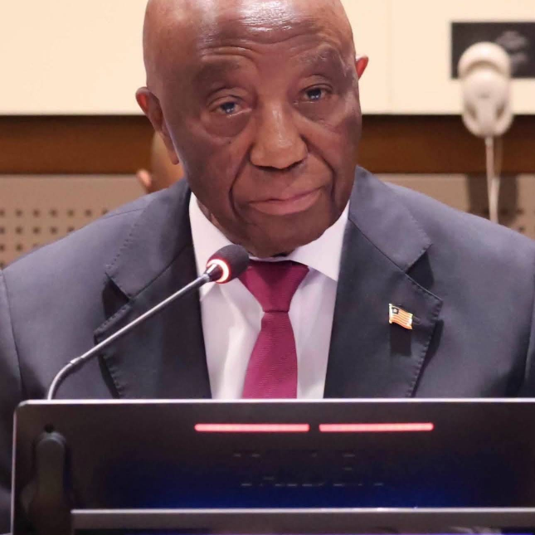
NEW YORK, September 25, 2026: President Joseph Nyuma Boakai has called for urgent reforms to the United Nations Security Council, including greater African representation in the international system. “Eighty years of patience is enough. The time for structural reform is now,” Boakai declared.
He said Africa, with about 1.5 billion people and nearly one-third of UN membership, still lacks a permanent seat on the Security Council, despite the Council devoting significant attention to peace and security issues affecting the continent.
He also warned that declining trust in multilateral institutions is deepening global fragmentation and weakening efforts to address conflicts, development challenges and emerging threats.
Addressing the 81st Session of the United Nations General Assembly in New York on Thursday, September 24, President Boakai said the principles of multilateralism remain relevant but must be applied more consistently and fairly.
“Trust in multilateralism is broken and needs to be restored,” Boakai said, arguing that the response to global fragmentation should not be less multilateralism but “better multilateralism.”
The Liberian leader recalled Liberia’s role as a founding signatory of the United Nations Charter, saying the country still believes global peace depends on international law, respect for human rights and dignity, and a shared commitment to development.
He pointed to Liberia’s transition from civil conflict to constitutional democracy as evidence that dialogue, institution-building and sustained national commitment can help societies overcome divisions and rebuild institutions.
Boakai said his administration is seeking to apply those principles domestically through stronger public accountability, prudent financial management, anti-corruption efforts and support for the judiciary as part of efforts to strengthen public confidence in state institutions.
Peace, Security and Drug Trafficking
Turning to international peace and security, Boakai called for an immediate end to hostilities in conflict zones, unhindered humanitarian access and respect for international humanitarian law.
He said preventive diplomacy, mediation and early-warning mechanisms should occupy a central place in the international peace and security architecture, arguing that preventing conflict is less costly than rebuilding societies devastated by war.
As a current member of the UN Security Council, Liberia is confronting emerging security threats in West Africa, including transnational organized crime, cyber warfare and illicit narcotics trafficking through maritime corridors in the Gulf of Guinea, Boakai said.
He said Liberia’s joint security forces are intensifying efforts against transnational drug networks but acknowledged that international criminal organizations cannot be effectively confronted by individual countries acting alone.
The President therefore called for greater international support for coast guard surveillance, intelligence sharing and port-security technology.
Calls for Global Financial Reform
Boakai also called for structural reforms to the global financial system as developing countries confront debt pressures, shrinking fiscal space and external economic shocks.
He said developing countries need greater access to concessional financing, sustainable debt arrangements and predictable development capital.
The President called for greater representation and voting power for developing countries within the Bretton Woods institutions, particularly the World Bank and International Monetary Fund, arguing that their governance structures continue to reflect an international system established in a different era.
“A financial system that decides the fate of billions cannot continue to be governed by so few,” Boakai said.
He linked reform of the global financial architecture to implementation of the Sustainable Development Goals, saying greater fairness in international financial governance is important to restoring confidence in multilateral institutions.
ARREST Agenda and Climate Justice
On Liberia’s domestic development efforts, Boakai highlighted his administration’s ARREST Agenda for Inclusive Development, which focuses on Agriculture, Roads, Rule of Law, Education, Sanitation and Tourism.
He cited progress in revenue administration and infrastructure development, including efforts to improve rural roads and strengthen connections between agricultural communities and markets.
On climate change, Boakai emphasized Liberia’s relatively low contribution to global greenhouse gas emissions while highlighting the country’s vulnerability to coastal erosion, flooding and changing agricultural cycles.
He said Liberia contains approximately 42 percent of the remaining Upper Guinean Rainforest, describing the forest as an important carbon sink.
The President called for climate responsibility to be accompanied by climate justice, urging industrialized countries to fulfill climate-financing commitments and support mechanisms addressing loss and damage suffered by vulnerable nations.
Youth, Women and Artificial Intelligence
Boakai also highlighted youth empowerment, gender equality and responsible technological development.
Noting Africa’s predominantly young population, he called for greater investment in science, technology, engineering and mathematics, digital literacy and technical training.
He said such investments would help young Africans become creators and innovators in the global digital economy rather than primarily consumers of technologies developed elsewhere.
On gender equality, Boakai reaffirmed Liberia’s commitment to the political, economic and social advancement of women and girls, saying greater participation by women strengthens peace, economic growth and accountability.
He also welcomed international efforts to establish governance frameworks for emerging technologies, including artificial intelligence.
The President called for stronger ethical standards and regulation of AI, particularly regarding its potential use in warfare, arguing that technological innovation should advance human development rather than contribute to destruction.
Liberia Demands Permanent African Seats
A major portion of Boakai’s address focused on reforming the UN Security Council, where he called for greater African representation.
He said Africa, with about 1.5 billion people and nearly one-third of UN membership, remains without a permanent seat on the Security Council despite the Council devoting significant attention to peace and security issues affecting the continent.
“Eighty years of patience is enough. The time for structural reform is now,” Boakai declared.
Liberia reaffirmed its support for the Common African Position on Security Council reform, including the demand for at least two permanent African seats with the accompanying rights and responsibilities, including the veto for as long as that power remains part of the Council’s structure.
Liberia also supports additional non-permanent seats for Africa.
Boakai argued that addressing Africa’s underrepresentation would strengthen the credibility, legitimacy and trustworthiness of the United Nations.
‘Liberia Is Ready’
Concluding his address, President Boakai urged UN member states to pursue reforms capable of restoring confidence in multilateral institutions.
He again cited Liberia’s experience of moving from civil conflict to constitutional democracy and rebuilding institutions as evidence of what sustained commitment to reform can achieve.
Boakai called for a United Nations capable not only of debating global crises but also of delivering concrete solutions, protecting vulnerable populations, respecting the rights of nations and promoting lasting international peace.
See more Liberia News Network stories in Google Search by adding LNN as one of your Preferred Sources.
★ Add LNN as a Preferred Source