
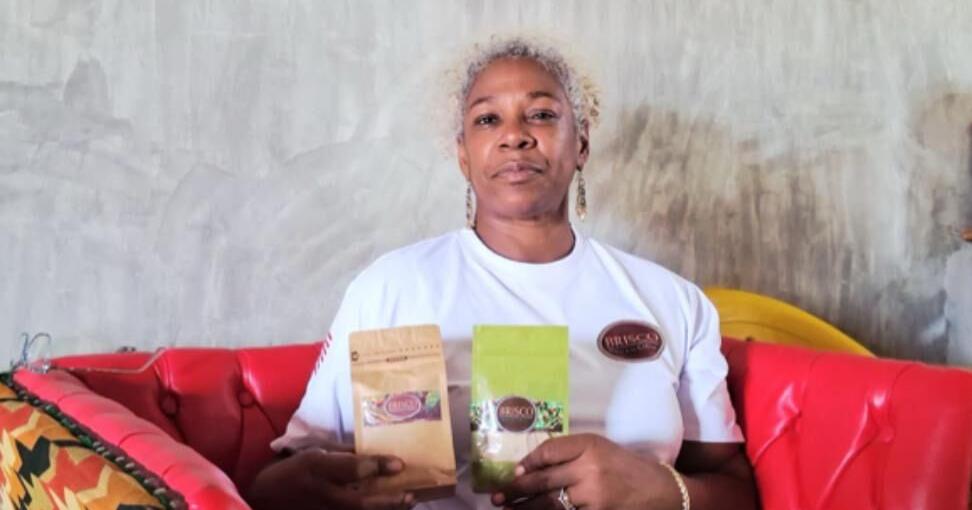
In a modest coffee shop tucked along Old Road in Monrovia, Liberian entrepreneur Sangai Hines-Brisbane is quietly working to revive one of the country’s most overlooked agricultural treasures — Liberica coffee.
But while global demand for specialty coffee continues to grow, she says Liberia’s indigenous coffee industry is struggling to expand because small producers lack access to financing and modern processing infrastructure.
“Everything I do is self-funded,” said Hines-Brisbane, Chief Visionary Officer of Brisco Natural Liberica Coffee. “As I make money, I reinvest it back into the business.”
For more than a decade, she has been promoting Liberia’s native coffee species while building a small but growing product line that includes roasted Liberica coffee, coffee cherry tea, coffee flour, and other specialty items derived from the coffee plant.
Yet the business, she says, has grown largely without government financial support.
“When people ask why the business hasn’t grown faster, they don’t realize I’m building it gradually without financial assistance,” she explained.
A Forgotten Coffee With Global Potential
Liberica coffee — scientifically known as Coffea liberica — is indigenous to West and Central Africa, including Liberia, Sierra Leone, and Côte d’Ivoire. Unlike the more common Arabica and Robusta varieties that dominate global markets, Liberica remains one of the rarest coffee species in the world.
Globally, coffee production reached about 11.1 million metric tons in 2023, with Brazil, Vietnam, and Indonesia leading the market.
Within that massive global industry, Liberica accounts for only a tiny share of production — but interest in the variety is rising as consumers increasingly seek specialty and single-origin coffees.
Market research suggests the global Liberica coffee market could grow from about US$972 million in 2021 to more than US$1.45 billion by 2025, with long-term projections exceeding US$3.2 billion by 2033.
Analysts attribute this growth to demand for unique flavor profiles and to Liberica’s resilience in warmer climates — a characteristic that may make it increasingly valuable as climate change threatens traditional coffee-growing regions.
Liberica beans are typically larger than those of Arabica or Robusta and produce complex flavors often described as fruity, smoky, and nutty, making them attractive to specialty coffee markets.
For Hines-Brisbane, that global trend represents a major opportunity for Liberia.
“When I realized Liberica was indigenous to Liberia, I felt everyone needed to know about it,” she said.
Liberia’s Coffee Legacy
Liberia once played a far larger role in the coffee trade than many people realize.
At its peak in the mid-1980s, the country produced over 200,000 bags of coffee annually, much of it Liberica.
Earlier in the 20th century, Liberia’s coffee sector was even more significant, with the country producing up to 10,000 metric tons annually, representing a notable share of the global market at the time.
However, decades of civil conflict, declining investment, and the shift of global demand toward Arabica and Robusta varieties caused the industry to collapse.
Today Liberia’s coffee production is estimated at fewer than 10,000 bags annually, placing the country far outside the ranks of major coffee producers.
Across the ECOWAS sub-region, coffee production remains modest compared with Latin America and Asia, though countries such as Côte d’Ivoire and Guinea maintain small export sectors.
Much of the coffee grown in Liberia is reportedly sold informally across borders into neighboring countries for export, limiting the value that remains in the domestic economy.
Government Seeks Revival
Recognizing the crop’s potential, the Government of Liberia has begun repositioning Liberica as a strategic agricultural product.
In 2024, Liberia applied to join the United Nations Food and Agriculture Organization’s “One Country One Priority Product” (OCOP) initiative, selecting Coffee Liberica as the country’s flagship agricultural commodity.
The initiative aims to strengthen production, research, and export opportunities around the indigenous crop.
Officials say the strategy could help create jobs along the entire coffee value chain — from farming and processing to branding and export.
Liberia hopes to become the first African country to launch a national Liberica coffee development program under the OCOP initiative, positioning the crop as a niche export product in global specialty markets.
But entrepreneurs like Hines-Brisbane say government policy must be matched with practical support for small producers.
Financing Remains the Biggest Barrier
Access to financing remains one of the most difficult challenges for Liberia’s emerging coffee entrepreneurs.
Hines-Brisbane says attempts to access agricultural grants have been unsuccessful because some programs focus primarily on fruits and vegetables.
“I tried to explain that coffee is technically a fruit — the bean is the seed inside the cherry — but they said the grants are only for fruits and vegetables,” she said.
Commercial bank loans also present challenges.
Interest rates for business loans can reach 17 percent or more, with repayment schedules beginning almost immediately.
“In agribusiness, you must first invest in production before you can make money,” she explained.
Instead of purchasing expensive equipment such as a US$15,000 coffee roaster, she spreads available funds across multiple needs — packaging, marketing, and product development.
Building a Liberian Coffee Culture
Beyond farming and production, Hines-Brisbane believes Liberia must also develop a stronger domestic coffee culture.
When she first introduced Liberica coffee in local stores in 2012, many retailers were hesitant to stock the product.
“Some stores didn’t want to carry it because it wasn’t imported,” she recalled.
To promote the product, she personally visited supermarkets, hotels, and restaurants across Monrovia — from Duala to Sinkor — introducing consumers to a coffee that many Liberians did not know originated in their own country.
Over time, she says attitudes began to change.
Today her products can be found in several stores across the capital.
Looking Ahead
To expand awareness and create opportunities for new entrepreneurs, Hines-Brisbane plans to open a Coffee Lab and Rotisserie that will serve both as a café and a training center.
The facility would allow farmers and aspiring entrepreneurs to roast their own beans and learn brewing techniques.
“If someone grows coffee and wants to enter the business, they can come here and roast their coffee for a fee,” she said.
She also hopes to train young Liberians interested in coffee roasting and barista skills — creating new employment opportunities within the sector.
Despite the many obstacles she has faced, Hines-Brisbane remains optimistic about the future of Liberia’s indigenous coffee.
For her, the revival of Liberica is not just about business.
It is about reclaiming a piece of Liberia’s agricultural heritage.
“Liberia has fertile soil and capable people,” she said. “We don’t need to import everything when we can produce many things ourselves.”
