
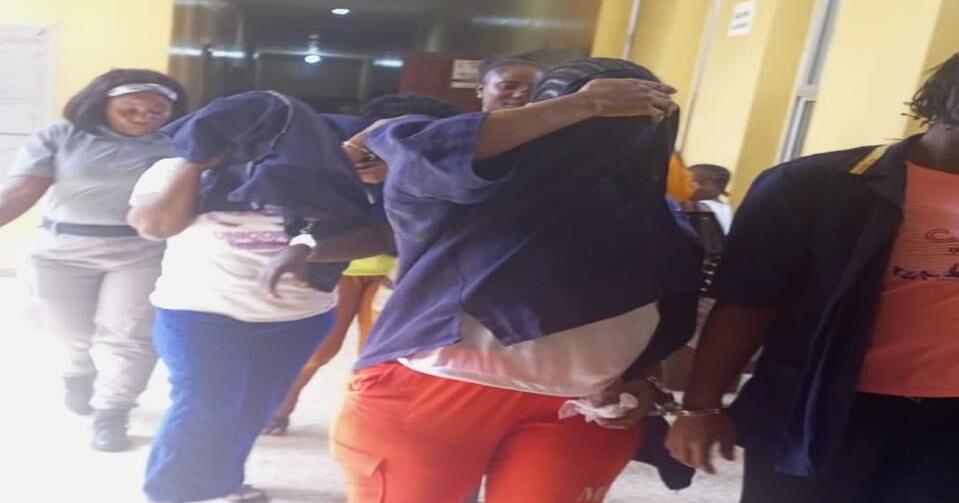
A landmark ruling by Criminal Court A in Montserrado County has highlighted both the persistent threat of human trafficking in Liberia and the government’s growing determination to combat the crime through stronger legal enforcement.
On Friday, a jury returned unanimous guilty verdicts against five women—Halimatu Daramy, Hareita Beaye, Grace H. Sesay, Hawa Kamara, and Famata Doe—for trafficking 14 children to Mali as part of a cross-border scheme designed to exploit vulnerable minors for financial gain.
The convictions represent one of the most significant prosecutions under Liberia’s anti-trafficking legal framework and are widely seen as a test of the country’s strengthened anti-trafficking law.
According to prosecutors, the defendants recruited and transported 14 children—ranging in age from 11 months to eight years—from Liberia to Mali under deceptive circumstances. Authorities told the court that the traffickers exploited the vulnerability of the children and their families, presenting the journey as an opportunity for care or relocation.
Court records revealed that after transporting the children to Mali, the suspects allegedly returned them to Liberia and collected approximately L$50,000 per child as so-called resettlement payments.
Prosecutors argued that the scheme was carefully organized and involved multiple coordinated steps, including the cross-border movement of the children and financial transactions tied to their relocation.
“The defendants knowingly, purposely, and willfully carried out the trafficking scheme,” the indictment stated, citing provisions of Liberia’s criminal code on trafficking in persons and criminal conspiracy.
Investigators further disclosed that the suspects allegedly planned a second operation, intending to move the same group of children from Liberia to Burkina Faso to secure additional financial benefits linked to international migration assistance programs.
The plan was disrupted when officers of the Liberia Immigration Service intercepted and arrested the suspects before the journey could take place.
The prosecution was conducted under Liberia’s Act to Ban Trafficking in Persons, originally enacted in 2005 and strengthened through amendments in 2021 to impose tougher penalties and enhance enforcement mechanisms.
Under Liberian law, trafficking in persons is classified as a first-degree felony, while criminal conspiracy carries second-degree felony penalties. Legal experts say convictions can result in lengthy prison sentences and significant fines, particularly when the victims are children.
Sentencing hearings are expected to follow the jury’s decision, during which the court may consider aggravating factors such as the number of victims involved, the cross-border nature of the operation, and the attempt to move minors through regions affected by insecurity and banditry.
Defense lawyers have indicated they plan to challenge the verdict, meaning the case could proceed to appeals.
A Persistent National Challenge
Human trafficking has long been a concern in Liberia, particularly involving the exploitation of children and young women in domestic labor, forced begging, street vending, and sexual exploitation.
Trafficking networks often exploit poverty, weak border monitoring, and the desperation of families seeking better opportunities for their children. Victims are frequently moved across borders within the West African region, including to countries such as Mali, Guinea, and Sierra Leone, where they may be forced into labor or other forms of exploitation.
In some cases, traffickers promise families education or employment for their children, only for the minors to end up in forced labor conditions in markets, farms, or households abroad.
Child protection advocates say the cross-border nature of trafficking makes it difficult for authorities to detect and dismantle networks operating between Liberia and neighboring countries.
“Trafficking is not just a criminal issue—it’s also a socio-economic issue,” one legal analyst noted. “Poverty, lack of education, and limited employment opportunities make children especially vulnerable.”
In recent years, the government has taken several steps to strengthen its response to the crime. The government recently launched the Third National Action Plan on Human Trafficking (2025–2029), coordinated by the National Anti‑Human Trafficking Taskforce.
The plan focuses on three key priorities, prevention of trafficking through awareness campaigns and community education, protection and rehabilitation of victims, and prosecution of traffickers and dismantling of trafficking networks.
Authorities say these efforts are beginning to show results.
According to the U.S. Department of State annual Trafficking in Persons Report, Liberia has recorded several trafficking convictions in recent years, including cases where offenders received 20-year prison sentences and fines of up to US$5,000.
Minimum prison terms under the law include one year for adult labor trafficking, six years for adult sex trafficking, and five to eleven years for child labor trafficking.
Despite the progress in prosecution, the anti-trafficking institutions remain under-resourced.
Advocates note that only about US$50,000 was allocated in the 2026 national budget for anti-trafficking activities—an amount critics say is insufficient for investigations, victim shelters, rehabilitation services, and cross-border law enforcement cooperation.
“The legal framework is strong, but implementation requires resources,” a stakeholder said at a workshop last year. “Investigations, victim protection, and regional coordination all require sustained funding.”
For many observers, the recent convictions signal a growing willingness by Liberia’s justice system to move beyond legislation toward active enforcement and accountability.
Human rights advocates say that sustained prosecutions, combined with stronger prevention efforts, could help deter trafficking networks that have historically operated with limited consequences.
“The message must be clear,” one anti-trafficking campaigner said. “Liberia will not tolerate the exploitation of its children.”
The case, as the court prepares to deliver final sentences, has become a significant milestone in the government’s broader effort to confront a crime that continues to threaten some of the country’s most vulnerable citizens.
