
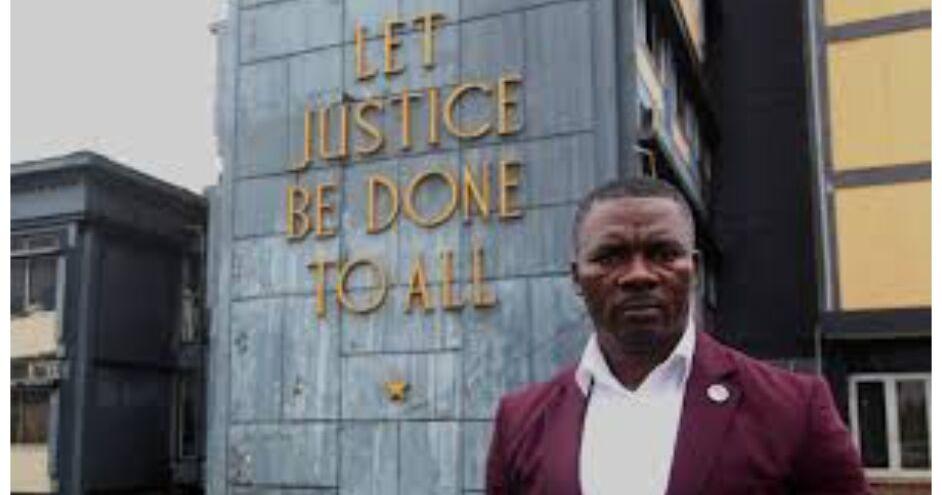
Liberia’s human rights community and civil society organizations have expressed deep concern over President Joseph Nyuma Boakai’s recent actions involving the leadership of the Independent National Commission on Human Rights (INCHR), warning that the decisions could undermine the Commission’s independence at a critical moment in the country’s transitional justice process.
In a strongly worded statement issued in Monrovia, the organizations said they recognize the seriousness of the allegations leveled against suspended INCHR Chairman Cllr. T. Dempster Brown and welcome an investigation into the matter.
However, they questioned both the legal basis for some of the allegations and the process adopted by the Executive Branch in appointing an Acting Chairman.
The statement comes after President Boakai suspended Cllr. Brown over three allegations: alleged signature forgery in a habeas corpus case before the Supreme Court of Liberia; alleged failure to convene meetings of the Commission’s Board of Commissioners for nearly two years; and alleged withholding of commissioners’ compensation as a punitive measure.
The President subsequently mandated the Ministry of Justice to investigate the allegations.
While describing the allegations as “grave,” the human rights community said it supports a thorough investigation but “takes exception to several aspects” of the President’s actions.
Addressing the allegation relating to the withholding of commissioners’ compensation, the organizations argued that the issue had already been addressed by the Supreme Court of Liberia.
According to the statement, the Supreme Court ruled in favor of Cllr. Brown in the case Attorney Mohammed El-Deust Fahnbulleh et al. v. Cllr. Dempster Brown, decided on December 19, 2024.
The groups noted that the Court denied the petition for a writ of prohibition, effectively affirming Brown’s position that commissioners who were not reporting to work were not entitled to receive salaries.
“The Supreme Court has previously ruled in favor of the suspended Chairman, finding that his action was lawful on grounds that Commissioners were not attending work while receiving compensation,” the statement said.
The organizations questioned why the same issue is now being used as one of the grounds for his suspension.
The human rights organizations also challenged President Boakai’s decision to appoint one of the commissioners—who they said is a party to the complaints against Brown—as Acting Chairman of the Commission.
According to the groups, the appointment departs from both the spirit and established practice of the INCHR Act of 2005.
“Given established governance practice and precedence over the years of its existence in the INCHR Act 2005, the Co-Chairperson should have been designated to act in the Chairman’s absence,” the statement asserted.
The organizations explained that throughout the Commission’s history, whenever a chairperson became unable to serve due to death, retirement, or other circumstances, the vice chairperson or co-chairperson traditionally assumed leadership.
They argued that appointing a commissioner who is directly involved in the underlying complaints raises concerns over impartiality and the integrity of the institution.
While reiterating support for accountability, the human rights community stressed that any investigation into the allegations must be conducted independently, transparently, and credibly.
The organizations urged the government to ensure meaningful participation by civil society organizations throughout the investigative process.
“While the human rights community welcomes accountability and investigation of the allegations, it stresses that the process should be independent and credible, with meaningful involvement of Civil Society Organizations to safeguard impartiality and public confidence,” the statement emphasized.
According to the groups, public trust in the outcome will depend largely on the perceived fairness and independence of the investigation.
The organizations also cautioned that the timing of the President’s actions could have far-reaching implications for Liberia’s ongoing transitional justice agenda.
They noted that the Legislature is currently preparing to debate and consult on legislation establishing the War and Economic Crimes Court.
“At this sensitive juncture, as the Legislature is on the verge of debating and consultations on the passing of the War Crimes Court Bill, the human rights community urges the President to exercise caution,” the statement said.
The groups warned that actions affecting “the independence and perceived neutrality of the national human rights institution” could negatively impact Liberia’s transitional justice efforts, damage the country’s international standing, and weaken public confidence in accountability mechanisms.
Reaffirming their position, the organizations pledged continued support for an independent and effective Independent National Commission on Human Rights that operates in accordance with the internationally recognized Paris Principles governing national human rights institutions.
“The human rights community and Civil Society reaffirms its commitment to an independent, effective, and functional INCHR that operates in line with the Paris Principles and serves all Liberians without fear or favor,” the statement declared.
The organizations concluded by stating that “there are more questions on the doctrine of fairness, transparency and independence” surrounding the President’s actions and called for a process that preserves both the integrity of the Commission and public confidence in Liberia’s democratic institutions.
The statement was signed by Adama Kiatamba Dempster, National Secretary General and Global Human Rights Ambassador, on behalf of the Human Rights Community and Civil Society Organizations of Liberia.
