
By Socrates Smythe Saywon | Smart News Liberia
MONROVIA, LIBERIA — Former President Ellen Johnson Sirleaf has called for the establishment of a Specialized National Anti-Corruption Court, warning that Liberia’s fight against corruption will remain “meaningless” unless political leaders demonstrate the will to uphold the independence of public institutions and ensure corrupt officials are investigated, prosecuted, and punished without delay.
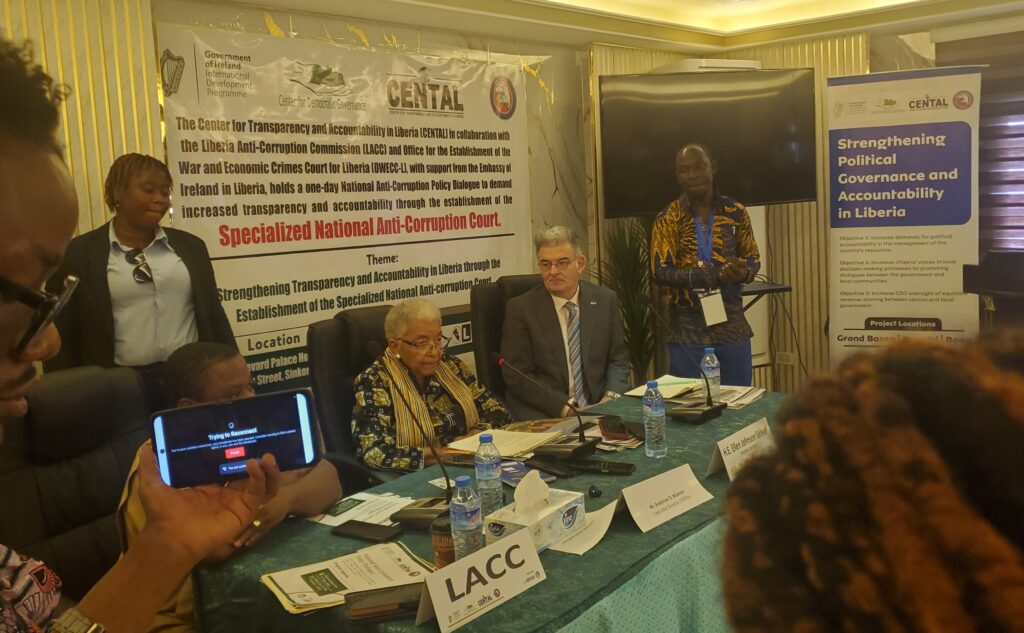
Delivering the keynote address on Tuesday, June 30, 2026, at the National Anti-Corruption Policy Dialogue organized by the Center for Transparency and Accountability in Liberia (CENTAL), in partnership with the Liberia Anti-Corruption Commission (LACC) and the Office for the Establishment of the War and Economic Crimes Court for Liberia (OWECC-L), Sirleaf argued that Liberia has reached a critical turning point in its decades-long struggle against corruption.
While acknowledging that successive governments have established important accountability institutions, she maintained that the country continues to suffer from one fundamental weakness: corruption is often investigated but rarely punished.
“No Court, existing or new, will achieve the desired result if the authorities of our three branches of Government fail to respect the independence of institutions, if they fail to be accountable, if they fail to recognize the importance of their individual contributions for national development,” Sirleaf declared.
“In other words, if they cannot set the example, then the fight will continue to be meaningless. We will then talk so, talk so, and nothing will happen.”
Her remarks placed political leadership, not merely legislation or institutions, at the center of Liberia’s anti-corruption challenge.
Reflecting on her own presidency, Sirleaf recalled assuming office in 2006 when corruption had become deeply embedded in public administration.
“When I took the Presidential Oath of Office in January 2006, Liberia was a nation where corruption was largely the operating system,” she said. “Public office had become, for too many, a license for personal extraction rather than an obligation to serve.”
She said her administration deliberately sought to reverse that culture by strengthening public institutions instead of relying solely on political rhetoric.
Among the reforms she highlighted were strengthening the independence of the General Auditing Commission, establishing the Internal Audit Agency, empowering the Public Procurement and Concessions Commission, supporting the Financial Intelligence Unit, opening the national budget to public scrutiny through the Open Budget Initiative, and establishing the Liberia Anti-Corruption Commission as the country’s principal anti-graft institution.
Despite those reforms, Sirleaf candidly admitted that her administration fell short of fundamentally changing attitudes toward corruption.
“I share this history, mindful that my Administration was not perfect and my legacy on this issue is unfinished,” she acknowledged.
“We built institutions but we did not change the minds and attitudes.”
According to Sirleaf, Liberia’s greatest institutional weakness is that corruption investigations frequently fail to end in successful prosecutions.
“An Anti-Corruption Commission that investigates but cannot see prosecutions through to conviction is a Commission that ensures that the Nation audits its accounts but does not consistently follow through to punish those who steal,” she stated.
“In other words, it is a nation that diagnoses the disease but fails to administer the cure.”
She argued that this gap has steadily eroded public confidence in Liberia’s justice system.
According to Sirleaf, corruption cases often begin with extensive investigations and growing public expectations, only to become trapped in prolonged judicial proceedings where they lose momentum or disappear from the court docket entirely.
“The result is a credibility crisis,” she warned. “Citizens come to believe that corruption is investigated but never punished, and that belief is a form of corruption’s victory.”
To close that gap, Sirleaf urged the establishment of a Specialized National Anti-Corruption Court dedicated exclusively to handling corruption cases efficiently and independently.
She described the proposed court as the missing pillar in Liberia’s accountability architecture, arguing that it would ensure evidence gathered by investigators and cases prepared by prosecutors receive timely and competent judicial consideration.
“This should not be the responsibility of any single administration or agency,” she emphasized. “It is a national infrastructure project, as important to our development as roads, electricity, physical and social infrastructure, all of which are necessary for sustainable economic growth and a matured democracy.”
Sirleaf also used the occasion to challenge each branch of government to strengthen its commitment to accountability.
She called on President Joseph Boakai to give urgent attention to establishing the Specialized Anti-Corruption Court and to take corrective executive action regarding the corruption scandals confronting the country.
She urged the Supreme Court to improve the efficiency and credibility of Liberia’s judiciary while encouraging members of the National Legislature to demonstrate leadership by strengthening anti-corruption legislation and exercising meaningful constitutional oversight.
The former President further appealed to civil society organizations to sustain public education campaigns and mobilize support for legislation establishing the proposed court.
She also urged Liberia’s business community to stop bribing public officials, arguing that corruption cannot be defeated if private companies continue facilitating illegal conduct.
Commending international development partners, Sirleaf said their continued support for Liberia-led governance reforms has strengthened national efforts to improve transparency and accountability.
Turning her attention to ordinary Liberians, Sirleaf stressed that defeating corruption requires active citizenship as much as institutional reform.
She urged citizens to reject corruption in everyday life and demand accountability from local officials, including superintendents, mayors, and heads of public agencies, as vigorously as they demand accountability from senior national officials.
According to her, transparency becomes meaningful only when citizens refuse to normalize corruption regardless of who commits it.
Ending on a note of cautious optimism, Sirleaf urged Liberians to unite behind the shared goal of building a nation where integrity, accountability, and transparency become everyday realities rather than political slogans.
“Liberia has come a long way,” she said. “We built institutions of accountability where none existed. We opened our books when secrecy had been the norm. We settled the national debt, secured peace, and achieved a democratic political transition. We must now finish the work by ensuring that corruption is exposed, corrective action is taken, and justice follows swiftly, fairly, and without exception.”
She concluded with a rallying call to citizens across the country:
“Liberia needs to be better. Liberia must be better. And Liberia needs each and every one of us to achieve this.”
