
By Kruah Thompson
Capitol Hill, July 3, 2026: The Government of Liberia has defended Executive Order No. 166, which bans the export of unprocessed rubber, rejecting claims that the measure is unconstitutional and insisting it is intended to protect farmers, preserve jobs, and strengthen the country’s rubber industry.
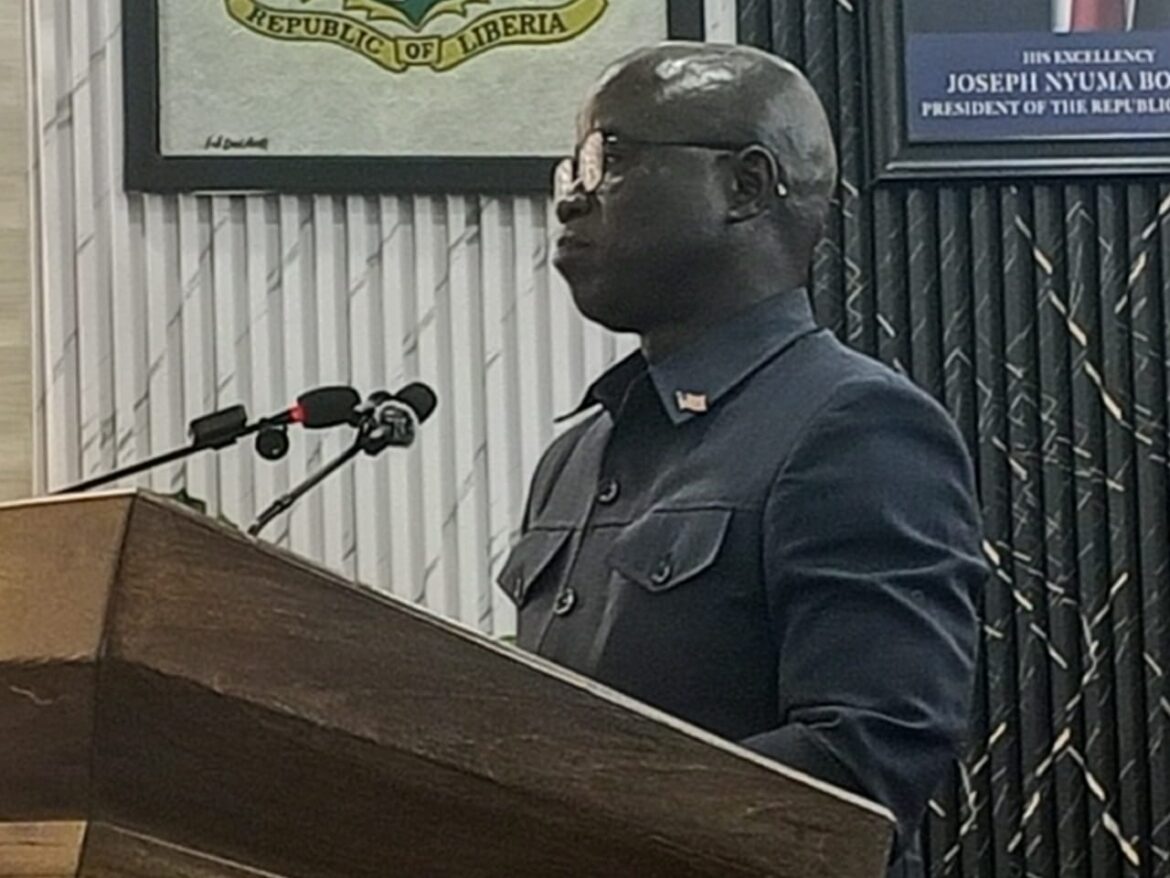
Speaking at the Ministry of Information’s regular press briefing on Thursday, Agriculture Minister Dr. J. Alexander Nuetah said the Executive Order, which took effect on July 1, was adopted after months of consultations with government institutions and industry stakeholders.
His comments come in response to criticism from the Liberia Farm Rubber Farmers and Brokers Union, which has argued that President Joseph Nyuma Boakai Sr. lacks the constitutional authority to impose the ban and has threatened to challenge the Executive Order before the Supreme Court.
Dr. Nuetah dismissed the allegations, maintaining that the decision was informed by recommendations aimed at reforming Liberia’s rubber sector and ensuring farmers receive fair prices for their produce.
He said concerns over low farm-gate prices prompted the government to establish an interministerial committee in August 2024, chaired by the Ministry of Agriculture and comprising the Ministries of Justice, Finance, Commerce and Industry, and Labor, alongside the National Investment Commission, the Rubber Planters Association of Liberia, and the Rubber Development Fund Incorporated.
According to the minister, the committee was tasked with setting monthly benchmark prices for processed rubber based on international market trends to ensure fair compensation for farmers.
He noted that the committee announced its first official price in June 2025 and has continued monthly price reviews since then. The net price paid to farmers, he said, increased from US$545 per metric ton in June 2025 to US$801 in June 2026 before rising to US$814 per metric ton for July 2026.
“The President took this action to ensure that our farmers receive fair prices for the labor they put into producing rubber,” Dr. Nuetah said, adding that many farmers have welcomed the government’s intervention.
The Agriculture Minister said the government later discovered that some exporters of unprocessed rubber were avoiding government taxes and industry levies while competing with licensed local processors.
He explained that licensed buyers are required to pay a four percent government tax, contributions to the Rubber Development Fund, and fees to the Rubber Planters Association. However, some exporters allegedly bypassed those obligations, enabling them to offer higher prices while depriving the government and industry institutions of revenue.
Dr. Nuetah also said the practice significantly reduced the supply of raw materials available to domestic processing factories.
He disclosed that major processors, including the Liberian Agriculture Company in Grand Bassa County, Firestone Liberia, and Jetty Rubber LLC, complained they were unable to secure sufficient raw rubber to operate at full capacity.
According to him, Firestone sources about 60 percent of the rubber it processes from smallholder farmers, while Jetty Rubber requires approximately 6,500 metric tons of rubber each month but has been able to obtain only about 2,900 metric tons, forcing it to operate at less than half of its production capacity.
He warned that continued shortages could force processing plants to scale back operations or shut down entirely, resulting in significant job losses.
Dr. Nuetah said the Liberian Agricultural Concessionaires Association (LACA) formally raised the issue with the government, prompting the Ministry of State to establish a committee chaired by the Minister of Labor and co-chaired by the Minister of Agriculture to investigate the concerns.
Following its review, the committee submitted recommendations to President Boakai on June 15, 2026, advising that exports of unprocessed rubber be prohibited to ensure adequate raw materials for domestic processing industries.
The minister said the Executive Order is intended to encourage value addition, protect existing jobs, and strengthen Liberia’s economy by promoting the export of processed rubber products rather than raw materials.
He added that Liberia is not alone in adopting such a policy, noting that Côte d’Ivoire and Ghana also prohibit the export of unprocessed rubber to support domestic manufacturing.
Responding to concerns that the ban could reduce market opportunities for farmers, Dr. Nuetah assured producers that local processors remain ready to purchase their rubber.
He urged farmers not to be misled by what he described as misinformation surrounding the Executive Order, stressing that the government’s priority is to improve farmers’ incomes while expanding Liberia’s rubber processing industry.
“The government has your interest at heart,” he said. “Do not be deceived by those who suggest you will lose your market. If you take your rubber to any buying station, it will be purchased. We cannot continue exporting our raw materials while our factories struggle to operate.”
