
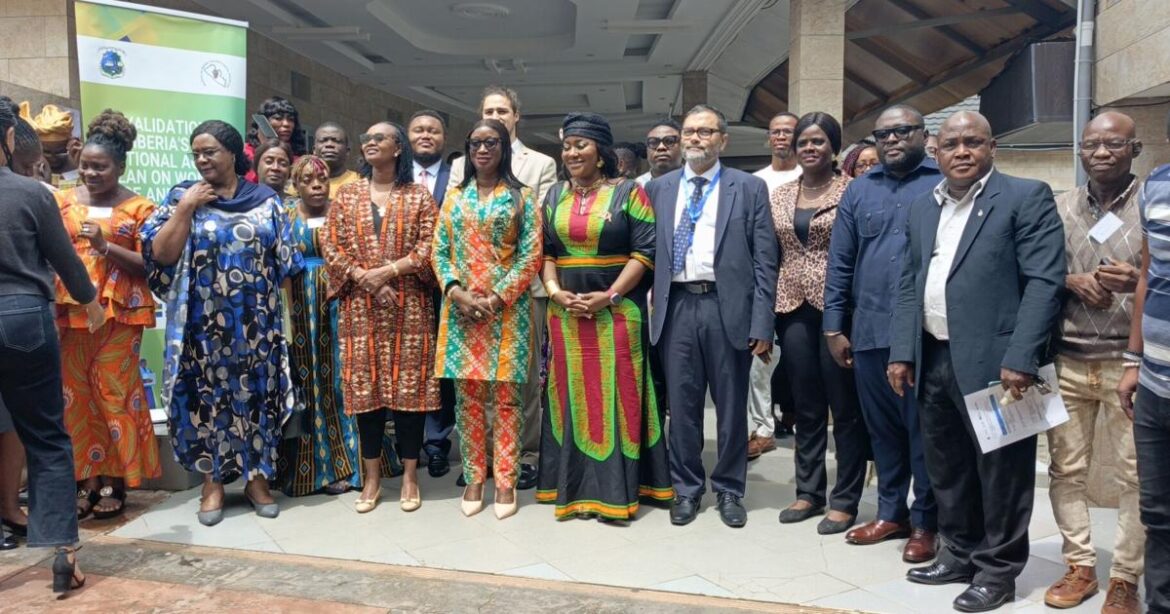
Liberia formally validated its Third National Action Plan (NAP) on Women, Peace and Security on Friday, July 3, closing a two-day workshop at the A La Lagoon Hotel with officials and partners describing the moment as a milestone in the country’s 17-year commitment to the United Nations agenda on women, peace and security.
The Ministry of Gender, Children and Social Protection led the closing session, thanking government institutions, civil society organizations and international partners, including UN Women, the African Union and the embassies of Ireland and Sweden, for guiding the plan from draft to validation.
“Today, we have successfully validated the third national action plan for Liberia. We can now move beyond phase one and phase two; we are currently in phase three, which is a milestone as a partner of Women, Peace, and Security, adopted in 2000. Today, Liberia can be proud of having the third national action plan,” said Fairnoh Gbilah, Director for Human Rights and Head of Women Peace and Security at the Ministry of Gender, Children and Social Protection presiding over the closing said.
Gbilah noted that feedback gathered during the two days would be incorporated as consultants finalize the document for submission to Gender Minister Gbeme Horace-Kollie, who will advance it toward an official launch.
Tsega Meles, the UN Women Program Specialist, thanked the government’s NAP secretariat team, including lead consultant Ghoma Karloweah, for steering what she called an intense but smooth process, and said UN Women looks forward to the plan’s launch.
“I would like to thank Goma for driving this process. She’s one of our own and also a WPS specialist,” the UN Women representative said. “This has been a very intense process, but also it never showed.”
Dr. Sally Wangamati, the African Union Special Envoy on WPS congratulated the government for completing the validation but cautioned that the more difficult task lies ahead in implementation.
“The biggest challenge is not the validation of the NAP. The biggest challenge is making sure that the women of Liberia are able to benefit from this NAP,” she said. “When you are implementing, this NAP will be owned by the women of Liberia at the grassroots, though it will be driven at the national level.”
Illustrating the point, the AU representative recounted the story of Black women in the United States during World War II who were assigned to a mail room to sort letters for soldiers, a task others considered menial, and who ensured that every soldier received mail, lifting troop morale in the process.
“This third NAP is being driven by women. This third NAP is going to be implemented by the women, and not only the women, but also the men of Liberia. Because when we work together, we have what? Sustainable,” she said.
The validation caps a two-day workshop that opened Thursday, July 2, bringing together the National Steering Committee, government ministries, security sector institutions, civil society groups, women’s and youth organizations, county stakeholders and international partners to review the draft plan and recommend amendments.
The Third National Action Plan, covering 2026 to 2031, is built on five pillars: prevention, protection, participation, relief and recovery, and coordination and accountability. It carries a budget of US$410 million, according to organizers, and addresses emerging concerns identified through nationwide consultations, including digital violence against women, sexual exploitation in mining communities, climate related insecurity and violence against women in politics.
Liberia became the first country in Africa to adopt a National Action Plan under UN Security Council Resolution 1325 in 2009. The third plan comes as the country serves its 2026 to 2027 term as a non-permanent member of the UN Security Council, a position officials said adds weight to Liberia’s continued leadership on the Women, Peace and Security agenda.
Organizers said the validated document will be submitted to the National Steering Committee and relevant national authorities for endorsement, clearing the way for its official launch and nationwide dissemination.
