
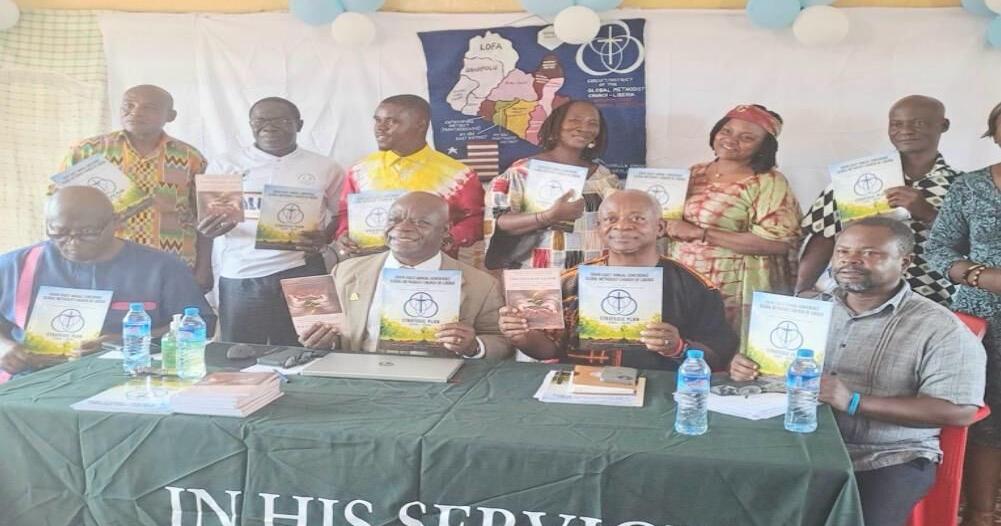
The Grain Coast Annual Conference (GCAC) of the Global Methodist Church of Liberia has launched a comprehensive 2026–2030 Strategic Plan with a proposed budget of US$10,383,932.60, outlining an ambitious roadmap to strengthen evangelism, discipleship, church planting, education and sustainable development throughout Liberia over the next five years.
According to the document, sustainable development receives the largest allocation of US$3.2 million, followed by Kingdom Advancement with US$1.99 million, Health and Welfare with US$1.75 million, Higher Education at US$1.63 million, and Education and School System with US$726,859. Other budgetary allocations include ministerial and pastoral welfare, youth, women, children’s and men’s ministries, communication, family life, finance and resource mobilization.
Church leaders say the investment reflects the conference’s determination to strengthen both its spiritual mission and its contribution to Liberia’s national development.
Launching the plan, Presiding Bishop Rev. Dr. John Pena Auta described strategic planning as an expression of faith rooted in Scripture, emphasizing that committing plans to God is essential for lasting ministry.
Quoting Proverbs 16:3, the bishop said the conference has been entrusted with “a growing mission field, devoted servants, and a sacred responsibility to steward God’s work with wisdom.”
He noted that the strategic plan will unify the church’s vision, strengthen discipleship, improve leadership accountability and expand evangelism and church planting while preparing the denomination to meet future opportunities.
Conference Superintendent Rev. Dr. Jerry P. Kulah said the five-year blueprint provides a clear direction for every department, board, committee and ministry of the church, enabling coordinated implementation of programs across the Annual Conference.
He stressed that planning is both biblical and indispensable, citing examples from the ministries of Moses, Joshua and Nehemiah, as well as God’s redemptive plan throughout Scripture.
According to Dr. Kulah, the plan is anchored on the Global Methodist Church’s mission “to make disciples of Jesus Christ and spread scriptural holiness across the globe” and its vision of multiplying disciples who worship passionately, love extravagantly and witness boldly.
He said Liberia’s social and economic realities, including widespread poverty, unemployment among young people, limited infrastructure and emerging digital and environmental challenges, require the church to combine spiritual ministry with practical interventions that improve livelihoods.
The strategic framework is built around four priority pillars: Evangelism, Discipleship, Church Planting and Sustainable Development.
Under the Evangelism Pillar, the conference plans to launch a national Gospel media ministry by 2026, establish evangelism teams in every congregation by 2027, develop a conference-wide evangelism training manual by 2028 and equip approximately 500 evangelists by 2030.
The Discipleship Pillar aims to develop a conference-wide discipleship guide by 2026, introduce a context-specific discipleship curriculum by 2027, train at least 500 small-group leaders by 2029 and roll out digital discipleship platforms by 2030.
Through the Church Planting Pillar, the conference intends to establish three regional church-planting hubs, construct 45 new church buildings and plant 241 new congregations by 2030 while integrating digital and hybrid ministry models.
The Sustainable Development Pillar focuses on mobilizing every local church to implement development initiatives, establishing sustainable projects across every circuit and district, launching a church-based microfinance scheme, carrying out 15 community development projects annually and promoting environmental stewardship and digital literacy throughout the denomination.
Conference Lay Leader Bro. L. Olandor Boyce described the plan as a comprehensive framework designed to produce lasting spiritual and social impact.
He urged lay members across the conference to fully embrace the initiative, saying the success of the strategy depends on collective participation from clergy and laity alike.
“Our total involvement is essential to its success, and together we can make a meaningful difference in our church and community over the next five years,” he said.
The conference expects the implementation of the strategy to produce measurable results by 2030, including a 45 percent increase in church attendance and professions of faith, 60 percent of members participating in structured discipleship, a 35 percent increase in congregations, and significant improvements in community livelihoods and environmental practices.
Initially, implementation will cover the conference’s existing six districts, nine circuits and 163 local churches, before expanding into additional counties across Liberia.
The strategy also integrates cross-cutting priorities such as youth and women’s participation, inclusion of persons with disabilities, climate resilience, environmental stewardship and digital transformation.
The Grain Coast Annual Conference forms part of the Global Methodist Church, a denomination established to uphold traditional Wesleyan doctrine and biblical authority while emphasizing evangelism, discipleship and church multiplication.
Since its establishment in Liberia, the conference has experienced rapid numerical growth and has increasingly focused on expanding ministry beyond traditional church activities into education, health, community development and economic empowerment.
Church leaders say the newly adopted strategic plan represents the conference’s first comprehensive roadmap for coordinating ministry activities, mobilizing local resources and ensuring long-term institutional sustainability.
They believe the document will serve as a blueprint for guiding the church’s mission over the next five years while positioning the denomination to play a greater role in Liberia’s spiritual renewal and national development.
