
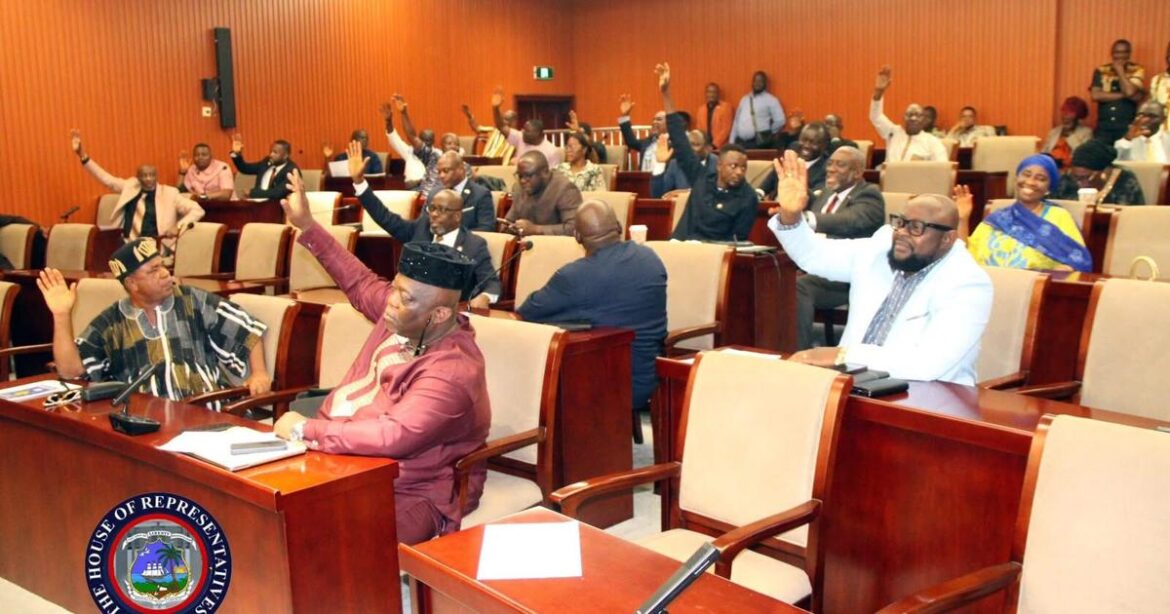
In what is being described as one of the most significant electoral and constitutional reforms in Liberia’s post-war democratic history, the House of Representatives has approved the creation of 16 additional electoral districts, increasing the number of seats in the Lower House from 73 to 89.
The House has subsequently forwarded the resolution to the Liberian Senate for concurrence, setting the stage for a possible nationwide reapportionment exercise ahead of the 2029 General and Presidential Elections.
The decision follows the signing of a resolution by 50 lawmakers, supported by a report from the House Committee on Elections and Inauguration, recommending the establishment of a constitutional and population threshold for electoral reapportionment based on findings from the 2022 National Population and Housing Census.
If the Senate concurs, the measure would pave the way for one of the most comprehensive electoral boundary reviews since the adoption of Liberia’s 1986 Constitution.
The Committee’s report argues that Liberia’s current electoral structure no longer reflects the country’s demographic realities, citing significant population growth and migration patterns across several counties since the last reapportionment exercise conducted after the 2008 census.
According to the report, Liberia’s population increased from 3,476,608 in 2008 to 5,250,187 in 2022, representing an approximate 51 percent rise. The Committee said the growth has created disparities in representation among counties and constituencies.
The report noted that the existing 73 electoral districts have remained unchanged through three consecutive electoral cycles — 2011, 2017, and 2023 — despite major demographic shifts across the country.
The proposed reapportionment relies primarily on Articles 39, 80(d), 80(e), and 84 of the 1986 Constitution.
Article 39 requires the Legislature to ensure that a national census is conducted every 10 years, while Article 80(e) mandates that following a census and before the next election, the National Elections Commission (NEC) shall reapportion constituencies based on updated population figures.
The provision states that:
“Immediately following a national census and before the next election, the Elections Commission shall reapportion the constituencies in accordance with the new population figures so that every constituency shall have as close to the same population as possible; provided, however, that a constituency must be solely within a county.”
The Committee argued that once the 2022 census results were validated and presented to the Legislature in 2024, the constitutional obligation to begin reapportionment became immediate.
Lawmakers further maintained that the current number of 73 representatives is not permanently fixed by the Constitution.
They cited Article 80(d), which empowers the Legislature to establish constituency population standards while limiting the total number of constituencies to no more than 100.
“The framers of the Constitution never intended for the House to remain permanently frozen at seventy-three members,” one lawmaker said during deliberations. “The Constitution envisioned a dynamic representative institution capable of evolving alongside population growth and demographic realities.”
Supporters of the resolution argue that failure to conduct reapportionment could raise constitutional concerns regarding equal representation and compliance with Article 80.
Under the approved framework, counties will be categorized into population tiers based on certified census figures.
The Joint Committee recommended a population-based formula that would determine the allocation of additional constituencies among counties.
The formula results in the creation of 16 new electoral districts, increasing House membership from 73 to 89 seats while remaining below the constitutional maximum of 100 constituencies.
Legislative sources said the resolution establishes the legal threshold required for reapportionment while leaving the technical process of constituency boundary delineation and demarcation to the National Elections Commission.
Supporters say the expansion is necessary to ensure fair representation, particularly for counties that have experienced substantial population increases and are currently considered underrepresented.
They insist that reapportionment is not a political arrangement but a constitutional mechanism aimed at protecting equal suffrage and strengthening representative democracy.
The Committee also highlighted the separation of constitutional responsibilities between the Legislature and the National Elections Commission.
Under the proposed framework, lawmakers would exercise their authority by setting population standards under Article 80(d), while the NEC would carry out its constitutional mandate to reapportion and define constituency boundaries under Article 80(e).
The report cautioned against legislative interference in technical electoral matters, stating that lawmakers, committees, political caucuses, and other actors should not influence constituency boundaries once the population threshold has been established.
The House is expected to collaborate with the NEC, the Liberia Institute of Statistics and Geo-Information Services (LISGIS), the Liberia Land Authority (LLA), and the Ministry of Local Government during implementation.
The Committee stressed that every constituency must remain entirely within a single county, as required by the Constitution.
It acknowledged that historical disputes and allegations of county boundary irregularities would require verification through official geospatial data and administrative boundary assessments.
The report warned that any constituency crossing county lines could be considered constitutionally defective and subject to correction.
Legal experts have also suggested that the reapportionment process could face judicial review before the Supreme Court, particularly on issues involving constitutional interpretation, constituency entitlement, equal representation, separation of powers, and the respective roles of the Legislature and NEC.
Political analysts believe the House’s decision could significantly reshape Liberia’s electoral landscape ahead of the 2029 elections.
Supporters argue that increasing the number of representatives would improve constituent engagement, strengthen legislative oversight, and enhance democratic participation.
Critics, however, have raised concerns about the financial cost of expanding the Legislature, constituency demarcation, political representation, and the risk of gerrymandering.
Nevertheless, proponents maintain that the move is a constitutional requirement rather than a political preference.
“The citizens counted in the 2022 census are constitutionally entitled to equitable representation,” the Committee stated in its report. “Reapportionment is not an option; it is a constitutional duty.”
With the resolution now before the Senate, attention shifts to the Upper House, whose decision will determine whether Liberia proceeds with one of the most consequential electoral restructuring exercises in its democratic history.
If approved and implemented, the creation of 16 additional constituencies would fundamentally alter the composition of the House of Representatives and reshape Liberia’s representative democracy ahead of the 2029 elections.
