
MONROVIA – Liberia’s US$19 million cocaine scandal has now crossed from domestic controversy into international diplomacy. Jefferson T. Koijee, Secretary General of the Congress for Democratic Change, has petitioned the United States Embassy for an independent international investigation. His letter goes far beyond procedural complaint. It accuses Police Inspector General Gregory O. W. Coleman of membership in a drug cartel. It also alleges that cartel-gifted vehicles now ride in the convoys of Liberia’s highest officials. The allegations are unproven, and Koijee is a partisan actor with political stakes. Yet his questions about the LDEA’s independence and the stalled investigation will not simply vanish. How the government answers may define the scandal’s next chapter. THE ANALYST reports.
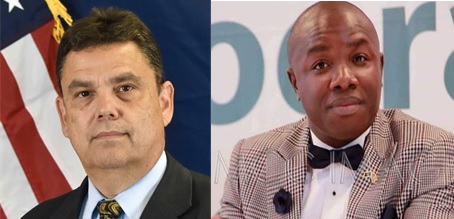
Jefferson T. Koijee, Secretary General of the opposition Congress for Democratic Change (CDC) and former Mayor of Monrovia, has formally requested the Embassy of the United States of America to support an independent international investigation into Liberia’s unresolved US$19 million (L$3.5 billion) cocaine trafficking scandal. In a letter dated July 15, 2026, and addressed to Charge d’Affaires Joseph Zadrozny, Koijee leveled sweeping allegations against Inspector General of Police Gregory O. W. Coleman, whom he accused of being an integral member of a well-established drug cartel.
Koijee, who described himself as a professional with specialized knowledge in counter-terrorism, intelligence, and homeland security, stated that he was raising the matter out of civic responsibility and profound love for Liberia. The patterns surrounding the case, he asserted, raise legitimate national security and intelligence concerns that require an independent, credible, and internationally supported investigative response.
Petition to the US Embassy
The CDC scribe told the American diplomat that the scandal continues to raise profound concerns about the rule of law, institutional independence, corruption, and Liberia’s commitment to combating transnational organized crime. Viewed through the lens of counter-narcotics enforcement, he argued, the case reflects a broader pattern in which organized criminal networks exploit institutional weaknesses to entrench themselves within the machinery of the state.
He reminded the Embassy that the United States has long been Liberia’s traditional partner, investing American taxpayers’ money in strengthening democratic governance, peace, and stability. If the matter is not urgently addressed, he warned, the United States’ presence and Liberia’s peace could be threatened by a growing wave of cocaine trafficking syndicates whose reach extends well beyond the country’s borders.
The case, Koijee contended, has become a test of Liberia’s willingness and capacity to investigate powerful actors without political interference. He claimed that the progress of the investigation remains uncertain and appears marked by political deception, adding that many Liberians fear the truth may never be established through existing domestic processes given what he called a dangerous pattern of impunity within the criminal justice system.
LDEA Independence Questioned
Koijee declared himself deeply troubled by the manner in which the Liberia National Police (LNP) is handling the scandal. In his view, the investigation has lacked the transparency and independence that a case of this magnitude demands, and the repeated public briefings by the Inspector General have failed to address the central questions surrounding the origin and ownership of the reported cocaine shipment.
He expressed equal disturbance at what he described as the erosion of the operational independence of the Liberia Drug Enforcement Agency (LDEA). It is his view, he stated, that Coleman has exercised undue influence over the appointment and functioning of the Agency’s current leadership, a situation he believes risks undermining the institutional autonomy of an agency established to investigate drug trafficking without interference.
Koijee alleged that in 2024, Abe Kromah became the victim of a political conspiracy orchestrated by Coleman, resulting in his dismissal as head of the LDEA. This was, in his view, a well-organized plot to ensure that a cartel of which Coleman is an integral member could flourish. He further claimed that Coleman lured and manipulated President Joseph N. Boakai into appointing his deputy at the LNP, Fitzgerald T. M. Biago, as Officer-in-Charge of the LDEA, describing Biago as another individual reportedly recruited by the cartel.
At the time of his appointment, Koijee noted, Biago was an active LNP employee serving as Deputy Commissioner of Police under Coleman, while the removed Kromah was a professionally trained criminal justice expert and graduate of John Jay College of Criminal Justice. The repeated placement of senior LNP officers at the helm of the LDEA, he argued, has blurred the Agency’s institutional independence and concentrated undue influence over Liberia’s security architecture.
Koijee also pointed to Coleman’s travel abroad while investigations were actively ongoing. Even as the cocaine was discovered at Roberts International Airport, he stated, Coleman was in the United Kingdom on June 18 and 19, 2026, which Koijee described as the reported intended destination of the shipment. One can reasonably infer, he asserted, that Coleman was in the United Kingdom awaiting the arrival of the consignment.
The Vehicle Allegations
Koijee further alleged that prior to the discovery of the shipment, Coleman received gifts from a well-known cartel for distribution among top government officials. Ten Toyota Hilux vehicles, he claimed, were distributed to the LDEA and the LNP without being registered or coded through the General Services Agency (GSA), as required under established government procedures.
He also alleged that seven Chevrolet Tahoe vehicles, each valued at an estimated US$90,000 (L$16.4 million), were given by the cartel to Coleman for distribution: two to President Boakai, currently used in his presidential convoy; one to Senate Pro Tempore Nyonblee Karnga-Lawrence; one to Vice President Jeremiah Kpan Koung; one to Speaker of the House of Representatives Richard Kun; and two retained by Coleman himself. The commercial value of the vehicles, he estimated, totals US$630,000 (L$114.9 million), and all remain visible in the convoys of the officials named.
Budget Math and a Disclaimer
Koijee cited the LNP’s 2026 national budget of US$25.7 million (L$4.7 billion), of which US$17.7 million (L$3.2 billion) covers compensation and US$7.2 million (L$1.3 billion) covers goods and services, alongside Coleman’s gross salary of US$4,436 (L$808,949). This, he argued, raises the question of how the LNP could distribute such a large quantity of vehicles when no such allocation exists within the national budget, reinforcing his suspicion that Coleman is being financially supported by the cartel.
He requested that the investigation review the management and allocation of the ten vehicles, whose provenance he linked to the junta regime in Guinea, and determine whether all procurement, registration, transfer, and asset management requirements were fulfilled under Liberian law. Establishing these facts, he stated, is essential to strengthening public trust in the security institutions and ensuring that public and donor-funded resources are managed transparently.
Koijee told the diplomat that he does not present the allegations to portray the government in an unfavorable light, but believes they are sufficiently serious to warrant an independent and impartial investigation capable of confirming the claims through credible evidence. The credibility of Liberia’s anti-drug institutions cannot be restored, he maintained, unless investigations are demonstrably independent, professionally conducted, and free from political influence.
The Liberian people, he concluded, deserve institutions that are transparent, accountable, and capable of confronting organized crime without political interference. If the matter is not taken seriously, he warned, the country’s peace and democracy stand at the verge of being undermined and descending into full-fledged chaos.
