
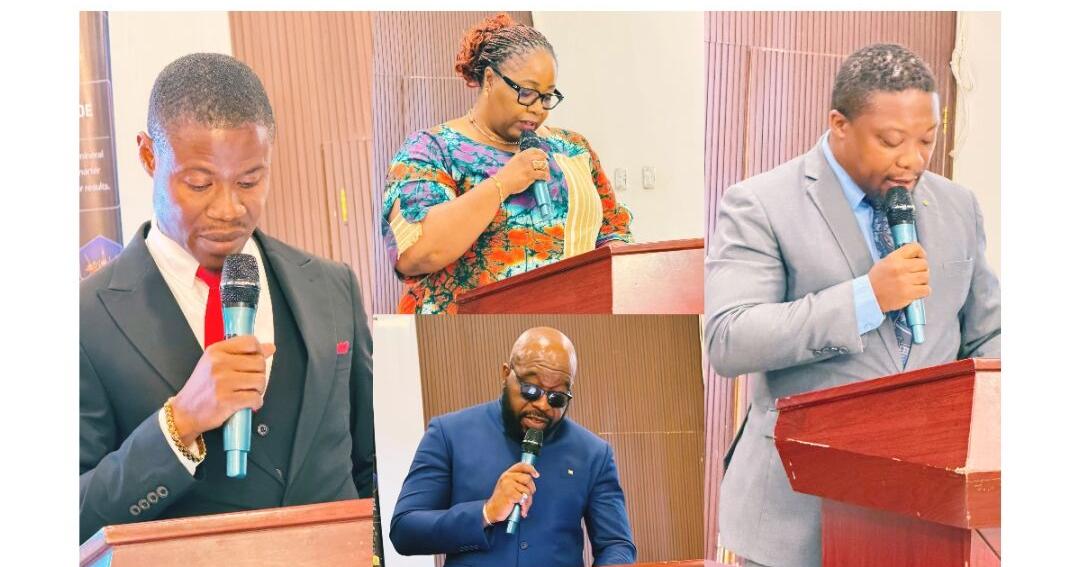
GeoMining & Environmental Consultancy has called for accelerated technology transfer, innovation, and strategic partnerships to transform Liberia’s mining and petroleum industries, saying the country’s vast mineral and hydrocarbon wealth can only be fully unlocked by embracing advanced exploration technologies while building the capacity of Liberian professionals.
The call was made Wednesday, July 15, during the Exhibition of Advanced Mineral, Oil & Gas Finding Technologies in Liberia, held in Monrovia under the theme, “Unlocking Liberia’s Natural Resource Potential through Modern Exploration Technology, Innovation, and Strategic Partnerships.” The exhibition was organized by GeoMining & Environmental Consultancy in collaboration with InterGeo Minerals Intelligence Liberia Inc. under the banner, “Discover. Invest. Develop.”
The one-day exhibition brought together officials from the Ministry of Mines and Energy, the National Oil Company of Liberia (NOCAL), mining and petroleum companies, investors, academics, development partners, and international technology providers to showcase cutting-edge exploration technologies capable of reshaping Liberia’s extractive sector.
Discussions centered on the growing role of artificial intelligence (AI), satellite imagery, remote sensing, airborne geophysics, and advanced mineral and petroleum detection technologies in reducing exploration risks, lowering costs, improving environmental stewardship, and attracting responsible investment.
Participants noted that although Liberia possesses abundant deposits of iron ore, gold, diamonds, lithium, heavy mineral sands, and significant offshore oil and gas prospects, much of the country’s geological potential remains untapped due to outdated geological data, limited technological capacity, and the high cost of conventional exploration methods.
Opening the exhibition, GeoMining Executive Director Carlos E. Tingban Sr. said the company’s vision extends far beyond introducing sophisticated exploration equipment into Liberia, stressing that building local technical capacity must remain the country’s highest priority.
“Our goal is not simply to introduce sophisticated equipment, but to ensure that Liberians acquire the skills and knowledge needed to operate these technologies, lead exploration projects and compete successfully in the global mining and petroleum industry,” Tingban said.
He explained that GeoMining was established with the ambition of becoming Liberia’s leading indigenous geological, mining, and environmental consultancy by providing geological consulting services, mineral exploration, geospatial analysis, environmental assessments, and mining advisory services.
According to Tingban, the company has already created employment opportunities for approximately 25 young Liberian professionals, demonstrating that developing the country’s natural resources should also translate into investing in Liberian talent.
He emphasized that technology transfer is essential if Liberia is to compete globally and maximize the value of its natural resources.
Tingban observed that modern technologies—including remote sensing, airborne geophysics, geochemical surveys, artificial intelligence, and advanced mineral detection systems—are revolutionizing mineral and petroleum exploration across the world by improving accuracy, reducing exploration costs, minimizing environmental impacts, and increasing investor confidence.
He called for stronger collaboration among government institutions, universities, development partners, investors, and the private sector to facilitate technology transfer while building a transparent, competitive, and environmentally responsible extractive industry.
“The greatest value of our natural resources lies not only beneath the ground, but in our ability to manage them wisely for the benefit of present and future generations,” Tingban declared.
Representing the Ministry of Mines and Energy, Acting Minister Eudora Blay-Pritchard described the exhibition as timely, noting that technological innovation is rapidly transforming the global mining industry.
She said traditional exploration techniques are increasingly being supplemented by artificial intelligence, robotics, remote sensing technologies, and real-time geological sensors that allow countries to generate more accurate geological information while improving transparency and operational efficiency.
“As Liberia continues to develop its mining sector, it is important that we remain open to learning about emerging technologies and best practices that can strengthen our institutions, inform investment and support sustainable management of our mineral resources,” Blay-Pritchard said.
She encouraged participants to use the exhibition as a platform to exchange ideas, establish partnerships, and identify innovative solutions capable of modernizing Liberia’s mining sector.
Speaking on behalf of NOCAL President Fabian Michael Lai, Executive Director for Operations Timothy K. Jarry II said the exhibition demonstrated Liberia’s determination to take ownership of its natural resource future through innovation and technological advancement.
“What you are doing here today is not just about technology; it is about national pride. It is about showing the world that Liberia is ready to compete on the global stage,” Jarry said.
He explained that the technologies being showcased combine satellite imagery, geological sensors, and artificial intelligence to create detailed three-dimensional subsurface models capable of identifying promising mineral and petroleum deposits before expensive drilling operations begin.
According to Jarry, these innovations represent a transition toward “precision, intelligence and responsibility,” allowing companies to reduce unnecessary drilling, minimize exploration costs, and significantly reduce environmental disturbance.
“This is not just exploration. This is responsible exploration. This is smart exploration,” he emphasized.
Jarry also outlined NOCAL’s broader strategy to reposition itself as a commercially driven national oil company by focusing on four strategic priorities: digitizing Liberia’s petroleum database, strengthening regulatory institutions, expanding local content participation, and attracting reputable international investment partners.
He disclosed that NOCAL is developing a centralized geoscience data repository that will consolidate seismic surveys, geological maps, well logs, and environmental studies into a secure digital platform to improve transparency and support better investment decisions.
Highlighting the importance of Liberian participation, Jarry stressed that local content remains central to NOCAL’s long-term vision.
“We are open for business, but on fair and transparent terms,” he said, adding that the corporation wants to see more Liberian geologists, engineers, contractors, and entrepreneurs actively participating throughout the petroleum value chain.
Closing the exhibition, Geoffrey Wade of Onirik demonstrated the company’s GeoMining Mineral Finder Technology (MFT) and InterGeo Oil & Gas Finder Technology (OFT), describing them as advanced exploration systems capable of identifying promising mineral and petroleum targets faster, more accurately, and at significantly lower cost than conventional exploration methods.
According to Wade, the technologies combine satellite imagery, remote sensing, geophysical interpretation, and field validation to identify and rank high-potential exploration targets before companies commit millions of dollars to drilling.
Rather than replacing traditional geological surveys and drilling, he explained, the systems enhance exploration decision-making by reducing uncertainty and lowering investment risks.
Wade said the technologies could help Liberia accelerate mineral and petroleum exploration, strengthen natural resource governance, establish a comprehensive national inventory of mineral resources, and reduce illegal mining by creating more formal investment opportunities.
He further revealed that the same technologies can also be applied to groundwater exploration, geothermal energy development, and natural hydrogen exploration.
According to Wade, the exploration process follows four stages—screening, ranking, validation, and drilling—with satellite-based assessments completed in approximately eight weeks before field verification begins.
He said the approach has the potential to reduce exploration timelines from several years to as little as one or two years, making projects more attractive to investors while substantially lowering exploration costs.
Rather than immediately launching nationwide surveys, Wade recommended that Liberia begin with carefully selected pilot projects before gradually expanding the technology across the country.
He assured participants that Onirik and its international partners stand ready to provide technical expertise, financing, and capacity-building support while working closely with Liberian institutions.
