
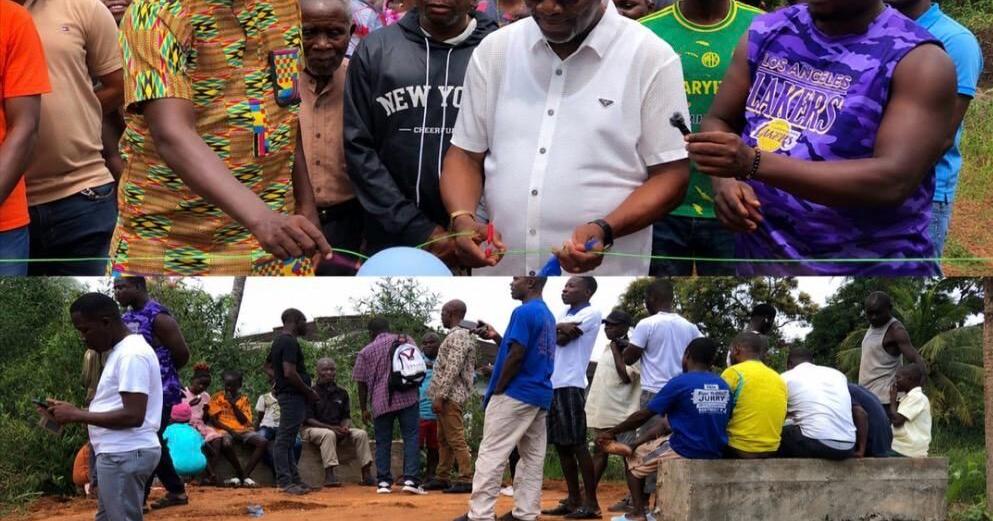
Maryland County Electoral District #1 Representative P. Mike Jurry is expanding his grassroots infrastructure development agenda with the completion of a reinforced concrete culvert that has restored road access to six communities in Harper District, ending years of transportation challenges for hundreds of residents.
The newly dedicated structure, constructed at a cost of US$10,145, reconnects Airfield, New Kru Town, Hoffman Station, Bassa Community, Marsh Street and surrounding neighborhoods after years of relying on a deteriorated crossing that frequently disrupted movement, particularly during the rainy season.
For residents, the project represents more than a physical improvement. It addresses a longstanding infrastructure bottleneck that had hindered access to schools, healthcare facilities, markets and businesses while slowing economic and social activities across one of Harper’s busiest residential corridors.
Speaking at the dedication ceremony, Representative Jurry said the project was undertaken in direct response to repeated appeals from community leaders, youth groups and residents who identified the damaged crossing as one of the district’s most pressing infrastructure needs.
“The voices of our people could not be ignored,” Jurry said. “This road is an important corridor used daily by students going to school, market women transporting goods, commercial motorcyclists, business owners and families. Our responsibility as leaders is to respond to the genuine needs of the people.”
He reaffirmed his commitment to expanding community-based development initiatives throughout Electoral District #1, describing improved public infrastructure as a key pillar of his legislative agenda.
Although modest in financial value, the project highlights the important role that community infrastructure plays in local development.
Across Liberia, damaged culverts, poor drainage systems and deteriorating feeder roads continue to isolate communities, increase transportation costs and limit access to essential public services.
In rural and peri-urban communities, reliable road connectivity often determines whether children can reach school safely, patients can access healthcare in emergencies and farmers and traders can transport goods to local markets.
By restoring this critical crossing, residents expect reduced travel time, improved mobility and stronger economic interaction among neighboring communities.
Project Engineer Anton Badawi explained that the completed structure reflects a revised engineering design intended to provide greater resilience than the original proposal.
According to Badawi, engineers initially considered installing a conventional circular culvert but changed the design following technical assessments and consultations with community members.
The final decision was to construct a reinforced single-cell concrete box culvert, which offers greater structural strength, improved water-flow capacity and stronger resistance to erosion during Liberia’s heavy rainy season.
“The total investment in this project amounts to US$10,145,” Badawi explained. “The figure reflects the quality of materials used, the engineering standards applied and the long-term durability we intended to achieve. This is infrastructure designed to serve these communities for many years.”
Representative Jurry commended the contractor for delivering quality workmanship, noting that Engineer Badawi had successfully executed previous infrastructure projects in New Kru Town.
Community Ownership
Residents welcomed the completion of the project, describing it as a significant improvement after years of navigating a crossing that often became impassable during heavy rainfall.
Youth President Prince Howbert praised Representative Jurry for responding to community concerns and pledged that residents would work together to protect the facility.
“This project belongs to all of us,” Howbert said. “We appreciate our representative for listening to our concerns, and we will do everything possible to preserve this important structure.”
Community elders and women leaders also noted that improved connectivity would strengthen commerce, enhance social interaction among neighboring communities and enable faster emergency response services.
The culvert project adds to a growing portfolio of community development initiatives undertaken by Representative Jurry across Maryland County Electoral District #1.
While large-scale national infrastructure projects often dominate public attention, smaller community investments such as culverts, bridges and neighborhood roads frequently have an immediate impact on residents’ daily lives by improving accessibility, reducing transportation barriers and supporting local economic activity.
For the six communities now reconnected, the reinforced concrete culvert stands as more than an engineering structure. It represents renewed access, improved mobility and a practical investment in community development that residents hope will continue to spur growth throughout the district.
