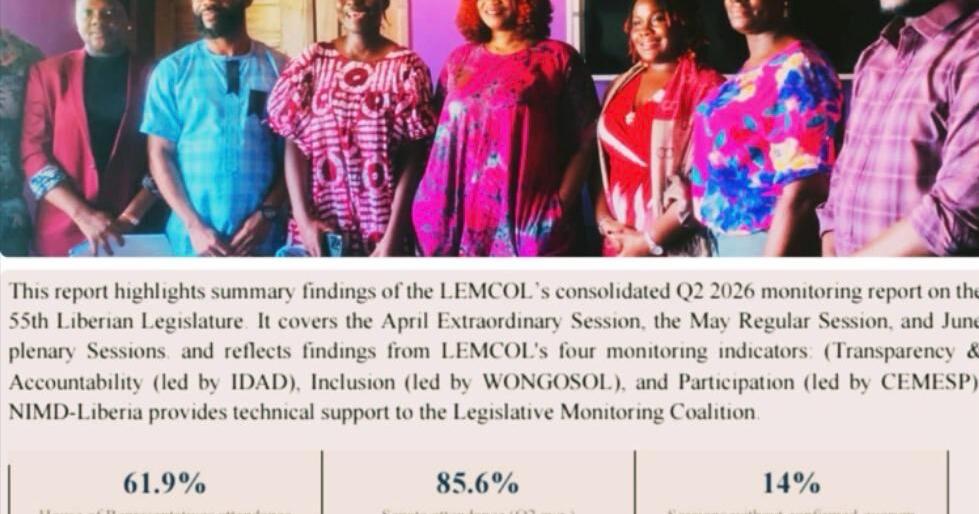
Liberia’s 55th Legislature made measurable progress on transparency and oversight in the second quarter of 2026, but persistent quorum breaches in the House of Representatives, a sharp drop in women’s participation, and thin opportunities for citizen input remain significant weaknesses, according to a new report from the Legislative Monitoring Coalition of Liberia (LEMCOL).
LEMCOL is a coalition of civil society organizations and media institutions that monitors Liberia’s Legislature to promote transparency, accountability, inclusion, and democratic governance. Its Second Quarter 2026 Legislative Monitoring Report, covering April through June, assesses the Legislature’s performance across four pillars transparency, accountability, inclusion, and participation with technical support from the Netherlands Institute for Multiparty Democracy (NIMD-Liberia). The quarter under review included the Extraordinary Budget Session in April and regular plenary sessions in May and June.
Transparency emerged as the Legislature’s best showing for the quarter. LEMCOL found that every monitored plenary session followed officially published agendas, circulated in advance via communication platforms, printed copies, and the Legislature’s Facebook page. Presiding officers in both chambers also consistently upheld lawmakers’ right to debate under legislative rules, and monitored sessions remained open to the public, civil society, and media, though many later shifted into closed executive sessions.
The most notable gain was in online document publication: the share of documents posted to the Legislature’s official website jumped from 8 percent in the first quarter to 37 percent in the second, a 29-point increase LEMCOL credits partly to its own advocacy with legislative leadership. Facebook, however, remains the Legislature’s dominant channel for sharing official information.
Quorum compliance was flagged as the most serious procedural failure of the quarter. LEMCOL recorded that 20 percent of monitored House sessions in April, and 11 percent in both May and June, proceeded without a confirmed constitutional quorum. Every violation occurred in the House; the Senate maintained full compliance throughout.
The coalition also criticized a motion adopted during the April Extraordinary Session that allowed quorum confirmed at the session’s opening sitting to carry over to subsequent budget deliberations without re-verifying members’ physical presence. LEMCOL argues this practice conflicts with Article 33 of the Constitution and Section 12.1 of the House Standing Rules, warning that repeated procedural shortcuts risk eroding legislative credibility even as it acknowledged that adjourning sessions for lack of quorum, which did occur, is the legally appropriate response when the alternative is proceeding without one.
Punctuality also diverged between chambers: the House generally convened near its scheduled 10:00 a.m. start, while the Senate routinely began two or more hours after its 11:00 a.m. start time, with one April session running late into the night.
Women’s voices in plenary debate declined markedly, from 72 percent of monitored sessions in the first quarter to just 33 percent in the second. LEMCOL attributes the earlier high largely to first-quarter debate over the Female Genital Mutilation (FGM) and Women and Girls Protection Bill, a issue that is no longer dominating the floor.
Female lawmakers who remained visibly active included Senate Pro Tempore Nyonblee Karnga-Lawrence, Senator Dabah Varpilah, and Representatives Moimah Briggs-Mensah, Ellen Attoh-Wreh, and Pricilia Cooper. Structurally, however, representation in leadership remains thin: women chair only 2 of the Senate’s 29 standing committees (7 percent) and 4 of the House’s 36 committees (11 percent). No bills were solely sponsored by female legislators in the second quarter, compared with four in the first.
Across 21 monitored sessions, House attendance averaged 61.9 percent (roughly 45 of 73 members), compared with 85.6 percent in the Senate (about 26 of 30 senators). House attendance slid from 67.3 percent in April to 57.5 percent in May, recovering slightly to 59.1 percent in June, while Senate attendance stayed above 83 percent all quarter. Nearly four in ten monitored House sessions recorded attendance as low as 55 percent.
LEMCOL found few structured channels for citizens or technical experts to shape legislation, with public input shown to have directly influenced only one legislative outcome, deliberations on the bill establishing the War and Economic Crimes Court. To help close that gap, the coalition held constituency engagement meetings across Nimba, Bong, Margibi, Gbarpolu, Grand Bassa, Rivercess, and Montserrado counties, giving citizens and lawmakers a forum to discuss governance, accountability, and women’s inclusion.
Despite the procedural concerns, LEMCOL credited the Legislature with sustained oversight of the Executive Branch, active in 89 percent of monitored sessions in April and May before dipping to 56 percent in June. Oversight hearings touched on the FY2026 Supplementary Budget, proposals to print additional Liberian dollar banknotes, Ebola preparedness, education and healthcare delivery, alleged mining violations in Bong County, Liberia-Guinea border security, and disciplinary proceedings involving former Representative Yekeh Kolubah.
LEMCOL noted, however, that no session was dedicated specifically to reviewing budget performance, and recommended opening future spending reviews to the public.
The supplementary Budget of about US$53 million, raising the national budget to roughly US$1.302 billion was the only instrument to complete the full legislative process via concurrence by both chambers this quarter. The House processed legislation faster overall, typically within ten days to a month, while the Senate took one to two months or longer on comparable bills. The House reviewed 31 instruments during the quarter with 26 still pending in committee; the Senate passed just two bills, with 15 more awaiting committee action.
Major bills under consideration included amendments reserving Class B mining licenses for natural-born Liberians, continued work on the War and Economic Crimes Court and a National Anti-Corruption Court, healthcare and education reform, human rights amendments, and electoral reform to eliminate the two-percent vote threshold for political parties while expanding election observers’ rights.
LEMCOL urged the Legislature to publish all agendas, committee reports, bills, voting records, and official communications online to build a permanent digital archive, strictly enforce constitutional quorum requirements in the House, improve compliance with official session start times in both chambers, expand opportunities for women to chair committees and participate in plenary debate, and institutionalize formal public consultation mechanisms for major legislation
LEMCOL’s monitoring work is organized around thematic clusters on transparency and accountability, inclusion, and public participation. The coalition is funded by the European Union and the Embassies of Ireland and Sweden, through NIMD-Liberia, under the Liberia Electoral Support Project Plus (LESP+), managed by the United Nations Development Programme (UNDP).
See more Liberia News Network stories in Google Search by adding LNN as one of your Preferred Sources.
★ Add LNN as a Preferred Source