Residents of the Far East Community in Gbarnga, Bong County, are calling for urgent intervention from Liberia’s health and disaster management authorities following an unusual invasion of giant caterpillars that has spread across homes, trees, and public spaces, triggering concerns over public health, sanitation, and household water safety.
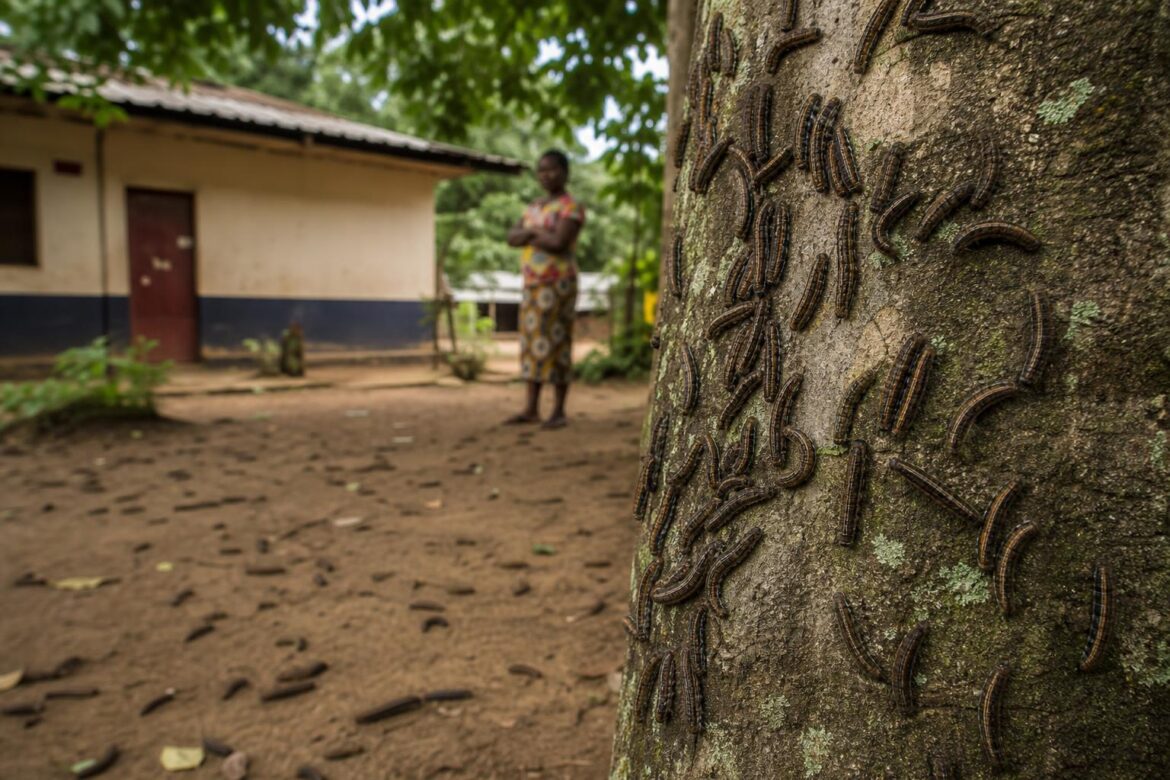
The infestation, which residents said was discovered early Thursday morning, has left families alarmed as hundreds of brown caterpillars continue crawling from large trees into residential compounds and surrounding areas.
During a visit to the affected community Thursday afternoon, the Bong County reporting team observed large numbers of caterpillars moving along tree trunks, vegetation, and the ground. Residents pointed to several large trees, particularly golden plum trees, as the apparent source of the infestation.
Community members described the situation as a “shocking invasion,” saying they woke up to find the insects spreading throughout their yards and homes.
Residents said the infestation is not limited to one household but has affected several compounds across the Far East Community, including the residence of Bong County journalist Exodus T. Weah.
They fear the situation could worsen if authorities fail to intervene quickly.
“This is an SOS call,” one resident said while pointing at caterpillars crawling around the compound. “These caterpillars are entering our homes. We need the Ministry of Health and the relevant authorities to come and help us.”
According to residents, the insects appear to gather in large fruit-bearing trees before descending onto the ground and spreading into nearby homes.
Some community members have attempted to control the invasion by collecting and burning piles of caterpillars. However, they said the effort has produced little result because the insects continue emerging from trees and moving into surrounding areas.
Residents are now appealing to the National Disaster Management Agency, environmental health authorities, and local government officials to conduct an immediate assessment and determine the appropriate response, including whether professional pest control measures are required.
Although residents have expressed fears about possible health consequences, no cases of illness associated with the caterpillars have been officially reported.
Mother Linda N. Kollie, a resident of the community and a mother connected to the Gbarnga Center School for the Deaf, said the appearance of caterpillars is not entirely new but has become a recurring concern for families.
“This caterpillar is not something strange,” she explained. “Almost every year, around August into September, when the golden plum and other fruit trees are producing, these caterpillars appear.”
However, she said residents have limited options for controlling the insects and often rely on traditional methods that have proven ineffective.
“We usually make fire or try putting oil around the trees, thinking it will stop them, but it doesn’t really solve the problem,” she said.
Mrs. Kollie explained that heavy rainfall often causes the caterpillars to fall from trees, forcing residents to gather and destroy them on the ground.
She said children are among those most affected by fear of the insects.
“We have many children around here. They become afraid when they see these caterpillars. They no longer want to go under the golden plum trees to pick fallen fruits because they fear the insects,” she said.
Beyond fear of direct contact, residents are increasingly worried about possible contamination of household water sources.
Mrs. Kollie warned that caterpillars falling into uncovered wells could create sanitation concerns for families who depend on well water.
“Some people drink pump water, while others depend on wells,” she explained.
“If these caterpillars fall into the wells, especially when children leave the covers open after fetching water, people could drink contaminated water and become sick.”
While there is currently no scientific evidence confirming that the caterpillars have contaminated water sources or caused disease, residents say the potential risk requires immediate attention from health authorities.
“We want the government to come before this becomes a bigger problem,” Mrs. Kollie appealed. “Please help us remove these caterpillars from our community so we can continue living in good health.”
Residents also recalled similar infestations in Sugar Hill and other parts of Gbarnga, suggesting that the occurrence may be seasonal rather than isolated.
However, they argued that repeated outbreaks require a coordinated response from government institutions rather than temporary community efforts.
In response to residents’ concerns, District Health Officer Ellen Menepele Gofarson confirmed that health authorities had received reports about the infestation and were preparing to assess the situation.
Speaking through a telephone interview, Madam Gofarson requested specific directions to the affected location, identifying the reported area as being near the Gender Office, around the Bong County Administration Building, close to Max Lutry Inn and a nearby swamp.
“We will try to do a follow-up tomorrow,” she said, adding that health officials would visit the community to verify the reports and determine the nature and extent of the infestation.
She also confirmed that similar reports had previously emerged from Sugar Hill involving what appeared to be the same type of brown caterpillar.
The District Health Officer said other relevant government institutions could be contacted depending on the outcome of the assessment.
Environmental experts caution that some caterpillar species can cause skin irritation, allergic reactions, or discomfort through tiny hairs or defensive chemicals, while others may pose little or no danger to humans.
However, because the specific species affecting the Far East Community has not yet been scientifically identified, authorities have not determined whether the insects present a direct medical threat.
Residents are therefore urging officials to conduct both environmental and public health assessments before deciding on control measures.
Meanwhile, parents continue advising children to avoid touching the caterpillars or playing under affected trees until authorities complete their investigation.
Community leaders are also encouraging residents to remain calm, avoid unnecessary contact with the insects, and report any unusual health symptoms to nearby health facilities.
See more Liberia News Network stories in Google Search by adding LNN as one of your Preferred Sources.
★ Add LNN as a Preferred Source