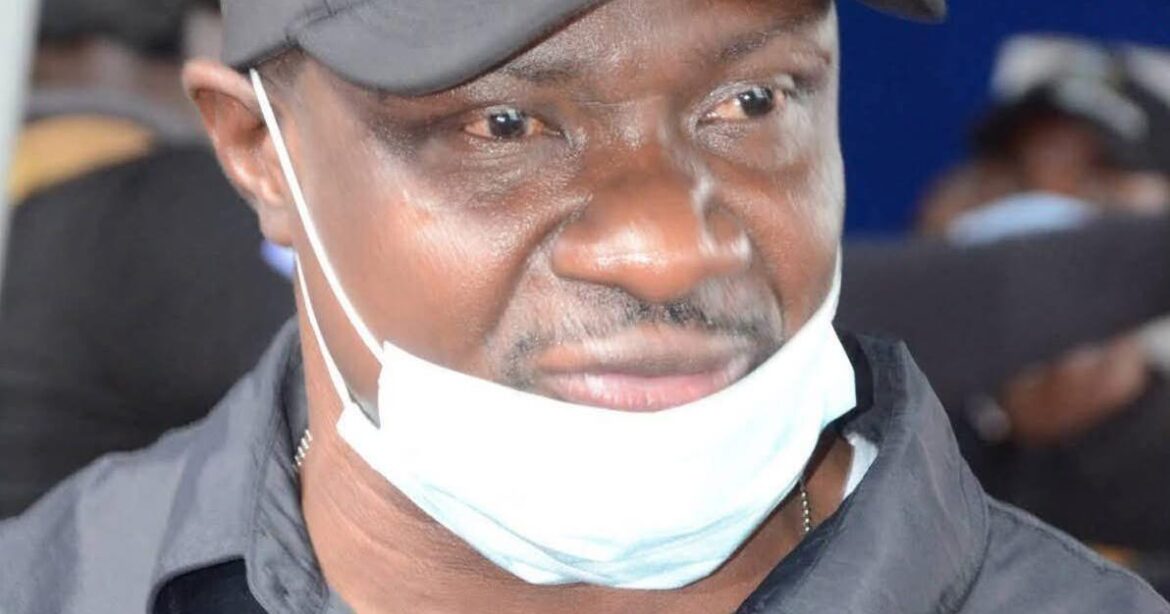
The Officer-in-Charge of the Liberia Drug Enforcement Agency (LDEA) has requested to temporarily step aside from his official duties amid an allegation that he received a Toyota pickup truck as a bribe from an individual allegedly linked to a drug-trafficking organization.
The unprecedented move within Liberia’s security sector is intended to allow an independent investigation into the allegation without the possibility of interference, influence, or a perceived conflict of interest at the highest level of the country’s leading narcotics enforcement institution.
In a formal letter addressed this week to Justice Minister and Attorney General Cllr. N. Oswald Tweh, a copy of which has been obtained by this newspaper, the LDEA chief requested authorization to recuse himself from the functions of Officer-in-Charge pending the outcome of an investigation.
“I respectfully request authorization to temporarily recuse myself from the functions of Officer-in-Charge of the Liberia Drug Enforcement Agency (LDEA), pending investigation into an allegation that I received a Toyota pickup vehicle from an individual allegedly associated with a drug-trafficking organization,” the LDEA boss wrote.
The request comes as Liberia continues to intensify its campaign against illicit drugs, particularly amid growing concerns over drug trafficking, the proliferation of Kush and other synthetic substances, and the impact of narcotics on young people and communities.
Despite requesting to step aside, the LDEA chief has categorically denied the allegation and rejected any suggestion that he solicited or knowingly accepted a bribe or inducement from a drug trafficker.
“I categorically deny this allegation. I have neither solicited nor knowingly accepted any gift, benefit, or inducement from a drug trafficker or anyone acting on behalf of a drug-trafficking organization,” he stated.
He also made clear that his decision to recuse himself should not be interpreted as an acknowledgment of wrongdoing.
“This request is not an admission of wrongdoing, but an act of institutional responsibility intended to avoid any actual or perceived conflict of interest,” he wrote.
The LDEA chief further pledged to cooperate fully with whatever investigation is authorized by the government.
He said he would provide investigators with relevant information and documentation lawfully requested as they seek to establish the facts surrounding the allegation.
“I will cooperate fully with the investigation and provide all relevant information or documentation lawfully requested,” he stated.
The decision to voluntarily seek recusal places the issue of institutional credibility at the center of the controversy.
As the country’s principal drug enforcement agency, the LDEA is responsible for investigating drug-related offenses, gathering intelligence, disrupting trafficking networks, supporting prosecutions, and working with national and international partners in the fight against narcotics.
Legal analysts say an allegation involving the agency’s leadership creates a potential conflict of interest, particularly if the individual accused remains directly responsible for the institution conducting or supporting investigations into drug trafficking.
The LDEA chief therefore argued that temporarily stepping aside would help protect the credibility of the investigation and prevent any actual or perceived interference.
“Temporary recusal is necessary to preserve the independence of the investigation, protect the integrity of the LDEA, and support public confidence,” he argued in his communication to the Justice Minister.
He also called for the immediate designation of an acting head to ensure that the agency’s operations continue while the matter is investigated.
The LDEA boss further urged authorities to ensure a “timely conclusion of a fair, impartial, and transparent investigation.”
The recusal request also raises broader questions about the standards expected of senior public officials, particularly those entrusted with sensitive national-security and law-enforcement responsibilities.
Legal analysts contacted by this newspaper said recusal can serve as an important safeguard where an allegation against a public official could create concerns about interference with an investigation or undermine public confidence in the institution.
They pointed to Liberia’s legal and institutional framework governing the conduct of public officials, including provisions dealing with integrity, conflicts of interest, accountability, and the protection of public confidence.
The LDEA, as a specialized security institution, also handles sensitive intelligence and works with international partners in the global fight against narcotics.
These include organizations such as the United Nations Office on Drugs and Crime (UNODC) and the United States Drug Enforcement Administration (DEA).
Legal observers therefore argue that any unresolved allegation involving the agency’s leadership could potentially have implications beyond the individual concerned, including questions surrounding the credibility of investigations, prosecutions, intelligence-sharing, and international cooperation.
One constitutional lawyer, who requested anonymity because of the sensitivity of the issue, described the recusal as an important test of institutional accountability.
“By stepping aside voluntarily, the Officer-in-Charge has taken a course of action that forces the government’s hand,” the lawyer said.
The lawyer added that the decision could establish an important precedent within Liberia’s security sector.
“In a security sector often accused of shielding its own, this sets a precedent. The administration now cannot be accused of a cover-up — it must produce a credible, non-politicized probe,” the source said.
The lawyer warned that failure to conduct a credible investigation could damage public confidence as well as Liberia’s international reputation in the fight against narcotics.
The allegation comes at a particularly sensitive time for the administration of President Joseph Nyuma Boakai, which has identified the proliferation of illicit drugs as both a public-health and national-security concern.
The Boakai administration has previously characterized the growing drug problem, including the spread of Kush and other synthetic narcotics, as a national emergency and established a multisectoral response aimed at tackling the crisis.
The LDEA remains at the center of that national response.
However, the agency has also faced criticism from civil society organizations, lawmakers, and members of the public over the effectiveness of efforts to dismantle major drug-trafficking networks.
Critics have questioned why law-enforcement operations often result in the arrest of street-level dealers and drug users while major trafficking networks and their alleged financiers remain difficult to identify and prosecute.
The latest allegation could therefore place additional scrutiny on the agency’s leadership and operations.
For the government, the challenge will be to demonstrate that the investigation is conducted independently and that no individual is protected because of his or her position within the security establishment.
If an investigation is formally constituted, several critical questions will need to be addressed.
Among them is the identity of the individual alleged to have provided the Toyota pickup truck and whether that individual has any connection to a drug-trafficking organization.
Investigators will also need to establish whether the vehicle was actually transferred to the LDEA chief, when and how the transfer allegedly occurred, who registered the vehicle, and where it is currently located.
If the vehicle was seized as part of a narcotics investigation, investigators may also need to establish its chain of custody and determine whether it was lawfully transferred, retained, or used.
Financial records, communication records, vehicle-registration documents, witness accounts, and other relevant evidence could also become important in determining whether the allegation has any factual basis.
The investigation will ultimately have to distinguish between an unsubstantiated allegation and evidence capable of establishing wrongdoing.
With the recusal request now before Justice Minister Tweh, attention has shifted to the Ministry of Justice and the broader security leadership.
As Minister of Justice and Attorney General, Tweh is expected to determine how the matter should be handled, including whether to authorize the requested temporary recusal and how an investigation should be constituted.
A temporary acting head could also be appointed to maintain continuity within the LDEA while the investigation proceeds.
Legal practitioners have recommended that any investigative mechanism should be sufficiently independent to command public confidence.
They have suggested that, in addition to relevant professional standards and investigative authorities within government, consideration could be given to involving institutions such as the Liberia Anti-Corruption Commission (LACC), along with an independent civil-society observer where appropriate.
Such participation, they argue, could help reassure the public that the investigation is not being controlled by individuals or institutions with an interest in its outcome.
As of press time Saturday, the Ministry of Justice had not publicly responded to the LDEA chief’s recusal request.
Efforts to obtain an official comment from the Ministry were unsuccessful.
For now, the LDEA chief remains under scrutiny over an allegation he strongly denies, while his decision to voluntarily seek temporary recusal has shifted the focus toward the government’s handling of the investigation.
The matter presents a significant test for Liberia’s anti-narcotics campaign.
The central question is no longer only whether the allegation against the LDEA chief is true or false, but whether the process used to establish the truth will be sufficiently independent, transparent, and credible to withstand public and institutional scrutiny.
The LDEA chief has made his position clear: he denies receiving any illicit benefit and says his decision to step aside is intended to protect the integrity of the investigation—not to concede wrongdoing.
“This request is not an admission of wrongdoing, but an act of institutional responsibility intended to avoid any actual or perceived conflict of interest,” he maintained.
Meanwhile, President Joseph Nyuma Boakai, Sr. has acknowledged the communication from the Minister of Justice and Attorney General regarding the recusal of the Officer in Charge of the Liberia Drug Enforcement Agency (LDEA), Deputy Commissioner of Police Fitzgerald T. M. Biago.
Following a review of the communication, the President has directed the Minister of Justice to immediately launch a comprehensive and impartial investigation into the allegations and all related circumstances surrounding the matter.
The Minister of Justice has been instructed to submit a detailed report to the President within forty eight (48) hours.
President Boakai reaffirmed that his Administration remains unwavering in its fight against illegal drugs, organized crime, and corruption, and emphasized that no individual or institution is above the law. He stressed that the investigation must be thorough, objective, and guided solely by the facts.
Upon receipt of the investigation report, the President will carefully review its findings and determine the appropriate course of action in the best interest of justice, accountability, and the people of Liberia.
The move comes in the wake of emerging public allegations and social media reports linking a pickup truck, allegedly connected to a narcotics suspect or trafficker, to the LDEA OIC’s office.
In his letter to the Minister of Justice, LDEA OIC Biago said he was taking a recusal from his active duties and functions as head of the LDEA. This move, he noted, is aimed at preserving the utmost integrity, transparency, and public trust of the national anti-drug campaign and to ensure an unhindered, credible administrative and security investigation.
See more Liberia News Network stories in Google Search by adding LNN as one of your Preferred Sources.
★ Add LNN as a Preferred Source