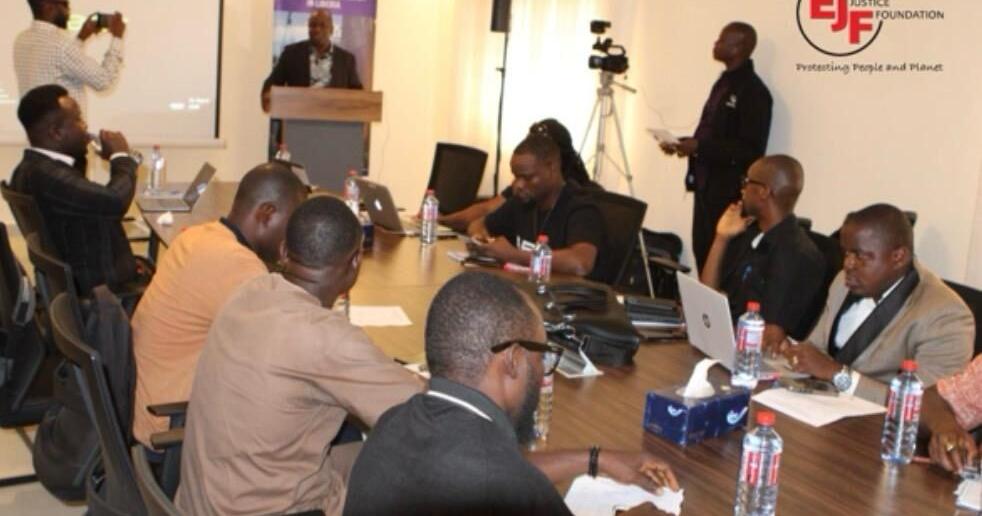
The Environmental Justice Foundation (EJF) has concluded a two-day fisheries reporting training for 12 Liberian journalists, aimed at strengthening media coverage of illegal, unreported and unregulated (IUU) fishing and promoting greater transparency in Liberia’s fisheries sector.
Held in Congo Town at the D’Calabash Hotel outside Monrovia, the training was organized under the Oceans 5-funded project “Creating Greater Fisheries Transparency in Liberia.” It brought together journalists from print, radio and television outlets including the Daily Observer, FrontPage Africa, Reuters, OK FM 99.5 and ELBC, among others, to deepen their understanding of fisheries governance, human rights abuses at sea, and the protection of Liberia’s Inshore Exclusion Zone (IEZ), which is reserved for artisanal fishers.
Giving an overview at the opening of the workshop, EJF Communications and Media Officer Abraham Nyorkor said the initiative was designed to build journalists’ capacity to produce informed, accurate, and investigative reports on fisheries-related issues.
“Informed, accurate, and investigative journalism plays a critical role in promoting transparency, protecting Liberia’s marine resources, and supporting the livelihoods of coastal communities,” Nyorkor said. “The media has an important role to play in bringing greater public attention to challenges affecting Liberia’s fisheries sector.”
IUU fishing remains one of the most significant threats to Liberia’s marine resources, food security, coastal livelihoods and fisheries governance. At the Liberia National Fisheries and Investment Conference (Kpongama 2026) in March, President Joseph Nyuma Boakai described IUU fishing as “a theft on the future of our children,” underscoring the need for stronger efforts to combat the practice.
Despite the fisheries sector’s significant contribution to Liberia’s economy and food security, media coverage of fisheries governance and transparency issues has remained limited, a gap the training was designed to help close.
Through hands-on sessions, participants were equipped with practical skills to understand the impact of IUU fishing, identify human rights abuses linked to fishing activities at sea, investigate fisheries-related issues of public interest, and produce accurate, evidence-based and ethical reports.
Journalists were also introduced to the Global Charter for Fisheries Transparency, an international framework promoting openness and accountability in fisheries management.
As part of the training, participants took part in a field visit to the West Point Fishing Community, where they engaged directly with artisanal fishers and fishmongers to gain firsthand insight into the effects of illegal fishing, the importance of protecting the Inshore Exclusion Zone, and community perspectives on fisheries governance. Among those who spoke with journalists was Weisne Barjloh, a boat owner and fisherman with 25 years of experience on the water.
“I own fishing boats and have employed fishermen as well. I have been in this business for 25 years, and I am still fishing,” Barjloh said. “This work sends my children to school, pays my rent, and supports my family. It means much more to me than just business.”
Mr. Barjloh said he has reduced his fishing trips to daytime hours, particularly during the stormy season. “We cannot go out at night because of the storms. The sea can be very rough, especially in August, so I try not to take too much risk during that month,” he said.
He also recounted an unresolved dispute from two years ago, when a fishing vessel damaged his net. “I filed a complaint, but since then, nobody has addressed my case. I lost nearly US$800 and had to take on debt to keep the business running,” he said.
Mr. Barjloh further alleged a log of incidents at sea and submitted printed reports to the National Fisheries and Aquaculture Authority (NAFAA), which had not been verified with authority at NaFAA. However, he expressed frustration over what he described as a lack of response to fishermen’s complaints.
“After paying our taxes and registering our nets, we get no accountability from NAFAA,” he said.
One of Barjloh main concerns is the lack of clear demarcation between areas reserved for artisanal fishermen and those designated for commercial fishing vessels. He said local fishermen are permitted to fish up to six nautical miles from shore, but commercial vessels sometimes operate as close as two or three nautical miles offshore, damaging the nets of artisanal fishermen.
“There is no clear boundary showing where the six nautical miles end. We want NAFAA and the marine police to establish clear demarcation so that we know where we are supposed to stop,” he said.
According to Weisne Barjloh, fishermen currently lack the equipment needed to accurately measure distances at sea and are often forced to estimate their location based on travel time and the speed of their boats.
He also called on NAFAA to establish a marine supply store where fishermen could access fishing equipment, replacement parts, and other essential materials at affordable prices. He said many fishermen struggle to find equipment and repair services within or near their communities.
The visit to West Point helped participating journalists develop story ideas based on the reporting skills gained during the workshop. The Environmental Justice Foundation (EJF) has encouraged journalists to ensure that stories produced from the training are grounded in verified facts, clearly distinguish evidence from opinion, avoid misinformation and sensationalism, and adhere to the highest standards of ethical journalism.
EJF believes that stronger and more responsible media reporting can contribute to greater accountability, improved fisheries governance, and the long-term protection of Liberia’s marine resources and coastal communities.
See more Liberia News Network stories in Google Search by adding LNN as one of your Preferred Sources.
★ Add LNN as a Preferred Source