
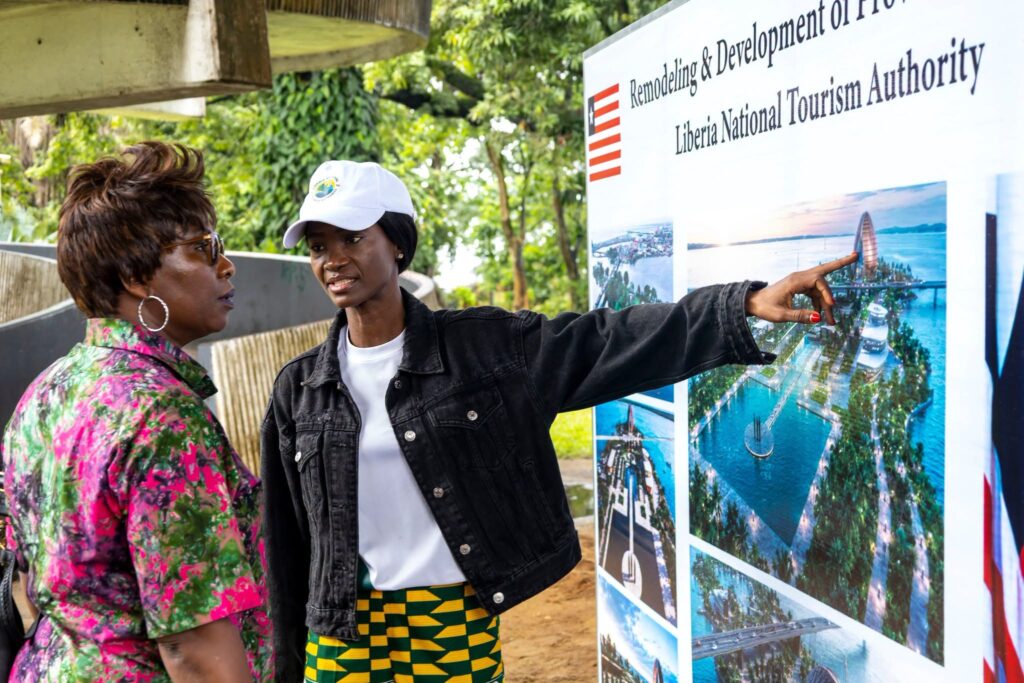
MONROVIA – Liberia is set to rebuild the ground it was born on. Providence Island, the 11.22-acre site where the founding settlers came ashore in 1822 and which has sat behind a locked gate ever since its foundations began to crumble, is to be developed into a full heritage destination with government money, marking the first time the state will have built a tourism product.
Ahead of the commencement of works, Minister of State for Presidential Affairs Samuel A. Stevquoah, Director General of the Cabinet Nathaniel T. Kwabo, and Nimba County Senator Samuel G. Kogar, chairman of the Senate Committee on Information, Broadcasting, Cultural Affairs and Tourism, toured the island with senior officials, the board chair of the Liberia National Tourism Authority, and executives of major media institutions. The visit gave the delegation a chance to inspect the site, review the emerging development vision, and examine how the project will balance new tourism infrastructure against the preservation of the island’s historical character and heritage assets.
The project is funded by the Government of Liberia through the Public Sector Investment Program and is being implemented as a design-and-build contract. This arrangement allows the final scheme to respond to site conditions, technical assessments, and heritage-preservation requirements as they are established. The conceptual designs circulating with the project therefore represent the development vision rather than the finished plan, with the detailed design process set to determine the actual construction and preservation interventions. The authority has not yet announced an official start date.
Under the concept, the island stops being a place visitors simply enter, photograph, and leave. The proposed experience includes heritage walks, historical and digital interpretation, arts and crafts, Liberian food, community vending, educational spaces, cultural performances, guided tours, and riverfront areas for reflection.
That represents a larger proposition than basic construction. For decades, Liberia has pointed to its beaches, forests, cultural traditions, historic landmarks, and natural landscapes as evidence of enormous tourism potential. However, competitiveness in international tourism requires more than owning attractive places. It requires access, visitor facilities, interpretation, professional management, maintenance, safety, and hospitality services—the elements that persuade a visitor to stay longer, spend more, and return. Providence Island is the government’s first opportunity to demonstrate that it can produce them.
The economics extend well past the shoreline. Tour guides, cultural performers, artisans, food vendors, photographers, content creators, transport operators, event producers, hotels, and restaurants all stand to gain once a properly managed destination begins generating sustained visitor traffic. The concept deliberately builds in cultural commerce, local crafts, community vendors, and visitor services so those linkages are designed from the start rather than left to chance. Sitting where it does in the capital, the island can also anchor a Monrovia heritage circuit, moving tourists from isolated site visits toward organized routes that connect several landmarks and keep visitors in the city longer.
There is a domestic return as well. Liberian students, families, researchers, and young people would gain a heritage destination where national history is interpreted rather than merely recited from textbooks. It offers a venue for school excursions, university research, cultural programming, and national commemorations. Internationally, the island gives Liberia an authentic platform in the heritage and diaspora travel market, where global interest in African history, settlement, and ancestry continues to grow.
The project is built directly on the country’s origin story. Formerly known as Dozoa, the island lies between the Mesurado River and Stockton Creek, roughly 500 to 600 meters from the bar mouth of the Atlantic, and takes the shape of a guitar from the air across its 11.22 acres of land. It was renamed Perseverance Island to mark the settlers’ determination to find a home after the setbacks they suffered at Sherbro Island in present-day Sierra Leone, and on January 7, 1822, the first group of Black American emigrants landed there. The settlers went ashore at Cape Mesurado and established a settlement they called Christopolis, which was renamed Monrovia in 1824 after the United States president. That first arrival was followed by the departure of roughly 25,000 manumitted Black people from the Americas between 1822 and 1861, of whom only about 12,000 survived the voyage.
The physical remains of the settlement period include a land dock, an ancient well, original building foundations, and the oldest cotton tree in Liberia. Only a few stone foundations remain on the eastern side of an island that once hosted concerts, festivals, and community gatherings. Liberia has already asserted the site’s global value. Providence Island was submitted to the UNESCO World Heritage Centre’s tentative list on March 30, 2017, under cultural criteria four and six by the then Ministry of Information, Cultural Affairs and Tourism. Liberia has three sites on that tentative list and none yet inscribed on the official World Heritage List, making the island’s status a live question for the country’s first inscription.
The development also occurs within an institutional context that did not exist two years ago. The Liberia National Tourism Act, signed August 15, 2025, created the LNTA as the principal government body responsible for tourism promotion, development, and regulation, ending the sector’s status as a department within a larger ministry. The transfer of tourism and culture functions from the Ministry of Information was completed in January 2026, with the authority taking on 94 transferred employees. Since then, it has adopted the Tourism Satellite Account as the official framework for measuring tourism’s contribution to the economy, begun a national registration, inspection, classification, and star-rating regime for accommodation, and, on August 6, 2026, signed a memorandum with the Liberia Special Economic Zones Authority to establish Liberia’s first Special Tourism Economic Zone at Lake Piso in Grand Cape Mount County. The authority also promoted Providence Island directly to European investors at the Liberia-EU Business Forum in Brussels.
The size of the delegation that toured the island, drawn from the Executive Mansion, the Senate, and the country’s media houses, signals the weight the government is placing on the project. It also sets the standard to which the work will be held. Architect and infrastructure systems consultant B. Garmondyu Zogar, who welcomed the initiative, has urged the LNTA to publicly disclose the feasibility study, approved master plan, environmental and social impact assessment, heritage impact assessment, archaeological investigations, geotechnical and hydrological studies, environmental permits, and procurement records before construction begins. On a site this small, with so little left standing, the preservation work itself is the core of the project.
