Published: August 21, 2026
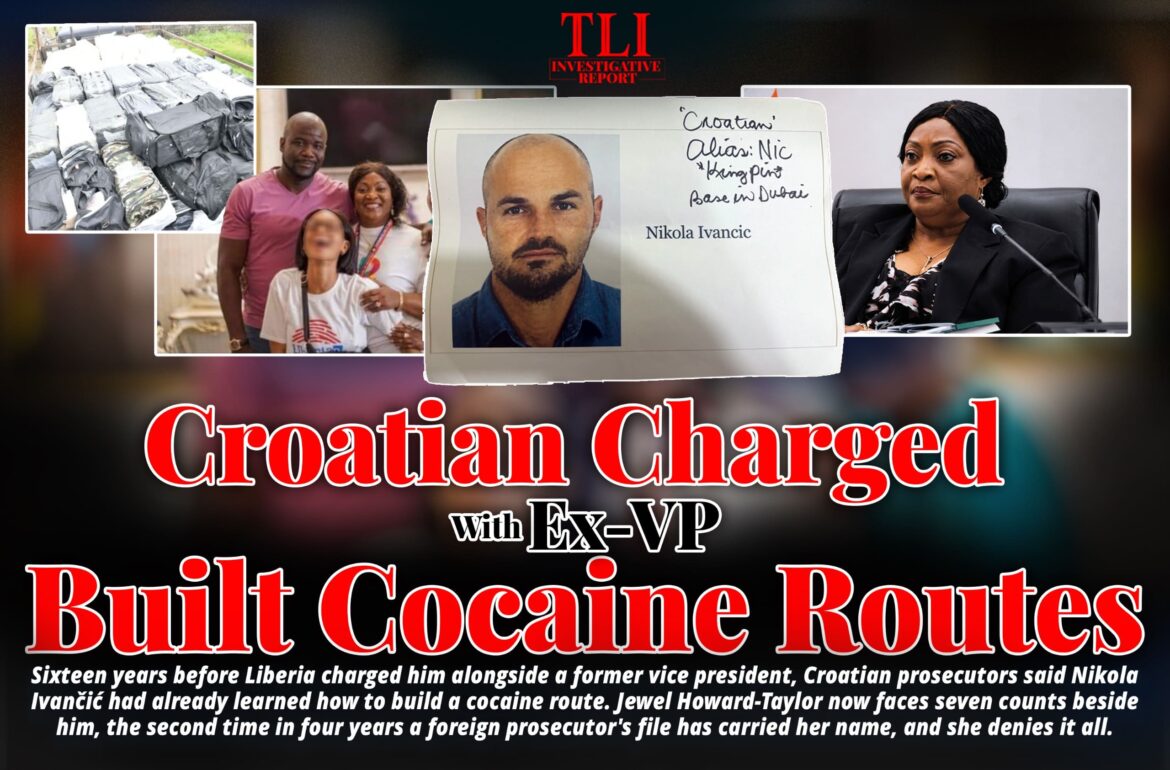
MONROVIA – MONROVIA — Nikola Ivančić, one of three foreign nationals charged alongside former Vice President Jewel Howard-Taylor, was accused by Croatian prosecutors 16 years ago of helping build a cocaine-smuggling network stretching from South America to Europe, records reviewed by The Liberian Investigator show.
By Lennart Dodo, [email protected].
The 2010 indictment alleged that Ivančić recruited an associate, introduced him to cocaine producers in Peru, took him through illegal laboratories in Ecuador and supplied him with a forged American passport and driver’s license to facilitate his movement through South America. Prosecutors accused the wider organization of moving 38 kilograms of cocaine and generating at least €938,000 in illegal proceeds.
Sixteen years later, Ivančić’s name has surfaced in another cocaine prosecution, this time in Liberia. Liberia’s Ministry of Justice charged Ivančić in absentia Wednesday as an alleged organizer of the transnational narcotics network it says operated through this country, and it charged him in the same statement that brought seven counts against Howard-Taylor, who served as vice president from 2018 to 2024.
The Global Initiative Against Transnational Organised Crime warned this year that the West African cocaine trade is driving corruption, local drug use and instability across the region. The Justice Ministry made the same point in its own words on Wednesday, describing narcotics trafficking as an attack on Liberia’s institutions, its economy and the future of its young people.
On Jan. 14, 2010, the news agency Hina reported that the Office for the Suppression of Corruption and Organized Crime, USKOK, had indicted Ivančić and 12 others at Rijeka. He was 31, which would make him about 47 or 48 today. Croatian prosecutors said he had organized a criminal organization across Poreč, Zagreb, Split and other Croatian cities that moved cocaine out of Peru, Argentina and Ecuador between 2005 and January 2009, recruited a warehouseman to cut and repackage the product in Split and Imotski, and used threats and force against members he suspected of disloyalty. The group was accused of moving 38 kilograms and taking illegal proceeds of at least 938,000 euros. Twelve of the accused were Croatian. One was Peruvian.
What Justice Minister Cllr. N. Oswald Tweh has not said is how Ivančić came to Liberia, when, or who received him.
The charges
Howard-Taylor was stopped from leaving the country at Roberts International Airport on Wednesday morning and taken to the headquarters of the Liberia National Police. Following a review of evidence presented by the Joint National Security Investigative Team, according to Tweh, she was charged with unlicensed importation of a controlled drug or substance under Section 14.83 of the Controlled Drug and Substance Act of 2023; unlicensed sale, trading, distribution, dispatch in transit and transportation under Section 14.85; and illicit trafficking under Section 14.93. She was further charged with criminal solicitation, criminal facilitation and criminal conspiracy under Sections 10.2, 10.3 and 10.4 of the Penal Law, and with money laundering under Section 15.2 of the Anti-Money Laundering and Terrorist Financing Law.
Charged in absentia alongside Ivančić were Mihovil Vrovac, also described as Croatian, and Tara Zaderieko, described as Ukrainian. Tweh said the government would pursue all lawful domestic and international measures to locate and apprehend them. Former Deputy Director of the National Security Agency for Administration Gerald Smith was called in for questioning in connection with the same investigation. He has not been charged.
Tweh said the government would pursue the network’s leadership, financiers, facilitators, transporters, operational coordinators and institutional protectors. “No office is too high, no political connection is too powerful,” he said. He said criminal charges are accusations rather than judgments of guilt and that all defendants remain presumed innocent.
Police Inspector General Gregory Coleman separately linked Howard-Taylor’s charges to the US$317 million cocaine seizure at a warehouse in the VOA Community in Paynesville in July.
Liberia has been here before, and the last time it said no
The year Croatian prosecutors indicted Ivančić, Liberia was in a courtroom in Manhattan on the other side of the same trade.
In 2010 the government deported seven men to the United States after they were accused of trying to move 4,000 kilograms of cocaine, worth about US$100 million, out of Colombia, and of attempting since 2007 to bribe senior Liberian officials to protect large shipments. The operation worked because Fombah Sirleaf, then director of the National Security Agency, was one of three senior Liberian officials who secretly assisted the United States Drug Enforcement Administration. According to United States prosecutors, one defendant, Gilbrilla Kamara, had sought to corrupt West African officials in order to establish safe havens for the receipt, storage and shipment of thousands of kilograms of cocaine, and had met men he believed to be the director and deputy director of Liberia’s NSA, both of whom were in fact working with the DEA.
That was the arrangement traffickers wanted from Liberia in 2010: the country’s security leadership, bought. It did not work.
Sixteen years later, Liberia is again confronting allegations that an international cocaine network found people inside the country willing to facilitate its operations. The Ministry of Justice has now called a former deputy director of the same agency in for questioning, though Smith has not been charged and the ministry has not accused him of wrongdoing. It has charged a former vice president. And it has named a foreign organizer whose Croatian indictment describes exactly the method the state alleges was used here, which is the installation of people on the ground and the payment of them to stay there.
Why a Croatian, and why here
The Global Initiative Against Transnational Organized Crime reported this year that Balkan networks are embedding across West Africa to move cocaine to Europe, forging alliances with Latin American cartels and local intermediaries, and that Montenegrin clans such as Kavac and Skaljari, rivals with ties to Italy’s ‘Ndrangheta, have built close partnerships with Latin American suppliers. Lucia Bird Ruiz, who directs the group’s Observatory of Illicit Economies in West Africa, said a third of Europe’s cocaine now transits West Africa and that the share could reach half by 2030. Croatian ports have themselves been documented as entry points on cocaine routes established by Western Balkan groups dealing directly with Latin American suppliers.
What changed between 2009 and now is the geography. GI-TOC says West Africa offers traffickers expanding port facilities, weak oversight and a location that makes it ideal as a transit point. Investigators have long held that the cartels moved into the region because of corrupt institutions and lax law enforcement, and that in some countries they operated with the complicity of ruling families.
That is the structural claim the charges make. A European organizing layer, a Liberian protective layer, and a corridor between them.
A pattern the former vice president has answered before
Howard-Taylor has been placed in proximity to foreign defendants before, in a record that is documentary rather than alleged, and she has denied wrongdoing each time.
In May 2022, a United States court denying bail to Sheik Bassirou Kante, arrested that April in a wire fraud case involving more than US$7 million, found that an email search warrant production showed the defendant had “a close personal relationship with the Vice President of Liberia,” and that agents searching his residence found him holding a Liberian diplomatic passport despite occupying no diplomatic position. Judge Timothy J. Sullivan treated that as evidence of connections to the highest levels of the Liberian government and as a factor raising his risk of flight. Her office responded then that she has many friends across all sectors of society and that it would be a travesty of logic to suggest she is aware of the personal dealings of everyone she has interacted with. She denied any involvement in issuing the passport.
Six months earlier, in November 2021, the Nigerian businessman Obi Cubana visited her in Monrovia to discuss a business partnership and was arrested on his return by Nigeria’s Economic and Financial Crimes Commission over tax fraud and money laundering allegations.
Neither episode is charged in the present case, and neither is evidence in it.
The response
Howard-Taylor’s counsel, Cllr. Kabineh M. Ja’neh, told Reuters he had met his client on Wednesday and had been told she would be charged, though he had not seen the indictment. “She is in the custody of the Liberia National Police tonight,” he said, adding the matter could proceed once the formal charge was received.
Former President George Manneh Weah, political leader of the Congress for Democratic Change, called the action an abuse of power in a statement the same day. He said Howard-Taylor was prevented from traveling without prior notice, in violation of her constitutional right to free movement, and was then harassed and detained. He said he had spoken to her and that she vehemently and categorically denied the allegations, and that the Justice Minister had read out blanket accusations without explaining how they were formulated. Weah said the two large cocaine discoveries, which he put at nearly half a billion dollars, involved narcotics that officials have acknowledged entered Liberia after the CDC handed over power, and he accused the government of manufacturing links to his administration while sparing its own officials, many of whom he said still roam the streets despite being named. “President Boakai seeks to rule as a tyrant,” he said, pledging to return to Liberia to organize resistance by political and legal means.
The government’s statement urged the public, political actors and media institutions to avoid speculation and the publication of unverified information.
See more Liberia News Network stories in Google Search by adding LNN as one of your Preferred Sources.
★ Add LNN as a Preferred Source