Published: August 24, 2026
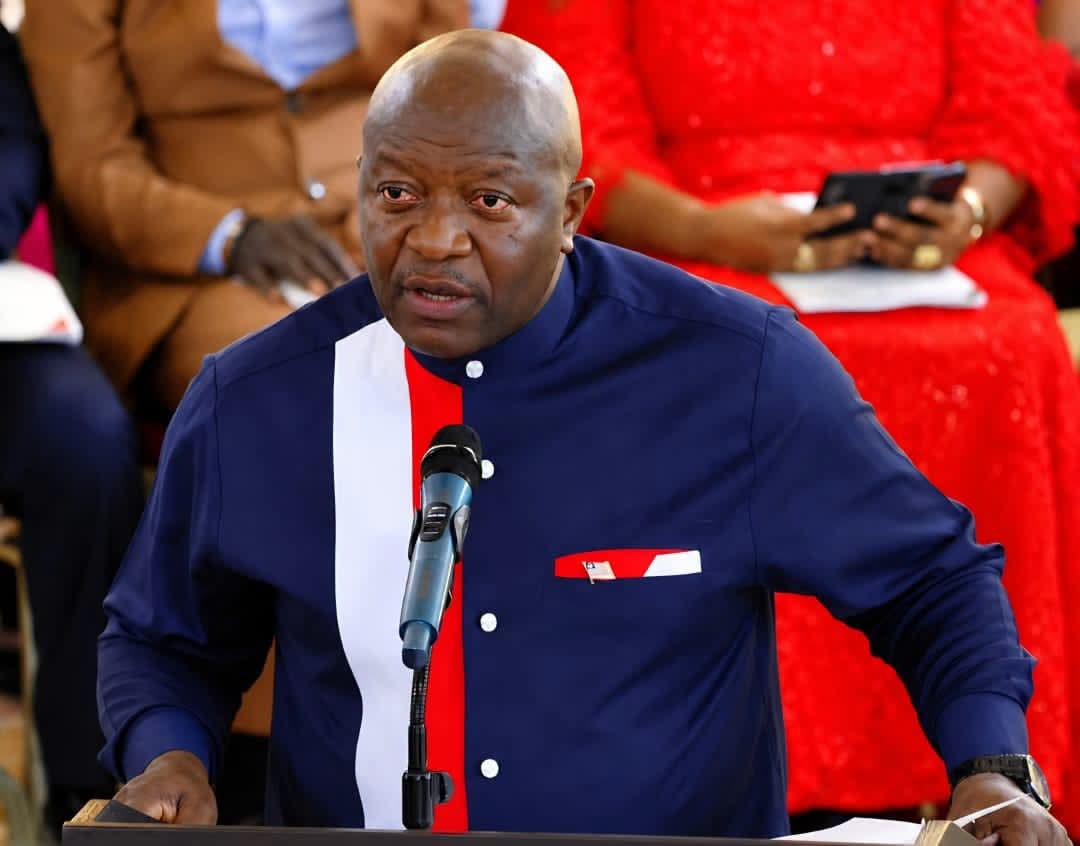
MONROVIA – Liberia’s national budget will pass US$1 billion for the first time in the country’s history sometime next month, Finance Minister Augustine Kpehe Ngafuan said Monday, using the National Flag Day oration to put a date on a threshold he said critics had dismissed as unreachable.
“When some critics and cynics considered a billion-dollar national budget a distant and unrealistic aspiration, we chose to pursue the difficult work of expanding domestic revenue and strengthening fiscal capacity. And sometime in September this year, we shall hit the historic billion-dollar mark, the first time since the founding of our country,” Ngafuan said.
He immediately qualified what the figure is worth. “But a bigger budget is not an end in itself,” he said. “Its meaning lies in what it makes possible: More roads. More electricity. Better schools. Stronger healthcare. More jobs and opportunities. Stronger institutions. And measurable improvements in the lives of our people.”
“That is the standard by which development must ultimately be judged,” he said.
Ngafuan delivered the oration at the 179th anniversary of National Flag Day under the theme “From Heritage to Hope: The Flag That Unites Us.”
He paired the fiscal announcement with a road commitment covering two of the country’s longest-standing corridors, framed as achievable within a few years.
“Based on what we are doing, I can now confidently say that this generation of Liberians will in few years be able to drive on paved roads from Monrovia to Harper and from Gbarnga through Zorzor, Voinjama, Kolahun, and Foya toward Mendikorma on the Sierra Leone border, things that previous generations of Liberians since the nation’s founding could only dream of,” he said.
He said the government is rehabilitating or constructing more than 100 schools for foundational learning, and argued that infrastructure is itself a unifying force.
“The roads we are paving do not ask the political party of the persons traveling on them,” Ngafuan said. “The electricity we are expanding in Monrovia, in Buchanan, in Voinjama and across the country does not ask the tribe of the child studying beneath its light. The hospitals we are improving, or the ones we are building, will not ask the county of the patient seeking treatment.”
He said the schools would “not ask whether a child’s parents voted for the government or the opposition.”
Ngafuan named resistance to drug traffickers among the duties of the security services, at a point when Liberia’s anti-narcotics enforcement is under scrutiny following the Roberts International Airport and Duazon cocaine seizures.
“A member of our joint security forces who resists the tempting overtures of drug cartels and enforces the law regardless of name, status, wealth, or connections is raising the flag,” he said.
“A public official who protects public resources is raising the flag,” he said. “A citizen who refuses corruption even when nobody is watching is raising the flag.”
“Patriotism is not only what we say about Liberia. Patriotism is what we do for Liberia,” he said.
Much of the oration was directed at the conduct of politics. The finance minister said political competition in Liberia has taken on a destructive character and called for it to be abandoned.
“There is a dangerous form of politics that treats national life as a zero-sum game: for me to live, you must die; for me to rise, you must fall; for me to succeed, you must fail,” he said. “We must reject that mindset.”
He acknowledged the position would be dismissed in some quarters. “Some may consider such a position naive or non-Machiavellian,” he said. “But we should never become comfortable acquiring our joy through the pain of others or celebrating our advancement through the destruction of others.”
“A person’s political opponent is not a person’s political enemy. After all, the position or office in contention is not the personal property of political contenders. It is for the Liberian people,” Ngafuan said. “When hatred becomes the organizing principle of politics, eventually everybody loses.”
He proposed what he called a minimum Patriotic Covenant, a set of values he said both government and opposition should accept.
“Liberia needs a minimum Patriotic Covenant, a set of irreducible national values to which government and opposition, Christian and Muslim, young and old, rich and poor can subscribe,” he said.
The covenant he outlined would affirm “that Liberia comes first,” “that political power must be pursued peacefully,” “that public resources belong to the people,” “that corruption is wrong regardless of who commits it,” “that truth matters,” and “that the Constitution and the rule of law must prevail over personalities.”
“These should not be government values or opposition values,” he said. “They should be Liberian values.”
Ngafuan also pushed back at the idea that virtue sits outside government and vice inside it, an argument aimed at critics of the administration he serves.
“Being outside government does not automatically confer sainthood on anyone, except if we fall for that feeble argument that the environment outside government is a paradise populated only by angels and cherubim,” he said. “Conversely, being in government does not automatically make a person bad, except again if we surrender to the warped argument that government by nature is an evil construct populated only by demons.”
“The location of a person matters less than the character and patriotism of the person,” he said.
He extended responsibility to the media and to online commentary, listing broadcasters and writers among those he called Liberian leaders.
“Talk-show hosts, panelists, editors, reporters, bloggers, and influencers are Liberian leaders because they influence what citizens believe to be true or false,” Ngafuan said. “A microphone can educate or inflame. A radio program can inform or divide. A political platform can inspire or incite. A social-media post can build bridges or deepen fractures.”
On public resources, he invoked the tragedy of the commons to describe how Liberians undercut what they say they want.
“Sometimes, because Liberia belongs to all of us, we behave as though Liberia belongs to none of us,” he said. “We say Liberia needs a bigger national budget, yet some of us deliberately evade legitimate taxes. We say we want a crime-free society, but when a friend or relative is lawfully apprehended, some of us demand that the police abandon the law.”
“We demand accountability from public officials, but excuse wrongdoing when the wrongdoer belongs to our party, county, tribe, church, family, or circle of friends,” he said.
He opened the oration with an account of marching as a first grader at Bolahun Public School in Wawoma Clan, Kolahun District, Lofa County, on Flag Day in 1978, in a white shirt and green short trousers.
“That little first grader marching through Bolahun in 1978, the little boy who would later return to Monrovia and continue his schooling in Logan Town, Jamaica Road, Kakata, and other places, could not have imagined that one day he would stand before his country as National Flag Day Orator,” he said.
“But that possibility should never be unique to one person. It should be part of the Liberian promise available to every child.”
He closed by inverting the day’s usual question.
“We often ask what do we see when we look at the flag. Today, let us reverse the question. If the flag could look back at us, what would it see?” he said. “Would it see leaders placing national interest above personal interest? Would it see public resources being transformed into roads, schools, hospitals, electricity, jobs, and opportunity?”
“Those questions cannot be answered by this speech. They will be answered by our actions,” he said.
See more Liberia News Network stories in Google Search by adding LNN as one of your Preferred Sources.
★ Add LNN as a Preferred Source