
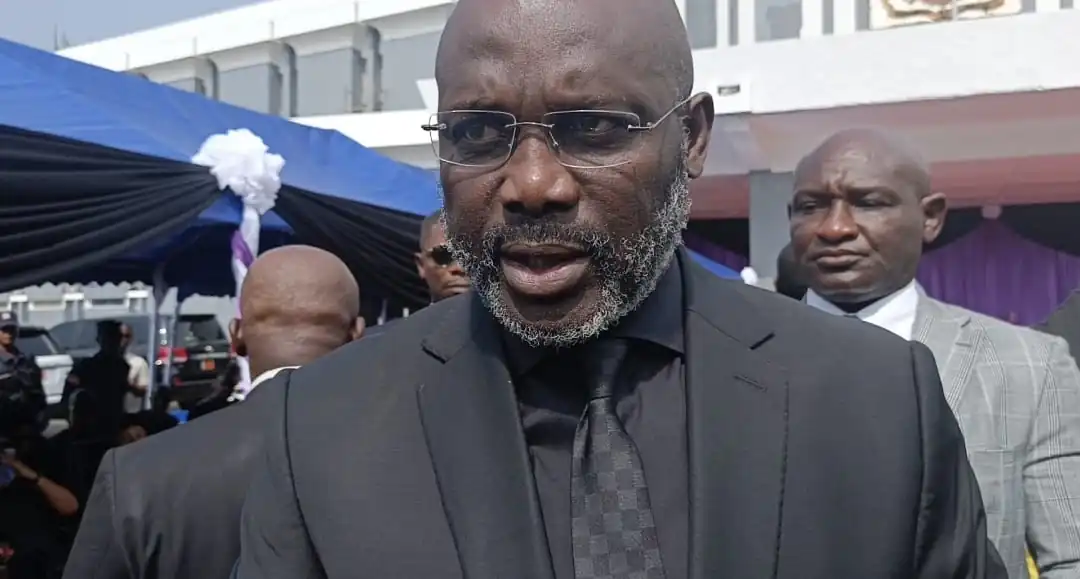
By Lincoln G. Peters
PORT HARCOURT, Nigeria, August 24, 2026 — Former Liberian President George M. Weah has warned that democratically elected leaders can gradually become tyrants by weakening the judiciary and legislature, arguing that winning an election does not give leaders the authority to undermine institutions designed to restrain executive power.
Speaking at the 66th Annual General Conference of the Nigerian Bar Association in Port Harcourt, Rivers State, Weah said democracy cannot survive on elections alone but depends on strong and independent institutions.
“A tyrant with a certificate of return is still a tyrant,” Weah declared, warning that democratic governance is tested by how elected leaders exercise power after taking office.
Weah delivered the keynote address on August 23 under the conference theme, “Beyond Limits,” focusing his remarks on the role of the Bar and Bench as guardians of democracy and the threats facing democratic institutions across West Africa.
Although Weah did not name President Joseph Nyuma Boakai in the remarks provided, his speech warned broadly against elected governments that exert pressure on courts and legislatures. He said such conduct can be as dangerous to democracy as military coups.
According to the former Liberian leader, his experience as president taught him that elections are only the beginning of democratic governance.
“Democracy does not survive on the strength of elections alone,” Weah said. “Elections are the doorway into democracy, not the house itself.”
He said the institutions that sustain democracy include an independent judiciary supported by a “fearless, principled Bar.”
Weah warned that threats to democracy do not come exclusively from soldiers seizing power or defeated political leaders refusing to leave office.
“The danger is not only that soldiers might seize power in the night, or that a defeated candidate might refuse to leave office,” he said.
“It is also that a leader who arrives in office through a free and fair election can, over time and often gradually, begin to govern like the very dictators the ballot was meant to guard against — leaning on the judiciary until it bends to his will, and strong-arming the legislature until it becomes an echo chamber rather than a check on his power.”
Weah said democracy does not end on election night but is tested continuously by how those entrusted with power treat the institutions established to hold them accountable.
He referenced remarks attributed to outgoing Nigerian Bar Association President Mazi Afam Osigwe that “democracy cannot survive on strong men. It survives on strong institutions.”
According to Weah, that principle should guide governments throughout West Africa.
“That sentence deserves to be written above the door of every parliament and every courtroom in West Africa,” he said.
The former president also stressed the importance of the rule of law, saying it should guarantee equal protection regardless of political status or proximity to power.
He said a journalist, trader or student in Port Harcourt, Monrovia or Bamako should enjoy the same protection under the law as a minister or military general.
Weah raised concerns about executive interference with the judiciary across the region, including governments exercising control over judicial budgets, creating special courts to achieve political outcomes and removing judges through executive action.
He also pointed to the resurgence of military coups in parts of West Africa since 2020, warning that no country should consider itself immune from threats to constitutional democracy.
“We have seen, across our region since 2020, an unsettling pattern of soldiers stepping over constitutions altogether,” Weah said.
“I raise these examples because this Bar to which you belong and have gathered here in your thousands cannot afford to assume that Nigeria, or Liberia, or any of us, is somehow immune.”
Weah said judicial decisions must be respected without political interference, warning that weakening the courts could undermine investment, security, public confidence and national peace.
“A court’s decision must mean what it says, without anyone’s political permission,” he said.
He warned that democratic governments can undermine institutions through manipulation of budgets, improper appointments and pressure on judges.
“This danger does not only come from the coup-makers who seize power in the night,” Weah said. “It also comes from governments that call themselves democratic through budget manipulation, wrong appointments, and pressure on judges, and deciding that courts should be a convenience rather than a check.”
Weah served as Liberia’s president from 2018 to 2024 before conceding defeat to President Joseph Nyuma Boakai following the 2023 presidential runoff election.
