
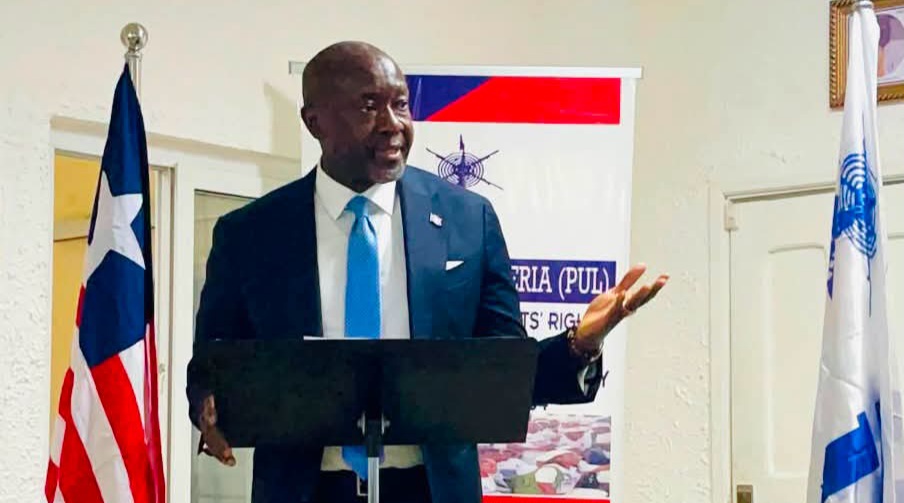
MONROVIA, LIBERIA – Senator Amara Konneh has challenged the Liberian government to move beyond drug seizures, official suspensions and public destruction of confiscated narcotics, arguing that the real test of Liberia’s escalating war on drugs will be whether prosecutors can deliver swift, credible convictions in court.
Speaking Wednesday, August 26, at the Edward Wilmot Blyden Intellectual Discourse organized by the Press Union of Liberia (PUL), Senator Konneh said the country had made an important start in confronting the drug crisis, but warned that the government could lose public confidence if the current investigation ends with disciplinary actions against officials rather than evidence-based prosecution.
Addressing a panel discussion under the theme, “Confronting Drug Trafficking: Strengthening Institutions, Advancing Accountability, and Safeguarding the Rule of Law,” Konneh praised President Joseph Nyuma Boakai, the Liberian Senate and the Joint Security Task Force for actions taken against the trafficking of illicit drugs.
But he insisted that the government must now undertake what he described as the harder part of the fight, building a case strong enough to survive scrutiny in court.
“Suspending officials and burning confiscated drugs are the easy part,” Konneh said. “Securing a conviction in court is the hard part.”
His remarks come amid heightened national concern over Liberia’s recent seizure of large quantities of suspected cocaine and allegations involving individuals within the country’s security establishment.
Konneh argued that the government’s handling of the investigation would ultimately be judged not by the volume of drugs seized or the number of officials suspended, but by whether investigators and prosecutors could establish a legally sound chain of evidence and hold every person implicated accountable regardless of status.
‘No Selective Justice’
The senator, who has been outspoken about accountability in the ongoing drug investigation, warned that selective enforcement could undermine the credibility of the entire operation.
He referenced Liberia’s experience with the approximately US$100 million cocaine case during the previous administration, arguing that the seizure itself was not enough to secure justice because weaknesses in prosecution, chain of custody and financial investigation contributed to the case’s collapse.
Konneh said Liberia must not repeat that experience.
“If we stop at suspensions and dismissals, we create the perception of selective justice,” he warned.
According to him, ordinary citizens cannot be expected to remain confident in the justice system if they see alleged drug traffickers facing criminal prosecution while senior security officials are merely suspended or dismissed without either being charged or cleared.
His proposed solution is straightforward: apply the same legal standard to everyone connected to the investigation.
Konneh called on the Ministry of Justice to pursue charges against suspended officials where sufficient evidence exists and to reinstate those against whom investigators cannot establish wrongdoing.
He also urged the government to work toward prosecuting the cases within 90 days, arguing that indefinite suspensions without criminal charges could become a form of punishment without trial.
“A swift, public trial clears innocent officers and permanently removes compromised ones,” he said, emphasizing that a credible process would also protect honest security personnel from suspicion.
For Konneh, accountability is therefore not simply about punishing wrongdoing. It is also about protecting institutions from the corrosive effects of doubt.
Konneh also turned his attention to emerging allegations concerning procurement and public financial management within the security sector.
He said reports circulating about police vehicles allegedly purchased from Minnesota, luxury SUVs assigned to officials and vehicles reportedly registered to private individuals but used by security officials must be addressed transparently.
He stressed that he was not presenting the allegations as established facts.
“These may be false, but in a drug case of this magnitude, perception is an enemy,” he said.
The senator called for the Joint Security Task Force to release a comprehensive documentary package addressing the procurement and ownership of vehicles linked to the investigation.
Among the records he wants made available are relevant Public Procurement and Concessions Commission approvals, General Services Agency asset-registration records, Ministry of Finance and Development Planning payment vouchers and Liberia Revenue Authority duty-waiver documentation.
Konneh acknowledged that security institutions may, under applicable procurement rules, use sole-source or single-source procurement in appropriate circumstances.
But he stressed that such purchases must still meet the required legal approval process.
His argument is that transparency over public assets could strengthen rather than weaken the government’s drug investigation.
“If the cars are GOL property, the documents will exonerate the police, build their credibility, and strengthen the cocaine case,” he said.
Conversely, he warned, unexplained procurement and ownership arrangements could provide defense lawyers with ammunition to attack the credibility of investigators and the integrity of the prosecution.
Konneh’s central argument was that Liberia cannot win the drug war through isolated enforcement actions.
Instead, he called for the current investigation to become the foundation for a stronger and more durable system of law enforcement.
He urged authorities to enforce Liberia’s revised drug legislation, including provisions concerning the seizure, confiscation and forfeiture of assets connected to narcotics offenses.
He also called for strict preservation of the chain of custody from the moment drugs are seized through laboratory examination and eventual presentation in court.
For Konneh, every stage must be properly documented.
He argued that drugs should move from the point of seizure to laboratory examination and eventually to court under procedures that leave little room for questions about whether evidence was contaminated, substituted, mishandled or improperly documented.
“The bulletproof evidence that must be followed is the chain of custody,” he emphasized.
The senator further proposed that proceeds recovered through lawful asset forfeiture be used to strengthen rehabilitation services, including facilities serving vulnerable communities across several counties.
Although he made clear that he was not speaking formally on behalf of the Liberian Senate at the event, Konneh said lawmakers remain committed to supporting the national response to narcotics trafficking.
He proposed stronger budgetary support for the Liberia Drug Enforcement Agency (LDEA), establishment of a forensic drug laboratory, hazard pay and insurance for members of the Joint Security Task Force, and the creation of a specialized drug court with protected judges capable of handling complex narcotics cases expeditiously.
He argued that Liberia cannot expect poorly resourced security personnel to confront sophisticated trafficking networks without providing them with adequate salaries, equipment, training, insurance and institutional protection.
“We cannot ask LDEA agents earning $150 to resist a cartel offering $50,000,” Konneh said.
For him, funding security institutions is not a luxury but a necessary component of national security.
However, he paired that demand for resources with a demand for accountability, saying institutions receiving additional public funds must provide receipts, maintain transparency and respect the judicial process.
Konneh’s intervention also carried an unusually personal dimension.
He disclosed that three of his nephews have been affected by drugs and said one died on Friday, just days before the discourse.
He said the family buried his nephew on Saturday.
The senator said he chose to publicly share the painful experience because Liberia’s drug crisis is not an abstract policy debate.
“It is not political for me,” he said.
According to Konneh, families across Liberia are confronting similar tragedies as young people become victims of addiction, street violence and drug-related social problems, while families with sufficient resources struggle to afford rehabilitation.
His personal disclosure transformed his argument from a purely institutional call for reform into an appeal for national action against a crisis affecting Liberian families.
Konneh credited President Boakai with demonstrating political will by taking action against senior officials alleged to have links to the trafficking network.
He also praised the Joint Security Task Force for seizing and publicly destroying the narcotics.
But he urged the government not to mistake those actions for the conclusion of the process.
“The President has taken a bold first step,” Konneh said. “The Joint Task Force took a bold step.”
The next step, he argued, must be swift, equal and transparent justice.
He called for an independent investigation into allegations of corruption involving senior security officials and insisted that the process should neither protect politically connected individuals nor subject innocent officers to indefinite suspicion.
“No selective justice. No sacred cows,” he declared.
Konneh also welcomed commitments by Attorney General Tweh to provide regular briefings to the Senate’s Defense, Security and Intelligence Committee, saying such briefings would enable lawmakers to exercise oversight based on information rather than relying solely on public reports.
Invoking Edward Wilmot Blyden’s belief in the importance of institutions, Konneh said Liberia’s response to the drug crisis should ultimately outlive the individuals currently leading the country.
