
Published: September 1, 2026
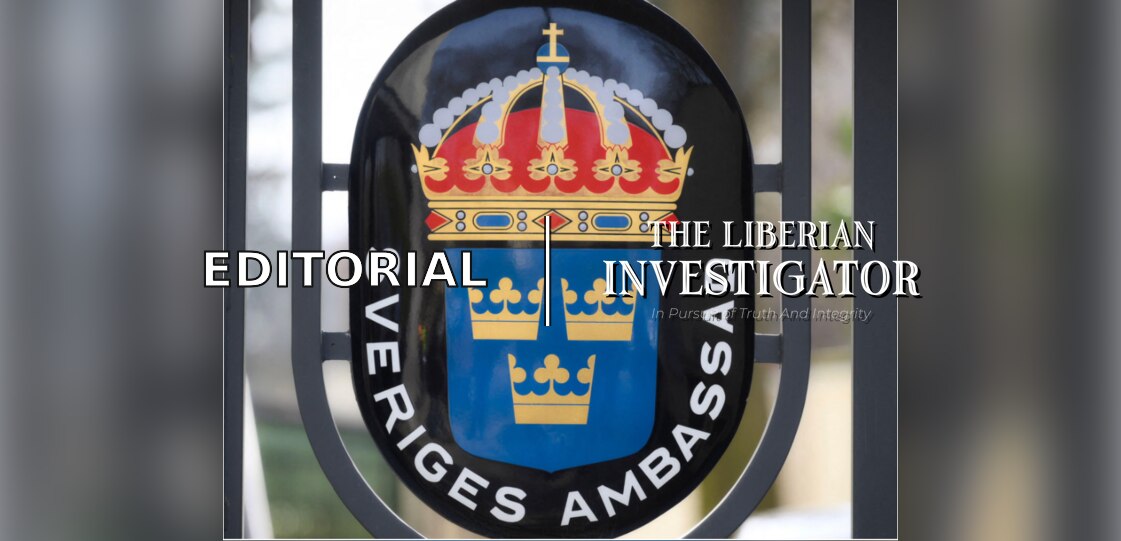
Sweden has closed its embassy in Monrovia and ended its bilateral development assistance to Liberia. What has departed is not merely a donor and a diplomatic flag. Liberia has lost one of the most consistent partners in its postwar recovery, and the country has been handed a brutally clear warning about the danger of allowing essential public functions to depend on decisions made in foreign capitals.
This is not only a health story. It is a story about roads connecting farmers to markets; electoral institutions protecting the vote; land governance reducing conflict; tax administration raising public revenue; renewable energy reaching neglected communities; young people finding work; forests, fisheries and mangroves being protected; and civil society holding power to account.
It is also a story about the Liberian state and whether, after more than two decades of peace, it can sustain important national programs when a benefactor leaves.
Sweden’s diplomatic relationship with Liberia dates to 1961, and its modern development partnership began in 2008 as the country struggled to rebuild after civil war. The Guardian reported that Sweden provided more than 5.77 billion Swedish kronor — about £445 million — and became Liberia’s second-largest donor after the United States.
Sida’s own account of its work in Liberia records 241.4 million Swedish kronor in assistance in 2025 alone. The agency supported cooperation between the Swedish Tax Agency and the Liberia Revenue Authority to improve tax administration. It backed transparent elections, local election observation and the strengthening of democratic institutions. It supported youth employment, agricultural productivity, market access and traceability, renewable electricity, sustainable forestry, coastal conservation and climate resilience.
Swedish assistance also reached places where national development plans too often remain promises. Under the Liberian-Swedish Access-Driven Rural Development Programme, Sweden committed funding to improve village access roads in Bong, Lofa and Nimba counties. Liberia’s Ministry of Public Works said the project was designed to improve about 195 kilometers of rural roads, connecting isolated communities to farms, markets, schools and clinics while creating local jobs.
In democratic governance, Sweden contributed 40 million kronor, then about US$4.8 million, to the Liberia Electoral Support Project for the 2021-2024 period. According to UNDP, the intervention emphasized credible elections, civic education, institutional accountability, peaceful voting and women’s political participation.
In land administration, Swedish cooperation helped strengthen county offices, technical systems and public awareness of customary and women’s land rights. In a country where land disputes routinely threaten livelihoods, investment and community peace, that work was not charity at the margins. It was support for national stability.
The loss is therefore larger than the closure of clinics or the cancellation of one grant, grave as those consequences are. Sweden helped fund parts of the machinery that allowed Liberia to govern, connect communities, protect rights and manage resources. Its exit leaves holes across that machinery.
Women and girls will, however, bear some of the harshest and most immediate consequences. The Guardian detailed the uncertainty facing organizations that provide family planning, support survivors of gender-based violence and defend bodily autonomy. The newspaper quoted Korto Williams, country director of Kvinna till Kvinna, as warning: “If you are investing in gender-based violence, that is not something that can wait.”
She is right. A survivor cannot postpone justice until a new donor is found. A rural woman cannot delay emergency care while ministries hold meetings. A girl at risk of abuse cannot wait for the next budget cycle.
Sweden has explained that its decision reflects reduced development funding and a decision to give greater priority to Ukraine. The Swedish government says humanitarian assistance will not be affected and that the bilateral phaseout is intended to lead to a new relationship centered more heavily on trade and shared foreign-policy interests. The embassy has also said the withdrawal is not a punishment for any Liberian policy or event and that some support will continue through the European Union and multilateral organizations.
Those assurances matter, but they do not replace bilateral programs or the institutional presence of an embassy able to engage the government, civil society and communities directly. Money routed through global institutions may still benefit Liberia, but it will not necessarily preserve the same projects, partners, priorities or level of access.
Sweden is entitled to determine how it spends Swedish taxpayers’ money. Liberia may reasonably regret the decision, but it cannot claim a permanent entitlement to another country’s aid. The harder question belongs in Monrovia: What did the Liberian government do after Sweden announced the phaseout in December 2025, and what has it prepared since?
The Executive must now publish a project-by-project account of Sweden’s development portfolio. Liberians deserve to know which programs have ended, which have bridging funds, which contracts and workers are affected, what equipment and assets will be transferred, which communities will lose services and how much money is required to prevent critical work from collapsing.
That disclosure should not be buried in a donor conference or reduced to a press release thanking Sweden for its friendship. It should be a formal transition plan led by the Ministry of Finance and Development Planning, with the ministries and agencies responsible for health, public works, agriculture, gender, elections, land, energy and environmental protection. The plan should identify programs the government will absorb, those that can be consolidated, and those for which replacement financing must be urgently negotiated.
The Legislature also has a duty. Its relevant committees should hold public hearings on the fiscal and institutional effects of Sweden’s withdrawal. Lawmakers should determine whether the current national budget protects indispensable services and whether wasteful or lower-priority spending can be redirected. A government that can find money for swollen delegations, political appointments and poorly explained discretionary spending cannot tell vulnerable communities that there is nothing available when a donor departs.
The government should also approach the European Union, other Nordic governments, the World Bank, African Development Bank, United Nations agencies and credible philanthropic institutions with specific, costed transition proposals. It should not arrive with a shopping list. It should present audited programs, measurable outcomes, domestic co-financing and a timetable for eventual Liberian ownership.
Local organizations must not be treated as expendable subcontractors. Many of them possess the community trust, trained personnel and field knowledge that ministries lack. Where their work serves a clear public purpose, government and successor partners should protect the institutional capacity already built instead of allowing experienced teams to disintegrate and attempting to recreate them years later at greater cost.
Finally, Liberia should take Sweden at its word about building a different relationship. The Ministry of Foreign Affairs and investment agencies should pursue a serious trade, technology and private-sector agenda with Stockholm. But trade cannot become a diplomatic slogan used to disguise retreat. Liberia must improve electricity, contract enforcement, customs administration, land security and anti-corruption safeguards if it expects Swedish companies or any responsible investors to take the country seriously.
The end of Swedish bilateral aid comes amid a wider contraction in foreign assistance. Liberia must assume that other programs will shrink or disappear. That reality makes domestic revenue reform, honest budgeting and competent public administration matters of national survival.
Sweden’s record deserves gratitude. But gratitude is not a transition strategy, and outrage is not a budget.
The most fitting tribute to the roads, institutions, organizations and public systems Sweden helped build is for Liberia to keep them working. The embassy may close. The Liberian state cannot.
