Published: September 2, 2026
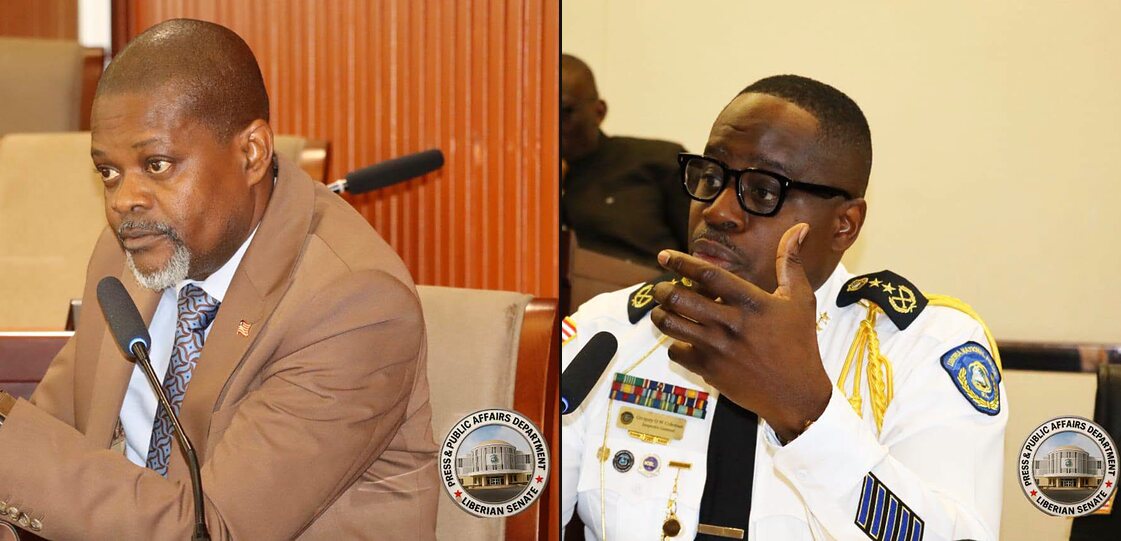
MONROVIA — Montserrado County Sen. Abraham Darius Dillon has given the Inspector General of Police until the end of this week to dismiss and prosecute the deputy commissioner for crime services over a bribe the IGP himself said the officer confessed to taking, warning that failure to act leaves his own credibility in question.
By Lennart Dodoo
The officer, identified as Johnny Dean, is accused of accepting US$10,000 from someone connected to the cocaine trafficking network under investigation, in exchange for easing conditions for suspects in custody. The disclosure came from Inspector General Col. Gregory Coleman on July 23.
Nearly two months later, Dean has not been charged and is under internal review by the police professional standards unit.
“The fact that it is not somebody else who alleged it, it is not somebody else, the police director says, somebody told him that Johnny received $10,000. The police director says Johnny confessed to him, the police director [IGP]. You don’t need no more evidence,” Dillon said on the OK Conversation on OK FM 99.5 on Tuesday.
“Johnny Dean is a subject fit for dismissal from the police. If Gregory does not do that, if he doesn’t take that action even before the close of this week, then Gregory has an issue with trust and confidence,” Dillon said.
Dillon, who describes himself as a member of the government and who spent 11 years at the Ministry of Justice as special assistant to a former solicitor general, said the delay is feeding the accusation that the narcotics investigation is being applied selectively.
“Johnny should be disrobed, dismissed from the Liberia National Police, and you should be prosecuted for bribery,” he said. “Then when you do that, you’re telling the people that no sacred cow, whether you’re small or big.”
“If you don’t do it now, then you give rise to the suspicion that this fight is selective,” he said.
Sen. Dillon contrasted the inaction with the speed shown elsewhere. When activist Martin Kollie made allegations against the head of the Liberia Drug Enforcement Agency, President Joseph Nyuma Boakai gave the Ministry of Justice and the joint security 48 hours to investigate and report back. Dillon said the investigation did not substantiate Kollie’s claim but found what he called indiscretion, or ethical issues, on the part of the LDEA head. The president acted within the 48 hours, he said. In Johnny Dean’s case, no presidential instruction is needed, because the officer falls under the Inspector General of Police’s own authority.
The senator extended the complaint to a list of people removed from office or held in custody in connection with the drug investigation, and about whom he said the government has told the public nothing since. He named former Deputy National Security Agency Director Patrick Doe, dismissed over the case, and a dismissed deputy at Roberts International Airport Mark Quiah. He also asked when the foreign nationals arrested in the case and now held as pretrial detainees at the Monrovia Central Prison will be brought to court.
“We as the government, through the joint security, owe it to the public and all of us to give an update on where the people are with this investigation,” he said.
“Just as we have all the cameras on Jewel and other people. Put the camera on the people too so the country can know that the fight is balanced and being fought without politics,” he said.
On the arrest of former Vice President Jewel Howard-Taylor, Dillon disclosed a personal connection before answering. Howard-Taylor hired him as her chief of staff when she was senator of Bong County, he said, and he considers her family. He said he received a missed call from her on the morning of her arrest, followed by a call from security authorities informing him of the action, and that he did not return her call because he did not want to appear to interfere.
He said the arrest itself was lawful but badly handled. Howard-Taylor, like other former presidents and vice presidents, is assigned Executive Protection Service officers, meaning her movements are known to the state.
“I would have done the arrest of Jewel or anybody in at her category or even lower than that differently,” he said. “They could have simply told the EPS people to hold her down at the house. That’s my view.”
He declined to say whether the prosecution is political. “The evidence will determine whether the fight against drugs was made political by us, the government, or whether we, the government, will prove that we went to prosecute a crime and not a political prosecution,” he said. “Nobody is above the law.”
Asked to speak to her character, he compared his position to a foreign ministry apostille, which certifies a signature but not a document’s contents. “I can vouch for Jewel to the extent that I know her,” he said.
Dillon maintained that the government is winning the wider drug fight, putting the decline in street drug use over the past two years at more than 90% and saying the government is succeeding “98%.” He argued that seizures of cocaine, which he said is trafficked through Liberia rather than sold into the local market, are being conflated with the campaign against locally consumed drugs, and that ghettos and open selling have largely disappeared. Callers challenged him, with one demanding data and asking what treatment programs exist in the counties. Dillon did not provide figures or name a source for the 90% estimate.
He also said the Senate will summon the Liberia Anti-Corruption Commission over a case against Bureau of State Enterprises officials that a judge dismissed for abandonment after prosecutors let two terms of court pass without proceeding. Dillon said the LACC now has direct prosecutorial powers and no excuse, and that proven negligence would be grounds for removal even of a tenured official.
“This government is not persecuting people. We are prosecuting people,” he said.
See more Liberia News Network stories in Google Search by adding LNN as one of your Preferred Sources.
★ Add LNN as a Preferred Source