
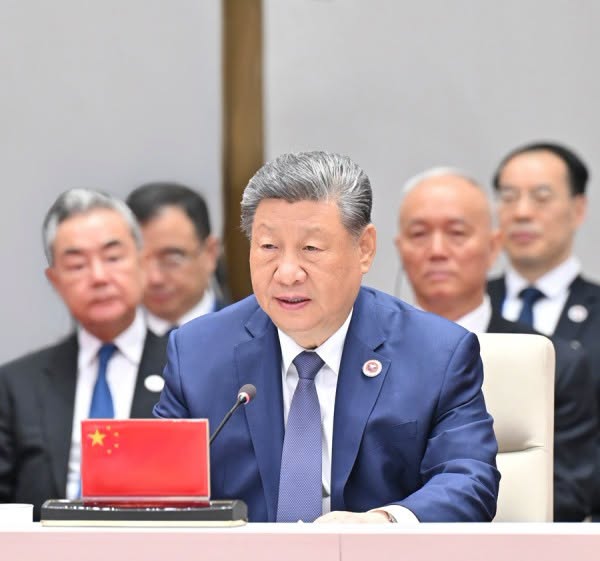
BISHKEK, Kyrgyzstan, September 2, 2026 — Chinese President Xi Jinping has called for deeper economic, technological and security cooperation among members of the Shanghai Cooperation Organization (SCO), pledging that China will implement 100 technology cooperation projects with member states over the next three years.
Xi made the commitment Monday while addressing the 26th Meeting of the Council of Heads of State of the SCO in Bishkek, where leaders marked the organization’s 25th anniversary and adopted a series of agreements covering security, economic development and regional cooperation.
The summit was chaired by Kyrgyz President Sadyr Zhaparov, whose country currently holds the SCO’s rotating presidency.
Among those attending were Russian President Vladimir Putin, Belarusian President Aleksandr Lukashenko, Indian Prime Minister Narendra Modi, Iranian President Masoud Pezeshkian, Kazakh President Kassym-Jomart Tokayev, Pakistani Prime Minister Shehbaz Sharif, Tajik President Emomali Rahmon and Uzbek President Shavkat Mirziyoyev.
In remarks titled “Toward Higher Quality Development of the Shanghai Cooperation Organization,” Xi outlined four priorities for the bloc, focusing on economic development, regional security, people-to-people relations and global governance.
Xi said SCO members should expand cooperation beyond traditional areas such as trade, investment, energy and connectivity to emerging sectors, including artificial intelligence, the digital economy, green industries and green mining.
He said China considers the SCO a priority for promoting cooperation under the Belt and Road Initiative and implementing its Global Development Initiative.
As part of that effort, Xi announced plans to establish an international artificial intelligence application cooperation center with SCO countries and a China-SCO port economic cooperation center in Tianjin.
China will also implement 100 technological cooperation projects with SCO member countries over the next three years, he said.
On security, Xi called for stronger regional coordination against terrorism, separatism and extremism, as well as transnational organized crime, drug trafficking and telecommunications fraud.
He also called for increased cooperation in information security, biosecurity and outer-space security.
Xi said China supports the early establishment of four SCO security centers designed to strengthen member states’ ability to respond to emerging threats.
Turning to people-to-people relations, the Chinese leader called for stronger cooperation among legislatures, political parties, educational institutions, think tanks, businesses and the media.
China, he said, plans to establish a China-SCO basic education cooperation center while continuing educational and cultural exchanges through programs including Confucius Institutes and Luban Workshops.
Xi also urged member states to resolve differences through dialogue and consultation and called for greater multilateral cooperation in addressing regional and global challenges.
Reflecting on the SCO’s 25-year history, Xi said the organization had developed into a major regional cooperation bloc based on what members describe as the “Shanghai Spirit” of mutual trust, mutual benefit, equality, consultation, respect for cultural diversity and common development.
He said the organization should maintain its approach of non-alliance, non-confrontation and not targeting third countries as geopolitical tensions increase globally.
SCO leaders, meanwhile, reaffirmed their commitment to strengthening cooperation in trade, investment, science and technology, energy, finance, industrial and supply chains, connectivity and regional security.
The leaders signed the Bishkek Declaration marking the organization’s 25th anniversary and approved amendments to the SCO Charter.
They also approved regulations establishing an SCO Universal Center for Countering Security Challenges and Threats and an SCO Anti-drug Center.
In total, the summit adopted 28 outcome documents covering security, economic cooperation, cultural and people-to-people exchanges and institutional development.
The meeting also agreed that Pakistan will assume the SCO’s rotating presidency for the 2026-2027 period.
The SCO currently brings together China, Russia, India, Pakistan, Kazakhstan, Kyrgyzstan, Tajikistan, Uzbekistan, Iran and Belarus, making it one of the world’s largest regional organizations by population and geographic coverage.
See more Liberia News Network stories in Google Search by adding LNN as one of your Preferred Sources.
★ Add LNN as a Preferred Source