
MONROVIA – Government property quietly loses public value when buildings decay, vehicles escape control and equipment disappears from official records. General Services Agency Director General Galakpai W. Kortimai’s reforms attempt to confront those weaknesses through renovation, tracking and enforcement. The Centennial Pavilion project offers the most visible test, with completion promised as broader maintenance needs remain across Liberia. Recovering unauthorized license plates and documenting county assets could also close longstanding gaps in national accountability and state revenue protection. Plans for a 5,000-seat National Convention Center and comprehensive fleet policy extend the agency’s ambitions beyond immediate repairs. Their credibility will depend on transparent costs, firm timelines and consistent enforcement across every branch of government. The Analyst’s George C. Flomo reports.
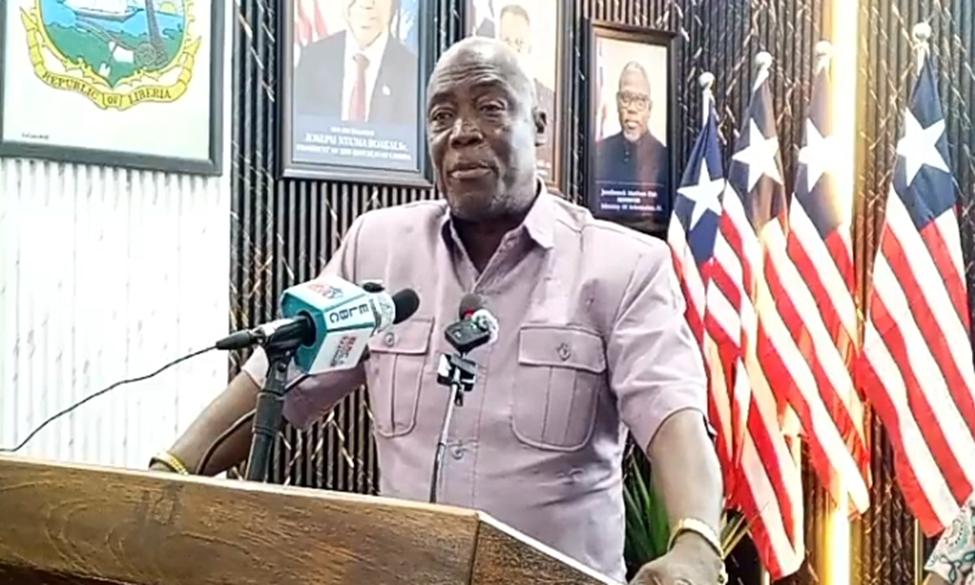
MONROVIA: General Services Agency (GSA) Director General Galakpai W. Kortimai has outlined several ongoing reforms and interventions aimed at strengthening government asset management, renovating public infrastructure, regulating government license plates and decentralizing the management of state properties across Liberia. He spoke Thursday at the Ministry of Information’s regular press briefing in Monrovia.
Kortimai stated that the GSA, as the custodian and manager of government assets, was undertaking several measures to ensure that public properties were properly documented, protected, maintained and used for the benefit of the Liberian people. According to him, the agency was moving beyond its traditional role of managing government properties by introducing systems that would provide greater accountability and efficiency in the management of state resources.
Pavilion Receives Complete Renovation
One of the major projects highlighted by Kortimai was the comprehensive renovation of the historic Centennial Pavilion, a structure constructed in the 1940s that has hosted several major national events. He explained that the building had historically received only partial repairs whenever national occasions, particularly Independence Day celebrations, were approaching.
Kortimai maintained that the practice of carrying out repeated partial renovations had contributed to the deterioration of the facility, including persistent leakage and other structural problems. Under the current administration, he explained, the decision had been made to undertake a complete renovation of the facility instead of continuing with temporary repairs.
“We have decided to do 100 percent full renovation of the compound,” Kortimai stated, noting that the project was already underway. He expressed optimism that the renovated facility would be dedicated by November.
Giving an update on the project, the GSA director general disclosed that the roofing component had been completed, while work on the bathrooms, plumbing and other facilities was approximately 50 percent complete. He added that electrical work was about 60 percent complete, with new wiring and other installations underway with support from the Liberia Electricity Corporation (LEC).
Painting, plastering and other finishing work was also progressing, Kortimai reported, with the project approximately 50 percent complete in those areas. He explained that the renovation was intended to give the building an entirely new appearance while addressing its longstanding structural weaknesses.
Kortimai disclosed that the drainage system around the facility was also being rehabilitated because portions of the existing drainage infrastructure had been damaged or covered over the years. He added that the agency was replacing materials damaged by years of water leakage and other environmental conditions, including ceiling and lighting components.
The GSA director general emphasized that the agency’s goal was to transform the Centennial Pavilion into a modern, durable and state-of-the-art national facility. He described the comprehensive renovation as a departure from the temporary repairs undertaken before major national celebrations.
Police Barracks Await Rehabilitation
Beyond the Centennial Pavilion, Kortimai stated that the GSA had identified several other government-owned buildings requiring urgent rehabilitation. He noted that many public buildings across the country had suffered years of neglect and deterioration, making renovation and maintenance priorities for the agency.
Among the facilities being considered for future rehabilitation, Kortimai identified police barracks as a major concern. According to him, some police barracks had not undergone significant rehabilitation since their construction, leaving security personnel to live in conditions that did not reflect the importance of their work.
Kortimai disclosed that the GSA hoped to include the rehabilitation of some of those facilities in the next budget cycle. “We can now have our security forces living in a special level of [facility] for officers, living in a place where we can actually have as a standard that people will be proud of,” he stated.
The agency intended to approach the renovation of government properties systematically rather than attempt to address all facilities at once, Kortimai explained. He indicated that the proposed rehabilitation would proceed according to the agency’s priorities and available resources.
County Asset Tracking Expands
Kortimai also disclosed that the GSA had begun strengthening its asset-management and tracking system outside Montserrado County. He revealed that the agency recently conducted a tour of several southeastern counties to determine the status of government-owned assets and improve cooperation between the GSA and county authorities.
According to him, the tour covered five counties and was designed to ensure that government properties, including equipment, computers, laptops and other materials purchased over the years, were properly identified, recorded and tracked. He explained that the initiative became necessary after the GSA discovered that some county authorities and government institutions were not fully aware of the agency’s mandate.
Kortimai stated that the GSA subsequently engaged superintendents and other local government officials to explain its functions and establish stronger collaboration. He described the outcome as encouraging, noting that GSA monitors in the counties now had improved access to government properties and were undertaking activities such as tagging and coding government equipment.
The new system was helping the agency determine which government assets were located in various parts of the country, Kortimai disclosed. He cited counties and locations in southeastern Liberia where the GSA could now provide information on government-owned equipment and properties, something he acknowledged had been difficult in the past because of inadequate records.
Unauthorized Plates Face Crackdown
Another major area of concern, according to Kortimai, was the misuse of government license plates. He disclosed that the GSA inherited a situation in which private individuals who were not entitled to government plates were using them on private vehicles.
Kortimai warned that the practice created confusion regarding the ownership and status of vehicles and could undermine government revenue collection and accountability. He announced that the GSA had established a task force, headed by the agency’s Deputy Director General for Operations, to identify and retrieve government plates being used improperly.
During recent enforcement operations, the task force retrieved more than 100 government license plates from private vehicle owners, Kortimai revealed. He warned that the enforcement exercise would continue without prior public announcement.
Vehicle owners found using unauthorized government plates should expect GSA enforcement teams to retrieve them, Kortimai cautioned. He commended the Liberia National Police (LNP) for supporting the exercise, stressing that cooperation from law enforcement was essential to the operation’s success.
The GSA director general also disclosed that the agency was working with the Judiciary to address the use of old and unauthorized government plates. He commended the Chief Justice of Liberia for issuing a memorandum requiring judicial institutions to report the government plates assigned to them.
Kortimai explained that the memorandum would assist the GSA in recovering old plates issued years ago that were still being used on vehicles. He acknowledged that retrieving government plates from members of the Judiciary required careful coordination, but maintained that the Chief Justice’s intervention was helping to resolve the problem.
The GSA was similarly working with the National Legislature on the replacement of old legislative license plates, Kortimai disclosed. According to him, the agency printed new plates for lawmakers, including separate plates designated for members of the House of Representatives and the Senate.
However, Kortimai reported that the agency had observed instances in which vehicle owners used one authorized plate while keeping another plate for use on a different vehicle. He stated that the GSA intended to meet with legislative authorities to address the issue and ensure that plates assigned to lawmakers were properly accounted for.
The agency would also intensify efforts to remove old license plates that remained in circulation, Kortimai added. He urged members of the public using government plates without authorization to surrender them, warning that enforcement teams would continue their operations.
Convention Center Plans Advance
In another major development, Kortimai disclosed that the government had begun preliminary work toward constructing a National Convention Center intended to decentralize major national and international activities currently concentrated in Monrovia. He stated that the initiative followed a commitment by President Joseph Nyuma Boakai, Sr. to establish facilities that would allow major national programs to be hosted outside the capital.
Kortimai explained that the concentration of major national activities in Monrovia had placed pressure on existing facilities, with the Ministerial Complex hosting many international programs. To address the challenge, he reported, an interagency committee had been established involving the Ministry of Public Works, the GSA and other relevant government institutions, including environmental authorities.
The committee was working on the technical and planning requirements for the proposed facility, Kortimai stated. He disclosed that the government had acquired approximately 50 acres of land for the construction of the National Convention Center.
According to Kortimai, the first phase of the project, involving the clearing of the site, had already been completed. The next phase would involve fencing the entire property to prevent encroachment.
The GSA director general stressed that protecting government land was critical, given the growing problem of encroachment on public properties across Liberia. He stated that the government intended to fence the property before major construction began.
Architectural and geotechnical work was also being undertaken, including soil testing and the preparation of preliminary designs, Kortimai disclosed. According to him, the proposed convention center was expected to accommodate at least 5,000 people at a time.
Plans also included a hotel and facilities representing all 15 counties, which Kortimai stated would form part of the broader development of the site. He explained that the next phase would include landscaping, construction of a borehole, expansion of the site and completion of the architectural designs before the project advanced to full construction.
The preliminary architectural concept and related documents were already being reviewed by the GSA, Kortimai disclosed. He noted that a more accurate cost estimate would be provided after completion of the foundational design and other technical assessments.
Kortimai stated that the proposed convention center formed part of a broader government effort to decentralize national activities and ensure that citizens outside Monrovia benefited directly from major government programs. He explained that the government intended to develop facilities capable of hosting major national programs in other parts of the country, allowing rural residents to participate in activities often concentrated in the capital.
The initiative reflected the administration’s desire to ensure that development and government services were not limited to Monrovia, Kortimai maintained. He identified the proposed convention center as one of the facilities intended to advance that objective.
Fleet Policy Targets Accountability
Kortimai also disclosed that the GSA was preparing a comprehensive government fleet policy to regulate the acquisition and use of government vehicles. He stated that the agency had been reviewing and improving the existing fleet policy and intended to present a more comprehensive framework to the government in the coming weeks.
The policy was expected to establish clearly which categories of government officials were entitled to particular classes of vehicles, Kortimai explained. He stated that the framework would cover the President, Vice President, Chief Justice, legislative leaders, ministers, deputy ministers and other government officials.
According to Kortimai, the objective was to eliminate confusion and ensure that government vehicles were assigned according to clearly defined standards. He maintained that the policy would provide a consistent framework for managing the government’s vehicle fleet.
Kortimai further disclosed that the agency was developing a resource-mobilization framework that could introduce a more structured approach to the management and use of government assets. He stated that the proposal had already been prepared and was expected to be submitted to the Cabinet for consideration and endorsement.
The initiative was based on the principle that government assets should be properly valued, managed and protected, Kortimai explained. He stated that once the proposed policy was approved, it would help the government generate resources from appropriate state assets while ensuring that those assets remained protected and accountable.
Kortimai stressed that the GSA was seeking to modernize its operations through new policies and systems rather than relying solely on traditional approaches to government asset management. Throughout his presentation, he emphasized that the agency’s ongoing reforms were intended to improve accountability in the management of government property.
The agency was working to establish proper records for government assets, protect public land, regulate government vehicles and license plates, renovate public buildings and improve coordination between Monrovia and county-level authorities, Kortimai stated. He maintained that the reforms were part of a broader effort to ensure that government property was treated as a national resource and managed in a manner that benefited the Liberian people.
“As we have come today again, distinguished members of the press, to inform you, the work is on,” Kortimai stated, emphasizing that the GSA would continue implementing its reforms and reporting progress to the public. With the renovation of the Centennial Pavilion, expanded asset tracking in the counties, the crackdown on unauthorized government plates, preparations for a National Convention Center and the development of new fleet and resource-management policies, the GSA says it is positioning itself for a more modern and accountable system of government asset management.
See more Liberia News Network stories in Google Search by adding LNN as one of your Preferred Sources.
★ Add LNN as a Preferred Source