
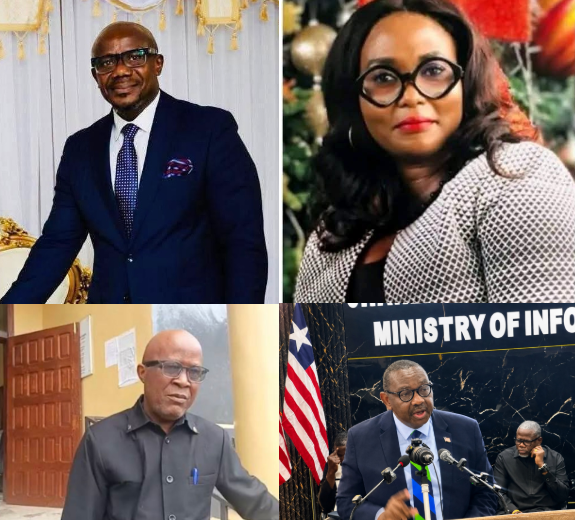
MONROVIA — President Joseph Nyuma Boakai has replaced his Minister of Justice and Attorney General, along with his Solicitor General, hours after former President George Weah returned to Liberia to a large reception — one at which supporters awaiting him at Rehab Junction reportedly booed the President as his convoy passed.
Rodney D. Sieh, [email protected]
Cllr. N. Oswald Tweh has been replaced as Minister of Justice by Cllr. Betty M. Lamin-Blamo. Solicitor General Augustine Fayiah has been replaced by Cllr. Abrahim Boimah Sillah Sr. The Executive Mansion said Tweh and Fayiah would be reassigned elsewhere in government, and did not cite the Weah homecoming, the Rehab Junction gathering, or the reported booing as reasons for the changes.
The timing has nonetheless fueled speculation that the dismissals may trace to a disagreement over how the area should have been handled — whether it should have been cleared of Weah supporters before the former president’s arrival, or kept clear until President Boakai, who also lives in the Rehab area, had passed through. There has been no official confirmation that such a disagreement occurred.
What happened at Rehab Junction
The Liberia Airport Authority had announced special security measures ahead of Weah’s arrival, anticipating large crowds. Supporters gathered at Rehab Junction to await him, and reports say President Boakai was booed twice as his convoy passed through. The following morning, government authorities demolished stalls at the junction, with a large contingent of armed police visible in the area. The government has not said publicly whether that operation was connected to the previous day’s gathering.
The distinction matters: the stall owners are not necessarily the same people who allegedly booed the President, and no official account has identified who did. If the demolition was a previously scheduled operation — tied to traffic, sanitation, public health, commercial regulation, or urban planning — the government has yet to say so. If it was ordered in response to Wednesday’s gathering, questions remain about its legal basis and whether owners received prior notice. The developments have also left open whether future Weah-linked gatherings will be permitted at the junction; no such policy has been announced.
The new Justice Minister: a familiar hand in government litigation
Cllr. Betty M. Lamin-Blamo returns to the Justice Ministry with a track record at the top level of state litigation. She served as Solicitor General under former President Ellen Johnson Sirleaf, appointed in 2014, and represented the Government of Liberia before the Supreme Court in a number of cases, including Thirteen Grand Gedians v. Republic of Liberia, Vrex Remodeling Inc. v. Liberia Petroleum Refining Company, and Selena Mappy Polson, Superintendent of Bong County v. The Government of the Republic of Liberia.
She is also the official who previously explained the government’s decision to enter a nolle prosequi — a formal discontinuance of a criminal case — against the Liberia Bank for Development and Investment, in the matter arising from allegations involving former Roberts International Airport Managing Director Ellen Corkrum. Lamin-Blamo said at the time that the case was dropped without prejudice, after LBDI agreed to cooperate with the government as a witness. Her return puts a former Solicitor General, well versed in the machinery of state prosecution, at the head of the ministry that oversees it.
The new Solicitor General: an opposition defender now representing the state
Cllr. Abrahim Boimah Sillah Sr. arrives from private practice, where he is Managing Partner of Heritage Partners & Associates and has practiced law for more than 13 years. He also teaches Evidence and Environmental Law at the Louis Arthur Grimes School of Law, and has represented clients in civil, commercial and criminal matters.
Notably, Sillah was part of the defense team for opposition politician Alexander Cummings in the criminal proceedings tied to the Collaborating Political Parties’ framework document — a case Cummings’ lawyers called a “witch hunt” and in which they fought prosecutors’ efforts to compel Cummings to hand over evidence against himself. Sillah now becomes the government’s principal lawyer for prosecutions handled through the Solicitor General’s office — a former defense counsel for a sitting opposition figure now directing the state’s own prosecutorial machinery.
What the new team inherits
Lamin-Blamo and Sillah step into a ministry already carrying some of the most politically charged cases in Liberia in years.
A Joint National Security Investigative Task Force — drawing on the Liberia Drug Enforcement Agency, Liberia National Police, National Security Agency, Executive Protection Service, Financial Intelligence Agency, Liberia Immigration Service, Customs and other bodies — is investigating major cocaine seizures reportedly worth roughly US$19.2 million and US$317.6 million. Tweh had been one of the government’s leading public voices on that investigation before his removal.
The government has also charged former Vice President Jewel Howard-Taylor in an alleged transnational narcotics-trafficking case; she was charged on August 19, and the allegations remain before the courts. The new Justice Ministry leadership inherits the prosecution of both that case and the broader narcotics investigation.
Police Inspector General Gregory O.W. Coleman remains involved in that investigation as well. Coleman and Tweh had jointly rejected allegations in July linking President Boakai’s son, Joe Boakai Jr., to the cocaine seizures, with officials saying investigators found no evidence tying him to either shipment. Even so, Coleman has faced calls to recuse himself — the Liberian People’s Party has demanded his recusal and an independent inquiry, and other critics have questioned whether he should remain in the investigation while heading the national police. These calls do not amount to a finding of wrongdoing against Coleman; the concern is whether his continued role affects, or appears to affect, the independence of an inquiry touching people and institutions connected to the police.
Weah’s return, and an opposition on the offensive
Weah’s homecoming on Wednesday drew heightened security and large crowds along his route and at his Rehab residence. Addressing supporters there, he accused the Boakai administration of interfering with justice and dismissed the prosecution of Howard-Taylor as bogus. His remarks add to a chorus of opposition figures questioning the government’s handling of criminal cases; Cummings, for his part, visited Howard-Taylor and called for a prosecution that is swift, transparent and non-selective. The Boakai administration maintains that its investigations and prosecutions rest on evidence, not politics.
What remains unanswered
The government has not publicly linked the Justice Ministry changes to the events surrounding Weah’s return, nor explained the Thursday demolition at Rehab Junction. Several questions remain open: Was there an order to clear the area before Weah’s arrival, and if so, from which agency? Did Justice Ministry officials disagree over how to handle the gathering, and were Tweh or Fayiah involved in that decision? When was the demolition authorized, and was it planned independently of Weah’s arrival? Were stall owners given notice? And was Thursday’s police deployment tied to the demolition, the previous day’s gathering, or a separate operation entirely?
What is established is the sequence of events: Weah returned on Wednesday; supporters gathered at Rehab Junction; President Boakai was reportedly booed as his convoy passed; the Justice Minister and Solicitor General were replaced; and stalls at the junction were demolished the following morning under heavy police presence. The government has not connected these events publicly, but their proximity is difficult to ignore.
The stakes for Liberia’s justice system
The new leadership takes charge of an institution now at the center of the country’s corruption and narcotics prosecutions, at a moment when the credibility of those cases is already under public strain. Lamin-Blamo’s background in state litigation and Sillah’s experience defending an opposition figure against the state give the ministry a notably different professional character than the team it replaces. Whether that translates into a different approach to the Howard-Taylor case, the broader narcotics investigation, or the handling of politically sensitive prosecutions more generally will become clearer only as those cases move forward — and as the government addresses, or continues to leave unaddressed, the questions still hanging over Rehab Junction.
See more Liberia News Network stories in Google Search by adding LNN as one of your Preferred Sources.
★ Add LNN as a Preferred Source