
Monrovia – Liberia’s justice system cannot prosecute corruption, organized crime or wartime abuses when witnesses fear retaliation for telling the truth. The Witness Protection Agency’s proposed amendments therefore address a weakness that reaches beyond institutional procedure and affects credible prosecutions. Director Teklo Maxwell Grigsby II says existing laws provide limited deterrence, weak incentives and inadequate protection outside Monrovia. Legislative support from Speaker Richard Nagbe Koon gives the reform momentum, but passage alone will not secure vulnerable citizens. Funding, confidentiality, trained personnel and nationwide protection capacity will determine whether the promised safeguards work beyond conference rooms. The final legislative engagement places responsibility squarely before lawmakers as Liberia prepares institutions confronting corruption, trafficking and grave crimes, as The Analyst reports.
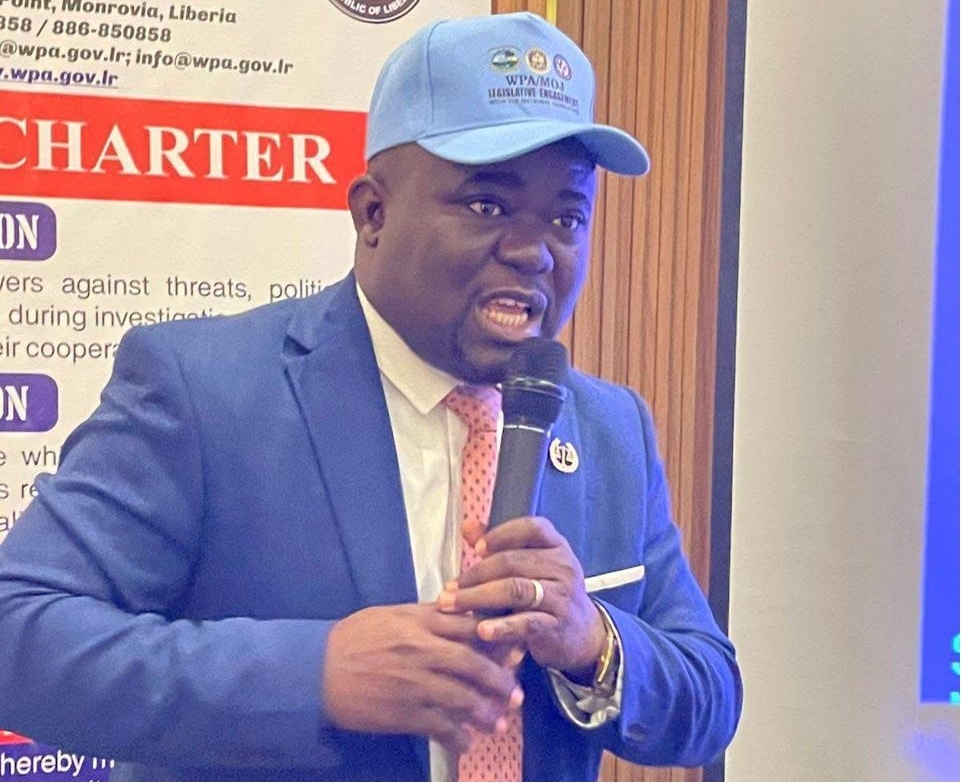
MONROVIA: The Witness Protection Agency (WPA), in coordination with the Ministry of Justice, has concluded a one-day legislative engagement with relevant committees of the National Legislature on proposed amendments to the Witness Protection Act of 2021 and the Whistleblower Act of 2021. Held at the Boulevard Palace Hotel in Monrovia, the engagement was the third and final in a series of consultations on the reform and brought together lawmakers, anti-corruption and rule-of-law institutions, civil society organizations and international development partners.
Agency Seeks Stronger Laws
Opening the engagement, WPA Director Atty. Teklo Maxwell Grigsby II traced the reform to the condition in which the agency was found. Although the two Acts of 2021 established the legal framework for protecting witnesses and whistleblowers, the agency remained largely inactive for years, without leadership, staff or the means to protect a single witness.
That changed in late 2025 with the completion of the recruitment process and the appointment of the director and deputy director. The agency subsequently recruited staff, constituted a secretariat, established operating procedures and developed a protection program covering the three phases during which witnesses are most at risk: investigation and pre-hearing, trial and post-trial.
Grigsby acknowledged that the agency began “with modest resources and a mandate considerably broader than the means placed at our disposal.” Against this background, President Joseph Nyuma Boakai, Sr. issued a Cabinet directive on March 25, 2026, calling for amendments to the Whistleblower Act to incentivize reporting, combat smuggling and strengthen accountability in the mineral sector.
The reform process began on May 5 with a high-level technical review involving the Ministry of Justice. It continued with a stakeholders’ engagement at Monrovia City Hall on July 3, involving 59 institutions and approximately 120 participants from government, civil society, the media and the donor community.
The consultations subjected the proposed reforms to substantive scrutiny, including questions concerning the composition of the proposed Board of Advisors, grounds for removing the director and deputies, leadership eligibility and definite implementation timelines. Grigsby explained that these issues were carried into the final engagement “because it is here that the matter is decided.”
Explaining the need for the amendments, Grigsby pointed to the agency’s operating experience, noting that its mandate was narrower than the threats it presently confronted. He also maintained that penalties for retaliation and the unlawful exposure of protected identities remained too weak to deter such conduct.
The director further stressed that the agency’s protection capacity remained concentrated in Monrovia, leaving citizens in counties such as Nimba, Lofa and Grand Kru with limited assurance that the state could reach and protect them when they provided information critical to justice. He also noted that existing digital safeguards had not kept pace with the speed at which reporting persons could be tracked and exposed, while the current five-percent whistleblower incentive was too modest to make coming forward “a rational decision rather than an act of sacrifice.”
Legislature Promises Prompt Action
Delivering special remarks, House Speaker Richard Nagbe Koon thanked the agency and the Ministry of Justice for the invitation. He told the gathering that the matter before it went directly to a core constitutional responsibility of the Legislature, specifically the enactment of laws that protect the rights and interests of the people.
A law becomes powerful, Koon declared, when it protects the citizen who knows something and must decide whether to come forward. “Corruption does not confess itself,” the Speaker observed, adding that economic crimes do not surrender themselves willingly and organized wrongdoing rarely leaves the full truth with those responsible for it.
Koon expressed dissatisfaction that the existing framework offered such citizens insufficient assurance that the state would stand with them against those they might expose. He declared that this must change.
Turning to the proposed amendments, the Speaker stated that their enactment would strengthen the agency’s capacity to provide protection in proceedings before the proposed Anti-Corruption Court and the War and Economic Crimes Court. The credibility of those institutions, he cautioned, would depend on the quality of evidence presented before them and whether witnesses and victims believed they could testify truthfully and return to their communities without fear of intimidation, retaliation or harm.
Witness protection must therefore be regarded as an essential pillar of justice and not merely as an administrative function, Koon maintained. He emphasized that Liberia’s laws must conform to its international obligations, including the United Nations Convention against Corruption, the United Nations Convention against Transnational Organized Crime and the Convention against Torture.
Accordingly, the Speaker commended the WPA, Liberia Anti-Corruption Commission (LACC) and Ministry of Justice for acting on the President’s directive. He also gave the forum a firm assurance that, upon formal submission, the relevant committees of the House would accord the bills prompt, thorough and fair consideration in keeping with legislative procedure.
Koon further committed his office to working with the Office of the President Pro Tempore of the Senate to encourage orderly and coordinated consideration by both Houses. He reminded the gathering that legislation alone would not be enough and that the laws passed must be properly implemented.
Lawmakers Identify Protection Priorities
For his part, House Committee on Judiciary Chairman Representative Johnson S. N. Williams, Sr. stated that he was honored to witness the nation move again to improve its justice system. Difficulties in obtaining facts during investigations and hearings, he noted, had long impeded access to justice in Liberia.
Williams maintained that because Liberian jurisprudence required the state to prove allegations beyond a reasonable doubt, the amendment and restatement of the two Acts must be acted upon immediately. As the process advanced, he urged particular attention to shelter-in-place arrangements for witnesses, the maintenance of confidentiality and integrity, and psychological support.
The lawmaker warned that organized crime syndicates, criminal cartels and powerful defendants might target witnesses or their families with threats capable of forcing many to withdraw their cooperation. He therefore pressed for safeguards strong enough to protect people throughout their involvement in investigations and judicial proceedings.
The Office of the United Nations High Commissioner for Human Rights (OHCHR) commended the agency, Ministry of Justice and Legislature for initiating the dialogue. It emphasized that witnesses, victims and whistleblowers were indispensable to credible investigations and fair prosecutions.
Their safe participation, OHCHR noted, would be essential to the credibility of the proposed War and Economic Crimes Court and the anti-corruption court framework. Protection, it stressed, must be timely, adequately resourced and responsive to the circumstances of each individual and family.
OHCHR called for particular attention to women, children, survivors of sexual and gender-based violence, persons with disabilities and other marginalized groups. It also announced the imminent deployment of an international witness-protection expert who would work under Grigsby’s leadership in the coming weeks.
Institutions Demand Effective Implementation
Representing the Center for Transparency and Accountability in Liberia (CENTAL), Executive Director Anderson D. Miamen described the engagement as an important step toward ending impunity for corruption, war and economic crimes, drug trafficking and human rights violations. He welcomed the proposed establishment of a joint whistleblower and witness protection agency.
Miamen called for the process to be holistic, realistic and evidence-based. He urged that the new agency be financially and operationally independent, with competitive recruitment, strong safeguards for the confidentiality of complaints and identities, predictable financing through the national budget and the incentives provided under the law.
Similarly, Law Reform Commission Executive Chairperson Cllr. Bornor M. Varmah endorsed the proposed amendments, telling lawmakers plainly: “We cannot ask citizens to be courageous while the state cannot protect them.” While the 2021 laws were a good start, he stated, new challenges demanded stronger protection, better coordination and a direct response to retaliation.
Varmah pledged the commission’s support to the 55th Legislature in passing reforms that would build public trust in the justice system. His intervention reinforced calls for the legal amendments to be matched by practical protection capacity.
Stakeholders further urged full implementation of the existing Act so that people already supporting ongoing prosecutions could receive the protections guaranteed under the current law. The agency reiterated its zero-tolerance position on identity leaks, warning that exposing protected individuals carried severe criminal penalties.
The WPA confirmed that recommendations compiled during the engagement would directly inform the final draft of the amendment package. It also pledged to continue working closely with the Ministry of Justice, LACC and National Legislature to secure enactment of the final bill.
The message emerging from the engagement was unmistakable: effective justice cannot be achieved without effective protection. When Liberia calls upon its citizens to speak, it must also have the courage to stand with them.
See more Liberia News Network stories in Google Search by adding LNN as one of your Preferred Sources.
★ Add LNN as a Preferred Source