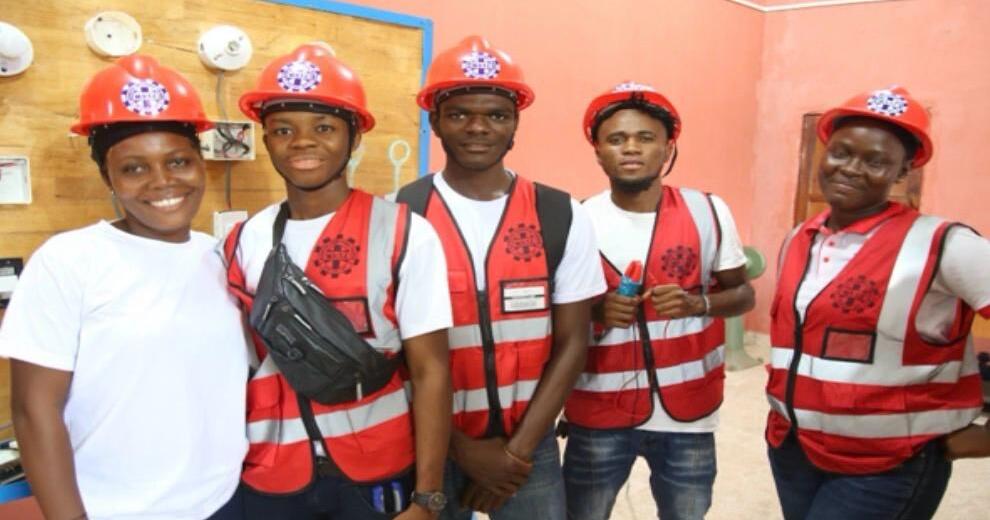

For Faith Wilson, electricity was once something she knew almost nothing about.
Before enrolling at the Monrovia Vocational Training Center (MVTC), she had never connected an electrical circuit, installed a receptacle or worked with electrical tools. Electricity was simply a trade she wanted to understand.
Today, Wilson can connect a single-pole circuit and perform basic electrical installations on her own.
For her, the change is not just about learning a trade. It is about discovering that she can do something she once thought was beyond her.
“I never had any knowledge of electrical work,” Wilson said. “But in MVTC, I’ve learned so many things. On my own, I can fix a single-pole circuit. I can connect a single-pole circuit, receptacles, switches and other things.”
Her experience highlights a broader challenge facing young Liberians pursuing technical and vocational education: earning a certificate is important, but developing practical, job-ready skills is what can truly open doors to better employment opportunities and a more secure future.
At MVTC, efforts supported through the STRIVE Project are helping move electrical training in that direction by connecting what students learn in the classroom with what they are expected to do in the field.
Funded by the Agence Française de Développement (AFD) and implemented by the European Institute for Cooperation and Development (IECD), the EUR10 million STRIVE Project (Strengthening Integration through Vocational Education) supports skills development and economic inclusion, with a focus on improving young people’s employability in Liberia.
At MVTC, one of the most significant changes has been the development and introduction of a structured electricity curriculum.
Before the intervention, according to Stanley S. Karmo, Assistant Director for Training at MVTC, electrical training was being conducted without a dedicated curriculum.
“We were running our electricity training in the absence of curriculum,” Karmo said. “The STRIVE project brought on board the curriculum, which shifted our training quickly and made it more impactful.”
The difference, he said, is that students are no longer simply being exposed to practical work. Their practical learning is now organized in a sequence that allows them to understand what they must learn, what they must demonstrate and what they need to master before progressing to the next level.
“It has brought more quality to the learning,” Karmo explained. “The guy was doing practical then, but now the practical is structured to the extent that the learner knows exactly what he or she must do and how they must do it to reach the next stage.”
For Wilson, that practical exposure has already begun to change the way she sees herself.
One of her first experiences outside the classroom came when a classmate invited her to join them on an electrical job.
“I was excited,” she recalled. “I’m doing electricity, so I should go there.”
Although she had little experience at the time, the opportunity gave her a chance to begin applying what she was learning.
She now believes the skills acquired at MVTC can give her a pathway into employment—or eventually allow her to create something of her own.
“I already know that I am an electrician, and I already know that I am able to do this job,” she said. “With these skills that I have learned from MVTC, I just want to have the confidence to go on.”
Wilson’s story also illustrates another important dimension of vocational training: breaking down assumptions about who can do certain jobs.
She said her participation in activities associated with the STRIVE Project changed some of her own perceptions about gender and work.
“I got to know a lot of things that men can do and women can also do,” she said. “The STRIVE project has shifted my mind from limiting people to certain things and put me on the right track.”
For Reuben J. Donkpain, a graduate and STRIVE-IECD beneficiary, vocational training has gone beyond classroom instruction.
He said the training helped him identify a business opportunity in his community.
Donkpain noticed that residents had to travel long distances to purchase electrical materials and equipment. He saw an opportunity to bring those products closer to the people who needed them.
“I observed the need for electrical devices and other electrical materials,” he said. “So I decided to venture into such a business.”
For him, that is what skills development means in practical terms: not waiting indefinitely for someone to offer a job but having the ability to identify a need and build an income around it.
Changing the way instructors teach
The transformation is also being felt on the other side of the classroom.
Ecarus K. Douglas, an instructor and Head of the Electrical Shop at MVTC, said the STRIVE intervention has changed not only what is taught, but how it is taught.
He was among instructors who benefited from pedagogical and technical training under the project.
Douglas said the training strengthened instructors’ ability to develop lesson plans, read and apply curricula, organize schemes of work and use more learner-centered teaching methods.
“Taking a lesson from the curriculum to the scheme of work, from the scheme of work to the lesson plan was a new strategy and an improved one that shaped our learning environment seriously,” he said.
The traditional approach, he explained, often placed the instructor at the center of the classroom.
“Before it was just a trainer standing, talking, talking,” Douglas said. “But this trend is like the trainer demonstrates; the student also does, with group learning and participation.”
That changes matters because employers do not simply need young people who can explain electrical concepts. They need technicians who can perform tasks safely, correctly and according to accepted standards.
Douglas believes the current curriculum is strongly connected to those industry requirements, saying roughly 80 to 90 percent of the curriculum is now being implemented in the electrical department.
December McCooper, another electricity instructor, said the competency-based approach has also changed his understanding of effective teaching. This method, which is a combination of knowledge, skills and attitude, assists learners to demonstrate that they can successfully perform a task or activity according to established standards.
He recalled that instructors previously relied heavily on syllabus developed within departments because there was no dedicated electricity curriculum.
Under the new approach, he said, instructors are encouraged to allow students to take a more active role in learning through hands-on exercises.
“At the beginning of the training, I was actually feeling so weak and tired going to class, explaining more and more the lesson,” McCooper said. “But from the competency-based training, I realized that you are not there to do more, but you allow the trainee to do the hands-on.”
The result is a classroom that increasingly resembles the workplace students hope to enter.
Beyond the classroom
The changes at MVTC are part of a wider effort to make Liberia’s TVET system more responsive to the labor market.
The STRIVE Project has also supported equipment and infrastructure at MVTC, including improvements to the electrical training environment. The project has additionally equipped and furnished the National Hospitality Training Center at the Ministry of Youth and Sports and other centers to include LOIC Monrovia, Maryann Cheeseman, AVTP, BWI, LOIC Buchanan, Tumutu Agricultural Vocational Training Centre, LOIC Gbranga.
For Karmo, the next frontier is to ensure students can move beyond basic residential electrical work into areas where demand for skilled workers is growing.
He pointed to industrial electricity, solar technology, programmable logic controllers and other modern systems as areas that require greater attention.
“If you go into the electrical environment now, electricity is moving to more simulation approaches,” he said. “PLC, programmable systems—that is where we want to reach. That is what the industry is really demanding.”
The ambition is bigger than producing employees.
Karmo wants graduates to leave training with enough technical and entrepreneurial capacity to create their own opportunities.
“I expect that learner to be able to start a small electrical business,” he said. “He will have to do his entrepreneurial skills so that he can create employment, not only wanting to be employed, but he can also create employment for himself and other people.”
That is perhaps the clearest measure of whether vocational education is working: what happens after students leave the classroom.
For young people such as Wilson, the journey is still underway. She has not yet reached the end of her career, but she has already crossed an important line—from knowing nothing about electrical work to being able to perform it.
Her message to other young people considering TVET is simple.
“You should be patient,” she said. “Once you are patient, you will do your best.”
In a country where thousands of young people enter the labor market each year, that combination of patience, practical skills and confidence could matter enormously.
Because the real promise of TVET is not the certificate hanging on a wall.
It is the moment when a young person can look at a machine, a wiring system, a customer or a workplace and say: I know how to do this.
And perhaps, even more importantly: I can make a living from it.
See more Liberia News Network stories in Google Search by adding LNN as one of your Preferred Sources.
★ Add LNN as a Preferred Source