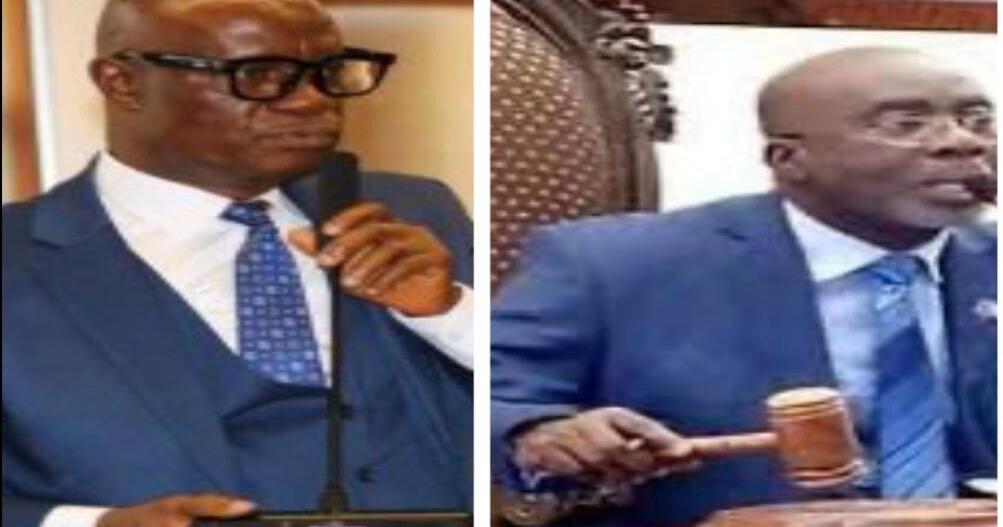

Nimba County Senator Samuel G. Kogar has extended an olive branch to former House Speaker J. Fonati Koffa, signaling a possible reconciliation between two political figures whose names became closely associated during a major legislative leadership crisis.
Kogar, a former Representative of Nimba County Electoral District #5 and former Chairman of the House of Representatives’ Majority Bloc, publicly expressed his willingness to apologize to Koffa, marking a significant shift from the political confrontation that once defined their relationship.
“I’m not too big to say sorry concerning whatever happened between me and former Speaker Cllr. J. Fonati Koffa, in the past. I’m not big to say sorry,” Kogar said recently at a political gathering.
He also suggested that reconciliation efforts may already be underway.
“So those who are so concerned about me and Fonati, dah y’all worry…! Hayaka! We’re gradually getting there,” he said.
The remarks have generated political interest, particularly because Kogar played a prominent role in the legislative struggle surrounding Koffa’s speakership.
As Chairman of the Majority Bloc, Kogar became a key figure in efforts by lawmakers challenging Koffa’s leadership. The dispute developed into a broader confrontation that divided members of the House of Representatives into competing political and legislative blocs.
The crisis tested parliamentary authority, legislative procedures, caucus discipline and the balance of power within the National Legislature, dominating political discussions for months.
Kogar was firmly positioned against Koffa during that period. His current willingness to apologize therefore represents a notable change in tone and could open the door to renewed dialogue between the two politicians.
While it remains unclear whether the gesture will result in a full political reconciliation, Kogar’s public remarks suggest a willingness to move beyond their previous differences.
Menipakei Dumoe, a former Political Director to Speaker Koffa, described Koffa as a forgiving leader who places broader party interests above personal disagreements.
“Rep. Koffa is a forgiving leader and he believes in the Party before personal differences,” Dumoe said.
The statement could provide an opening for further discussions between the two men, although whether personal forgiveness will translate into political cooperation remains uncertain.
Kogar’s overture comes at a politically sensitive time following his expulsion from the Movement for Democracy and Reconstruction (MDR) and his subsequent engagement with the Coalition for Democratic Change (CDC).
The developments have raised questions about Kogar’s political future and the possibility of changing alliances within Liberia’s opposition ahead of the 2029 elections.
Kogar’s political career has taken him from the House of Representatives, where he emerged as an influential legislative actor, to the Senate, where he continues to maintain political influence.
His experience in legislative negotiations, caucus politics and constituency mobilization could make him an important figure in future opposition coalition-building efforts.
His engagement with the CDC has consequently attracted attention as political parties and opposition figures begin positioning themselves for the next electoral cycle.
It remains unclear whether Kogar’s relationship with the CDC will develop into a long-term political alliance or form part of a broader political realignment.
His movements have prompted debate over party loyalty, political consistency and coalition discipline. However, allegations that his political repositioning amounts to “spying” or “mercenary politics” remain political claims and should not be treated as established facts without supporting evidence.
Kogar’s possible reconciliation with Koffa also comes at a time when Liberia’s political actors are expected to intensify efforts to build alliances and consolidate support ahead of 2029.
A rapprochement between the two politicians could therefore have implications beyond their personal relationship, particularly if it develops into broader political cooperation.
The question is whether two politicians who once stood on opposite sides of a bitter legislative confrontation can now find common ground.
For Kogar, rebuilding relationships with former political allies and adversaries could become an important part of his evolving political trajectory.
Whether his engagement with the CDC becomes permanent, whether trust can be restored with Koffa and whether the current overture develops into meaningful political cooperation remain unanswered questions.
For now, however, Kogar appears determined to leave the door open.
“I’m not too big to say sorry,” he said.
For a politician who once occupied a central position in one of Liberia’s fiercest legislative power struggles, the admission represents a significant change in tone.
Whether it becomes the beginning of genuine reconciliation or remains a gesture of personal goodwill will depend on what follows.
For now, Kogar says progress is being made: “We’re gradually getting there.”
See more Liberia News Network stories in Google Search by adding LNN as one of your Preferred Sources.
★ Add LNN as a Preferred Source