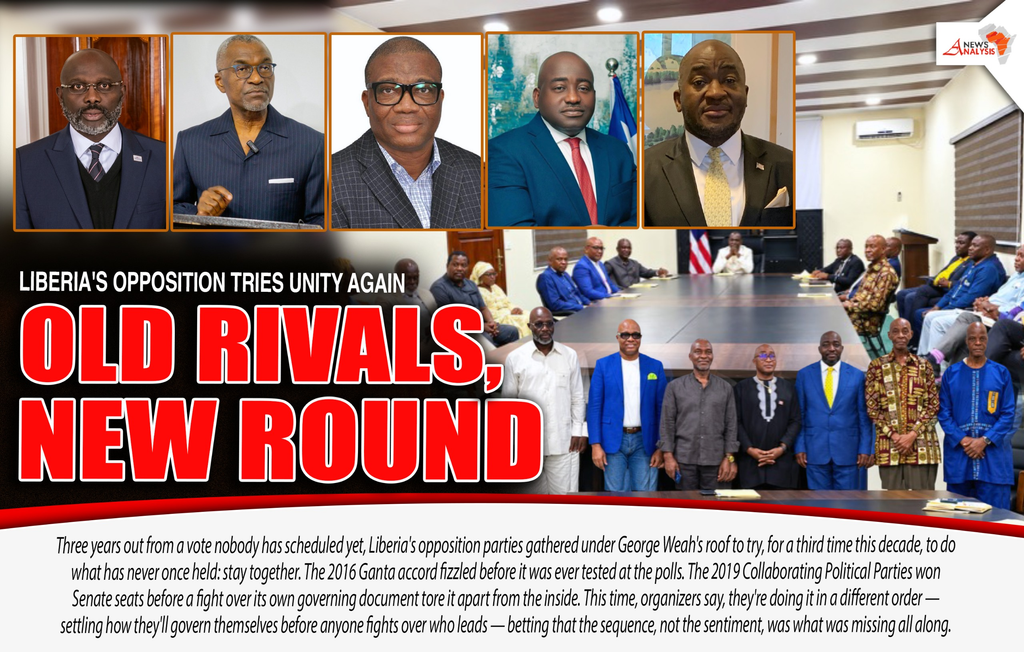
Three years out from a vote nobody has scheduled yet, Liberia’s opposition parties gathered under George Weah’s roof to try, for a third time this decade, to do what has never once held: stay together. The 2016 Ganta accord fizzled before it was ever tested at the polls. The 2019 Collaborating Political Parties won Senate seats before a fight over its own governing document tore it apart from the inside. This time, organizers say, they’re doing it in a different order — settling how they’ll govern themselves before anyone fights over who leads — betting that the sequence, not the sentiment, was what was missing all along.
The venue was the Jamaica Resort in Thinker’s Village, Paynesville, and the guest list read like a reunion. Alexander Cummings of the Alternative National Congress. Benoni Urey’s All Liberian Party, represented. Musa Hassan Bility, now leading the Citizens Movement for Change, after first declining the invitation and then showing up anyway. Simeon Freeman of the Movement for Progressive Change. D. Maxwell Kemayah of the Movement for Economic Empowerment. Former House Speakers J. Alex Tyler and Bhofal Chambers, representing the host party. Presiding over all of it, in a role that would have seemed unlikely a decade ago, was former President George Weah — the man whose 2017 election victory the last generation of these same opposition figures spent years trying to prevent, and whose own single term as president these same figures spent years trying to end.
On Sunday, they agreed to form a steering committee — two representatives per party — tasked with drafting a framework document for what organizers are careful to call political cooperation, not an electoral alliance. Not a joint 2029 ticket. Not, yet, anything that requires anyone to answer the question that has broken every previous version of this project: who leads it.
That carefulness is not incidental. It is, this paper’s reporting suggests, the entire lesson of what came before.
A PATTERN WITH A BODY COUNT
This is not Liberia’s opposition’s first attempt at unity, and it is worth being precise about how the earlier ones died, because the specifics matter more than the general sense that opposition coalitions in Liberia tend not to last.
In 2016, opposition leaders met in Ganta, Nimba County, and signed what became known as the Ganta accord, aimed at coordinating their approach to the 2017 election. It produced meetings, statements of intent, and ultimately no lasting structure. By the time the 2017 race arrived, Weah’s own Coalition for Democratic Change — built with the National Patriotic Party and the Liberty Party for Democratic Progress — was the alliance that held together and won, while the broader opposition coordination effort that Ganta represented had already come apart.
The bigger, more instructive collapse came next. In February 2019, the Unity Party, the Alternative National Congress, the All-Liberian Party and the Liberty Party signed a memorandum of understanding forming the Collaborating Political Parties, certified by the National Elections Commission that August. For a while, it worked: CPP candidate Abraham Darius Dillon won a 2019 Montserrado County Senate by-election, and the alliance took six Senate seats in the 2020 election — more than any single party managed. Then, in September 2021, it broke. ALP leader Benoni Urey accused ANC leader Alexander Cummings of tampering with the coalition’s framework document ahead of CPP’s internal primaries, alleging that party leaders had been given photocopies while an original circulated with signatures added later. The legal complaint went nowhere — it was later dropped for insufficient evidence — but the damage was already done. ALP walked out in December 2021. Unity Party followed in February 2022. The Liberty Party split the following month, with a Senate-led faction leaving while its chairman stayed. What remained regrouped around Cummings as standard-bearer with Charlyne Brumskine as his running mate — and won 1.61 percent of the presidential vote in 2023, with no Senate seats to show for an alliance that had held six of them three years earlier. The CPP held a dissolution ceremony in April 2024, closing out five years that had started with real electoral wins.
THE RECORD, BY THE NUMBERS
2016 — Ganta accord signed ahead of the 2017 election. No lasting alliance followed.
2019 — CPP formed by UP, ANC, ALP and Liberty Party; NEC-certified that August.
2020 — CPP wins 6 Senate seats, more than any other single party.
Sept. 2021 — Framework-document dispute between Urey and Cummings triggers the split.
Dec. 2021–Mar. 2022 — ALP, then UP, then a Liberty Party faction all withdraw.
2023 — Remaining CPP ticket (Cummings-Brumskine) wins 1.61% of the presidential vote; zero Senate seats.
April 2024 — CPP formally dissolves.
Notice what killed the CPP. It wasn’t the voters, and it wasn’t the government. It was a dispute over the document meant to govern how the alliance itself made decisions — a fight over the rules before the rules were ever tested by an election.
WHAT WEAH IS ACCUSING BOAKAI OF, AND WHY IT’S DRIVING THIS
The immediate backdrop to Sunday’s roundtable is a months-long campaign by Weah accusing President Joseph Boakai’s Unity Party government of authoritarian drift. “Despite a peaceful democratic transition, President Boakai seeks to rule as a tyrant,” Weah said in August, pointing to what he called “the continuous use of extrajudicial powers” to “trample upon the constitutional rights of Liberians who hold opposing views.” He has cited the detention of former Vice President Jewel Howard-Taylor — intercepted, her lawyers say, en route to meet her own counsel — and accused the government of pursuing a narcotics investigation selectively, going after opposition figures while, he claims without offering documentation, treating implicated security officials more leniently. He has separately criticized Boakai’s replacement of Justice Minister N. Oswald Tweh and Solicitor General Augustine Fayiah as evidence of interference in ongoing prosecutions.
“The rule of law is being tampered with,” Weah said this month. “It is wrong, tampering with justice.”
None of those allegations have been independently substantiated in the reporting available for this piece, and Weah himself has acknowledged offering no documentary evidence for the claim of political targeting. The government has not been quoted here disputing the specific characterizations, and this paper takes no position on whether the underlying prosecutions are legitimate or politically motivated. What is not in dispute is that this rhetoric — building since at least June, when Weah, Cummings and other opposition leaders first rallied publicly around the idea of unity ahead of 2029 — is the organizing energy behind Sunday’s gathering. An opposition that agrees on little else has found, in accusations of democratic backsliding, a shared grievance broad enough to sit everyone at the same table.
A CASE THAT’S DIVIDING AS MUCH AS IT’S UNITING
Three days before the roundtable, Weah went to see Howard-Taylor himself. He arrived at Monrovia Central Prison flanked by CDC chairman Janga Kowo and former House Speaker Bhofal Chambers, with hundreds of supporters gathered outside under heavy police guard, having already called the charges against her “bogus.” It was, in effect, the same argument he would later make publicly about Boakai and the rule of law — except this version wasn’t rhetoric aimed at a press conference or a complaint to the UN. It was Weah, in person, standing by the woman who served as his own vice president for six of the last eight years.
That personal stake is exactly what has made the case as divisive inside the opposition as it is useful to Weah’s argument outside it. Howard-Taylor’s own party, the National Patriotic Party — the CDC’s governing partner for the entirety of Weah’s presidency — did not send an institutional delegation to Sunday’s roundtable. NPP Chairman George Mulbah said the party was never properly invited and complained of being treated like an “auxiliary” rather than an equal partner. CDC Secretary-General Jefferson Koijee countered that only individual NPP members, not the party’s leadership, had ever been asked — and then went further, faulting the NPP for what he called “one of the weakest responses in the history of a party once renowned for its fighting spirit” to Howard-Taylor’s prosecution.
There’s an irony sitting inside that fight. By most accounts, it was the NPP’s quieter, more measured approach — not CDC’s public solidarity campaign — that is credited with helping secure Howard-Taylor’s actual compassionate release from Central Prison. Loud advocacy and practical results pulled in different directions here, and the party that got results is the one being accused of not caring enough. A handful of self-described “Concerned NPP Partisans,” along with at least one sitting senator, broke with their own party leadership to publicly back the unity effort anyway — a fracture inside a fracture.
None of that makes the underlying prosecution political theater or proves that it isn’t. The case traces back to a cocaine seizure that had nothing to do with any opposition figure to begin with — nearly four tons, valued at roughly $317 million, which also implicated senior police and intelligence officials — a harder thing to wave away as manufactured than a single, conveniently timed indictment would be. But it does mean the drug probe is doing double duty in this story. It is simultaneously the grievance Weah cites to justify uniting the opposition against what he calls creeping authoritarianism, and a live fault line splitting the opposition’s own ranks over how loudly, and by whom, that grievance should be pressed. A coalition that cannot agree on how to handle the case of its own most prominent example may struggle to present a united front on anything larger.
THE FEAR ANIMATING THE ROOM
Underneath both the drug case and the wider run of corruption dockets sits a broader anxiety inside CDC and allied circles: that Boakai’s Unity Party is using law enforcement to do to the last government what an election alone might not — weaken its most viable 2029 figures one prosecution at a time. Boakai has publicly rejected that reading. “There will be no selective justice, political protection, sacred cows,” he pledged after July’s cocaine seizure, and his government has cast each case, Howard-Taylor’s included, as ordinary law enforcement rather than retaliation.
The pattern critics point to, though, keeps recurring. Former Finance Minister Samuel Tweah, who served under Weah for the CDC’s full six years in office, was acquitted on all counts in a corruption trial in May — only for the Asset Recovery and Property Retrieval Task Force to summon him again five days later a fresh matter. CDC went further, accusing the Boakai administration of funneling $275,000 through the head of the state petroleum refining corporation to bribe jurors in the case, and casting the new summons as retaliation for the jury’s refusal. None of that has been independently verified in reporting available for this piece, and the government has not been quoted here disputing the specifics. But paired with Howard-Taylor’s prosecution, it is the concrete evidence CDC points to when it argues the pattern runs bigger than any single case.
Critics have also noted the asymmetry runs the other direction, too: allegations connected to people in Boakai’s own circle — including, according to civil society groups, his own son — have so far produced denials rather than arrests, investigations or independent review, even as more than a dozen security-agency officials have been dismissed and both Howard-Taylor and Tweah have faced criminal process. Whether that gap reflects selective enforcement or simply how far each investigation happens to have gotten is not something this paper can settle. What does seem clear is that the fear itself — that accountability is being applied unevenly, aimed disproportionately at the people best positioned to lead an opposition ticket in 2029 — is doing real work inside the coalition Weah convened Sunday. It may be, as much as any shared vision of what comes after Boakai, the glue holding a historically fractious opposition at the same table this time.
THE SEQUENCING BET
What’s different this time is not the cast — Cummings and Urey were both there for the CPP’s rise and its unraveling — but the order of operations.
The CPP put the destination first: a joint political party, a shared platform, a path to a single 2023 presidential ticket, all committed to in a signed, NEC-certified document before the coalition had ever been tested by an internal disagreement. When that first real disagreement came, over the document itself, there was no established process to resolve it that didn’t feel to at least one party like betrayal. Sunday’s organizers appear to be betting that skipping straight to a governing structure is what broke the last attempt, and that a longer runway spent agreeing on how disputes get handled might survive contact with the next one. That is the entire logic of a steering committee whose sole job, for now, is drafting a framework document — not endorsing a candidate, not even declaring the coalition an electoral vehicle. Cummings framed the ambition modestly: “They are in power, and they are managing our resources. We will unite and be the voice of the Liberian people in holding the government accountable,” he said, explicitly not a positioning statement about 2029.
The other structural change is who is doing the convening. Unity Party — the party that anchored the last coalition — is now the government the coalition exists to oppose, not a member of it. And the host this time is Weah’s CDC, a party that spent the CPP era as its target rather than its member, now lending its convening power and Weah’s personal standing to an effort that includes newer, smaller vehicles like Bility’s CMC, Freeman’s MPC and Kemayah’s MOVEE alongside CPP veterans. Whether a coalition organized around one dominant party’s former president can avoid the leadership friction that sank a coalition organized around no single dominant figure is, itself, an open question — arguably just a different version of the same problem CPP had, rather than a solution to it.
WHAT’S NEXT
MPC’s Simeon Freeman said the group plans to reconvene within two weeks at another venue to continue the process. The steering committee’s framework document — its actual content still unwritten — is where this effort will be tested for real, since it is exactly this kind of document, and exactly this kind of internal disagreement over its terms, that ended the CPP. Bility, for his part, framed the stakes in plainer terms than the diplomatic language of “cooperation” and “framework” being used around him: “We are happy that we are able to come together,” he said. “It is about the Liberian people, united under one voice to advocate for them and to rescue them from the so-called rescuers.”
Cummings called the current process “still in its early stages” but said he is confident it can succeed “if the parties remain focused on their broader objective.” That is what everyone said about the CPP in February 2019, three years and a dissolution ceremony before it mattered. What is different this time is not the confidence. It’s whether the document the steering committee produces answers the question that keeps recurring: not whether Liberia’s opposition wants to unite, which it clearly does, again, but whether it can survive agreeing on who’s in charge once unity starts costing something.
See more Liberia News Network stories in Google Search by adding LNN as one of your Preferred Sources.
★ Add LNN as a Preferred Source