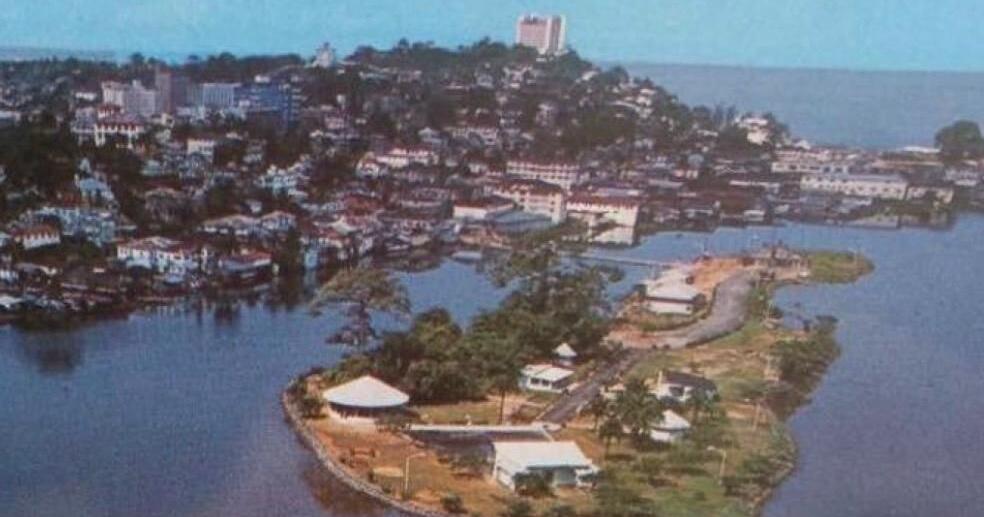
In a ceremony held August 17, President Joseph Nyema Boakai, Sr., officially broke ground for the development of Providence Island as a heritage site and tourism destination. The actual historical significance of the island in relations to events in 1822 was its formal transition from a former slave barracoon to a beacon of abolition. If properly packaged and documented, the true story of Providence Island highlights our abolitionist beginnings in a way we can all be proud of. It also would very likely secure the island’s designation as a UNESCO World Heritage Site.
A Factual History
What is now called Providence Island was two separate islands until they were joined by the administration of Pres. William R. Tolbert using soil brought from the mainland.
During the trans-Atlantic Slave Trade, the larger and older of the two sites was used by foreign slave buyers as a prison for holding kidnapped indigenous Africans awaiting shipment to the Americas. In 1807, it was occupied by a European named Mr. Jump, who was replaced by another called Joseph Dennison, followed by a Mr. Smalley in 1810. During that period, it was known as Gomez Island.
The next merchant to operate on the island was Mr. Hayes, an employee of John Mill, a slave-trading tycoon from England with barracoons in Guinea and other parts of West Africa. Hayes’ companion was a local woman named Phillipa, whose white father was an American and mother was African. Her daughter, Hannah, was the concubine of the British governor in Freetown. While living on Gomez Island, Hayes had the smaller island built using rocks and soil brought from the mainland.
In 1817, Mill sent his son by an African woman, John S. Mill, to replace Hayes. After the former manager’s departure, Phillipa continued living on Gomez Island, while his replacement occupied the smaller island, which was called Dazoa. With wealth earned from selling human beings, Hayes retired to a “showy mansion” one mile outside of Liverpool. When Philippa died, she left several hundred captives on Gomez who were said to be “strangers to this part of the coast.”
Writing in 1825, ACS Agent Jehudi Ashmun noted that the population along the Mesurado River “has been wasted by the rage for trading in slaves, with which the constant presence of slaving vessels and the introduction of foreign luxuries have inspired them.” That carnage was ended by indigenous rulers, repatriates, and Africans liberated from slave ships, all working together based on a campaign that radiated outward from Providence Island. But that world-changing history lies obscured by myths.
The Flawed Alternative
As someone with a passion for Liberian history, I followed keenly as plans for memorializing Providence Island were developed during the Weah administration. That process began in 2020 when the U.S. Department of State awarded a nearly $100,000 grant to the World Monument Fund to conduct a study on how best to preserve and utilize the Island. WMF then hired Allison James, a landscape architecture professor at the University of Virginia. Officials at the U.S. Embassy in Monrovia connected her with Dr. William Ezra Allen, history professor at the University of Liberia, to supervise archival research, and Chief Zanzan Korwor, head of the National Traditional Council of Chiefs and Elders, to supply oral histories.
Those efforts were flawed from conception through execution. One comical aspect was the placement on the Island of a grossly ill-designed model ship mislabeled as “the Mayflower,” which was supposed to represent the vessel that brought black emigrants from the U.S. Other flaws were more problematic; they ranged from the awarding of no-bid contracts to false historical claims.
For the memorialization of heritage sites, a two-step process is normally followed: First, bids are solicited through a publicly advertised process for work that meets specified criteria to be done by historians, consultants, contractors and others with certain minimum levels of demonstrated expertise. Second, bids and final written reports would be subject to vetting by procurement officers and the general public.
None of those two steps seem to have been followed by the WMF. Instead of a written report, professors James and Allen merely posted a video on the University of Virginia website, which remains inaccessible to most Liberians. Furthermore, their oral presentations contain several claims that lack evidence or are patently false.
According to Professor James, their research process took a year and a half, including the collection of oral histories and archival work at the Library of Congress, Indiana University and other institutions. But such an extensive and diligent research process should have revealed the fact that what is now one island was previously two. It also should have uncovered the factual history of Providence Island, much of which is publicly available; for example, see the book by Charles Huberich listed below that was used to prepare this article.
Listed below are eight false claims in the video presentations by professors James and Allen, with their location on the video noted in parentheses:
- Claim (Allen: 32:28): Dazoa, the name by which Providence Island was known in 1822, was derived from the Gola language in which it means “the land at the center of the water.”
Response: Prof. Allen offers no proof of any Gola connection to the island or even to the surrounding area that would help to explain how they came to name it. He also does not identify any plausible oral history that was collected from a credible source to support his claim. It seems implausible that the Gola would have applied that name to the man-made island but not to Gomez, which was older and larger. Allen’s claim suggests an ex post facto explanation.
According to oral traditions collected in the 1950s, the Dei people, who exercised dominion over the area, called the island Tuuopkon. “Dazoa” entered the written literature when the ACS bought the recently constructed island from John S. Mill. That name, which means of Zoa (female name) in Spanish, was probbly applied by foreign merchants, just as Gomez was.
- Claim (James: 16:45-16:51): To settle a conflict allegedly between indigenous Africans and emigrants from the U.S., “peace talks” were held under the cotton tree which once stood on Dazoa Island. Prof. Allen (33:00-33:07) alluded to conflicts between the two groups that occurred on that island.
Response: That brief passage contains two false claims. First, the conflict alluded to did not involve the emigrants from the U.S. at all. It was between armed men from Margibi who were threatening to behead Tawu Peter, the Dei ruler of the Cape Mesurado area, for having sold land in his jurisdiction without their permission. Second, talks to settle the issue were held at Tawu Peter’s residence on Bushrod Island, not on Providence Island!
After negotiations for land on Cape Mesurado were concluded in December 1821, ACS Agent Eli Ayers left to purchase supplies in Freetown. Approximately seven repatriate men opted to remain on Dazoa including Joseph Blake and Frederick James. They faced no antagonism from any indigenous persons. On the contrary, Dei oral traditions say a local woman named Wholo, who was related to several powerful men in the area, aided them in securing thatch and other building materials which they used to construct housing atop the hill where central Monrovia now sits.
After arriving from Freetown, Ayers said he was informed that “king Peter was sick in his back and could not come; but that the kings were at his town, and wished me to come there.” Although his Kru guides discouraged him from going there, Ayers “proceeded on to the town” (which stands near the present-day bridge to Caldwell. He was told “the kings of the Do country, called king Peter to a palaver … for selling the country to a white man without first consulting them, and that they still retained him prisoner, and threatened to cut off his head.
Note: Tawu Peter, the Dei ruler who lived on Bushrod Island, was the rightful land holder. Yet, he was being threatened with beheading by interlopers who came from about 45 miles away. The palava hut where talks were held was surrounded by about 60 men armed with muskets. Ayers recorded, “King Peter took a private opportunity of begging of me to take the things (used as original payment for Cape Mesurado) back to [Dazoa], and wait there until capt. Stockton should arrive, or else, says he, they will kill we, and we no want to die; the big tears rolling down his furrowed cheek at the same time.”
Ayers stated, “There were twelve kings present; two of these were very clamorous for us to go away, the others said nothing. King Willey said he would eat all our tobacco, and drink all our rum, and then he would drive us away. All but these two, I understood, were anxious for us to settle among them.”
Ayers later added that, after a long delay, he told the assembled chiefs that he would “make a present of the tobacco which was left, to be divided among all the kings. In a few minutes we made out the required list [of the goods paid for the land], and they began moving the goods to the beach, and we started for home. On our way we met our people coming with fixed bayonets, and well disposed to use them if occasion required. Peace and harmony being restored, trade flowed in upon us from all quarters, [with requests] to quit that place and to go with them. They said they would give me as much land as I wanted.”
Contrary to what Prof. James implied, the repatriates were not named as parties in that dispute, nor were any of them present at the conference. She ignored the unity of purpose that existed between 10 indigenous leaders and the ACS agent, while downplaying the criminal actions of those who threatened to a sovereign ruler without trial.
- Claim (Allen: 32:08-32:15): Those emigrants from the U.S. who disembarked at Freetown in 1820 and 1821 were relocated to Providence Island on Jan. 7, 1822.
Response: When Agent Ayers arrived on Jan. 7, he was accompanied by a few repatriate men. The women, children and other men would not arrive until 25 April 1822. By then, houses for them had been built atop Cape Mesurado, under the leadership of Lott Cary, Elijah Johnson, and Joseph Blake, with help from Wholo.
Emigrants from Freetown were not transported aboard the Elizabeth, the Nautilus or the Mayflower (as claimed by the staff of former Monrovia Mayor Jefferson Kwojee. They were brought on the Calypso, a clipper-style sailing ship which had formerly been used to transport African captives to the Americas. It was bought at auction by a free black man who sailed with his family and associates from Charleston, South Carolina, to Freetown, where he sold it to the ACS. As with the rest of the Providence Island story, the history of that ship symbolized the triumph of abolitionism over slave trading.
- Claim (Allen 33:30-33:41):The settlers had made known their intention to abolish the slave trade that continued along the coast, which some of the chiefs opposed.
Response: Opposition to the slave trade is presented by Allen as exclusive to the repatriates. This polarized framing is not only false; it assumes that Africans were not opposed to slave trading. It also helps to fuel divisiveness among Liberians along ethnic lines.
After Britain launched its Anti-Slavery Squadron in 1818, patrols along the West African coast were a sign to Cape Mesurado residents that the centuries-old international market for African captives was at risk. In 1813, that threat became manifest when British marines attacked a slave barracoon on the St. Paul’s River operated by Misters Bostock and McQuinn, two British citizens, and liberated over 67 captives, two-thirds of whom were children. Relocated to Freetown, two of the liberated men, William Tamba and William Davis, became abolitionists who later aided the founding of Liberia.
Mill, too, supported abolition. After settling on Dazoa Island, he had quickly acquired a small fortune selling African captives, but the immorality of slave trading “subjected him to the most disturbing anxiety and vexations.” According to John, he was persuaded to abandon the human traffic in 1821 by a missionary from Britain who visited Cape Mesurado months before the arrival of Dr. Eli Ayers of the American Colonization Society and Captain Robert F. Stockton of the U.S. Navy.
- Claim (James 5:56, Allen 34:21-36:28): Both professors James and Allen refer to a traditional school that was used for initiation ceremonies by the Gola. They do not name the site of the school, but, given the focus of their research, they convey the impression that it was on Providence Island.
Response: No such school existed either on Gomez or Dazoa when the repatriates arrived because both of those islands had been continuously used as prisons for indigenous Africans kidnapped for sale to slave markets overseas. Furthermore, Dazoa had been continuously occupied by Mr. Hayes from the time of its construction between 1810 and 1817.
While the sale of a cultural site proved to be a momentary sticking point during land negotiations between indigenous rulers on the one hand and the ACS agent and U.S. Navy representative on the other, that site was not on Dazoa Island and it was not being used for a Poro School.
ACS Agent Ayers wrote, “I found that the objection which had been raised to our settling on the Cape, … arose from a peculiar sanctity supposed to be attached to that place on account of its peculiar formation. Below this spot which is called the Devil’s bush, they had no more objection to our settling than on any other place, and here I determined to build our town.”
- Claim (James 3:45-5:51; Allen 32:21-32:28): Professors James and Allen as well as the World Monument Fund’s website credited the Gola as the ethnic group with dominion in the region of Providence Island when the repatriates arrived.
Response: If left unchallenged, this false claim risks damaging efforts at strengthening national unity by erasing the historical role of one ethnic group in order to elevate another. A variety of sources establish unequivocally that the Dei were the land holders in the Cape Mesurado region at that time, including oral histories collected by Hon. S. Jangaba M. Johnson and Bai T. Moore in the 1950s.
- Claim (Allen 38:16-41:36): “We have a conundrum now. We say Providence Island is essential. It’s very important to Liberia. … It’s an area of conflict and convergence. To indigenous people it represents a loss of sovereignty … So the question is how do you commemorate a heritage that is conflicted. To one group it represents the best thing that ever happened to Africa: the creation of a black republic. To another group it represents the loss of culture essentially and also a loss of identity.”
Response: Allen here suggests that Providence Island represents a conundrum, but it is a false conundrum that he and Professor James created. To achieve that effect, he conflated important but unrelated issues onto the history of the island, while ignoring its actual historical significance. Contrary to his claim, Providence Island was not the focus of repeated conflicts between our repatriate and indigenous ancestors, nor was it ever the site of a Poro school that was erased by emigrants. Repatriates were neither parties to the dispute nor present at peace talks between Tawu Peter and the interlopers from Margibi who were threatening to behead him. Furthermore, those negotiations were held on Bushrod Island, not under the cotton tree of Dazoa. The story that will attract tourists to Providence Island must be built on the solid rock of truth, not the shifting sands of a false and divisive narrative.
A Proper Memorialization
All of the processes conducted by the WMF regarding selection of consultants, architects and builders seem to have flaunted Liberian laws. Based on a flawed “history,” the organization crafted a building design tied to Providence Island’s history as a so-called conundrum. The imposing structure it proposed to build features a split into two halves symbolizing a permanent ethnic dichotomy that did not exist while erasing our collective abolitionist legacy. Does the recently installed Liberia National Tourism Authority (LNTA) intend to implement the flawed plans developed by WMF based on a narrative riddled with falsehoods, or will it initiate a process in keeping with Liberia’s procurement and open-government laws that allows for careful vetting? So far, the signals emerging from different agencies of government seem mixed.
A news story from 2025 said, “The Government of Liberia has signed a US$7 million contract with the World Monuments Fund (WMF) to rehabilitate Providence Island into a world-class heritage center.” But at the recent groundbreaking ceremony, Chairman of the LNTA Board, Ambassador Christopher Hayes Onanuga, said “We want the whole world to know that whatever money is being spent on this island now is directly from the Government of Liberia.”
Regarding financing for the project, it seems reasonable to ask how much has been allocated, how were the funds obtained, and do the funds come with stipulations that pre-selected historical claims be enshrined at the site? Groundbreaking suggests that construction will begin soon. If so, who is the builder? Through what process was the contractor selected?
In raising these questions now, I aim to aid this administration in achieving its objectives of preserving our heritage and nurturing tourism. But, let us avoid the fate of Esau in the book of Genesis who sold his birthright to Jacob for a bowl of porridge.
By properly memorializing Providence Island, we will be offering a solemn libation to the memory of those ancestors who were kidnapped in the interior and imprisoned in the middle of the Mesurado River before being sold to foreign slave buyers. We will sanctify the island’s role as the Door of Return through which refugees from grueling oppression in the Americas found freedom on the continent of their ancestry. We will honor all of our nation’s founders, including visionary indigenous rulers of the Cape Mesurado region who provided land for what became Liberia and those ancestors of various ethnicities who spilled their blood to liberate our coastline from the rapacious trans-Atlantic Slave Trade. When accurately documented, that history likely will receive easy designation as a UNESCO World Heritage Site, which would boost tourism to Liberia tremendously.
Figure 1. Gatumba drives the captive Deis from Millsburg
The title of the illustration refers to Gatumba, a Gola ruler, and his slave raiding activities on the Dei around Millsburg in 1840. The image was first published in 1851 in an apparently anonymously authored work, Africa Redeemed: or, the means of her relief illustrated by the growth and prospects of Liberia (London, 1851, facing p. 184).
Figure 2. A captive being inspected for purchase, taken from a book by Théophile Conneau, a notorious slave merchant who operated along the Liberian coast; Captain Canot; or twenty years of an African slaver, New York: D. Appleton and Company, London: 16 Little Britain, 1854.
See more Liberia News Network stories in Google Search by adding LNN as one of your Preferred Sources.
★ Add LNN as a Preferred Source