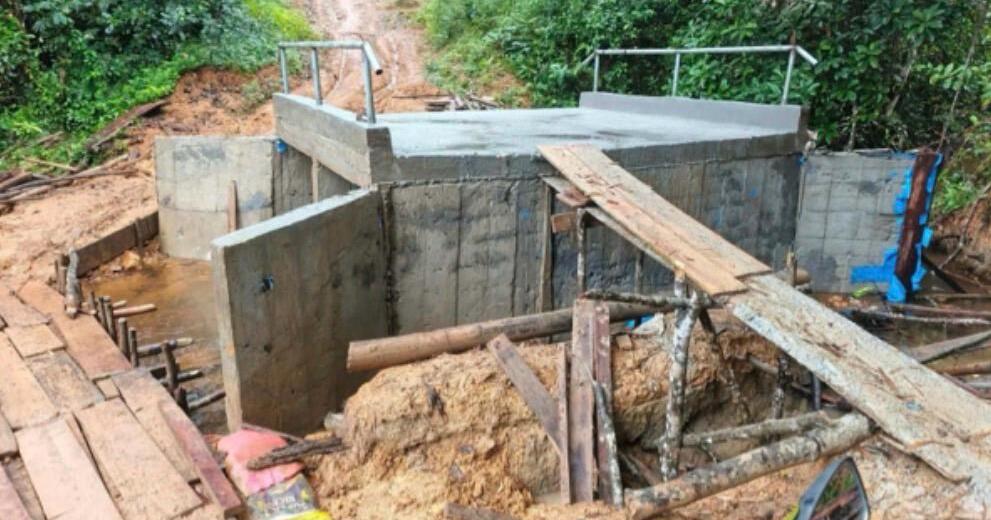
Before now, the road connecting Monah, Gbowee, and other towns in the Wedjah district was damaged. Motorbikes could not easily cross over; cars or trucks were a no-go zone. People here only commute on foot. Their cassava and other crops harvested could not be transported to Greenville, Sinoe’s capital, easily, leaving them at the mercy of a few motorbikes who rarely came along.
So, when the Liberian NGO, the Integrated Development Learning (IDL), engaged them for a conservation project, the “Payment for Stewardship,” an Irish government-funded initiative, people from Monah and Gbowee, and others who own portions of the Sapo forest were excited.
Their participation in the project awarded them the amount of $21,392 for protecting 7,131 hectares—a rate of $1.50 per hectare. They are now constructing a concrete bridge on the Gleegbayee-Neyan with the money.
“Now that we are close to the end of the two-year deal that we agreed on, on behalf of our people, they are asking while coming here if this project will continue; then they are prepared to work with you,” said Lasting Kaydea, project executor and chairperson of the Forest Management Committee of Central and Lower Wedjah, at the launch of the scale-up project of the Payment for Stewardship project in Monrovia.
The new project titled “Sustaining the Gains of Community Climate Actions in Sinoe County” will build on gains made through the Payment for Stewardship project, including expanding livelihood and income diversification activities, benefiting at least 2,000 households, including the 1,395 households that are currently benefiting.
This component will build on existing investments and utilize available resources, including the existing Small Business Development Fund (more than 41,905 United States Dollars in revolving grants targeting these districts), cassava grinders (Garrie Machines) and processing sheds, as well as the motorbike revolving scheme, which are key investments already in place and will be used.
Kaydea said the payment for the stewardship project has been a lifeline for his people, adding that they are willing to continue and even increase the hectares of forest. “We will fight hard even if it causes us to manufacture forests to move to 10,000 because they are benefiting a lot,” he said.
Sustaining the Gains of Community Climate Actions is a 16-month project with a value of EUR 399,862, will run from September 2026 to December 2027, and is funded by the Government of Ireland through its embassy in Liberia.
Under the current project, IDL will work with Fauna and Flora, an international conservation NGO based in the UK, to carry out a science-based, participatory biodiversity assessment of community-protected forests in each district. The information gathered will be used to develop a conservation plan and implementation strategy that balances biodiversity protection with the livelihood needs of the target communities.
According to Silas Siakor, Executive Director of IDL, the project has already achieved some important milestones, including 50,674 hectares set aside by land-owning communities as reserved forest, 31 Village Saving and Loan Associations (VSLAs) with 1,041 members supported, 24.5 million Liberian Dollars generated in savings by the VSLAs from January to June 2026, a dramatic increase from the 13 million Liberian Dollars saved in 2025, and 11 million Liberian Dollars disbursed as revolving grants to 202 households to start or grow a small business, with 8.4 million Liberian Dollars (77%) of the grants going to women
The concrete bridge construction is one of the tangible gain’s towns have received from the Stewardship project. Other benefits include an elementary school and hand-dug wells to be fitted with hand pumps.
Irish Ambassador to Liberia Gerard Considine underscored the importance of supporting community livelihoods and providing alternatives that reduce dependence on the forest as the bedrock of conservation work.
“We understand a fundamental truth: you cannot talk about forest conservation or protecting the global carbon canopy without addressing human need,” the Ambassador said.
According to Siakor, IDL’s founder, said the Payment for Stewardship project was initially just an idea shared with the Irish embassy, and they opted to support the project. “The idea behind this project was just an idea, and they said we will work with you to try it out, and let’s see how it goes so Mr. Ambassador, thank you so much for your support.”
Deforestation in Liberia is growing alarmingly, fueled by logging, charcoal production, and slash-and-burn agriculture, now worsened by the presence of cocoa migrants from Ivory Coast and Burkina Faso. Experts say conservation that puts money in the hands of communities is crucial to protecting Liberia’s forest, which covers more than 40 percent of the Upper Guinea rainforest. When communities who depend on the forest are empowered, they support conservation work.
EPA’s executive director, Dr. Emmanuel King Yarkpawolo, supports the project for its people-centered approach. According to him, climate change may be discussed at international conferences, but its impacts are experienced locally, especially in Liberia.
“It is the farmer whose crops fail because the rains have changed,” he said. “It is the family whose home is threatened by flooding. It is the community whose forest, water source, and traditional livelihoods are placed under increasing pressure. Therefore, our response must reach the people where these impacts are felt.”
With the growing impacts of climate change, including chnage in wealther pattern, Dr. Yarkpawolo argued that local people must have the knowledge and practical ability to understand climate change, adapt to its effects, and contribute to mitigating it.
“This project supports those efforts by bringing forest protection, biodiversity conservation, livelihoods, and community development together. It recognizes a simple truth: conservation will be sustained when communities are respected as partners and when protecting nature also improves their lives.”
Isaac N.Kannah Teah, Fauna, and Flora extolled the project for its impact, adding that “IDL ‘s approach in Sinoe County through this project shows practical ways.”
Through the assessment, key challenges and threats to biodiversity conservation, including illicit and poorly regulated mining, will be identified, and strategies will be developed, including formal engagement with the Environmental Protection Agency (EPA), Forestry Development Authority (FDA), and the Ministry of Mines and Energy (MME) to advocate for stronger enforcement of relevant policies, laws, and regulations, as well as facilitating and supporting the affected communities to engage in dialogue with resource-extraction companies whose activities threaten their environment and overall well-being and lay out their concerns.
See more Liberia News Network stories in Google Search by adding LNN as one of your Preferred Sources.
★ Add LNN as a Preferred Source