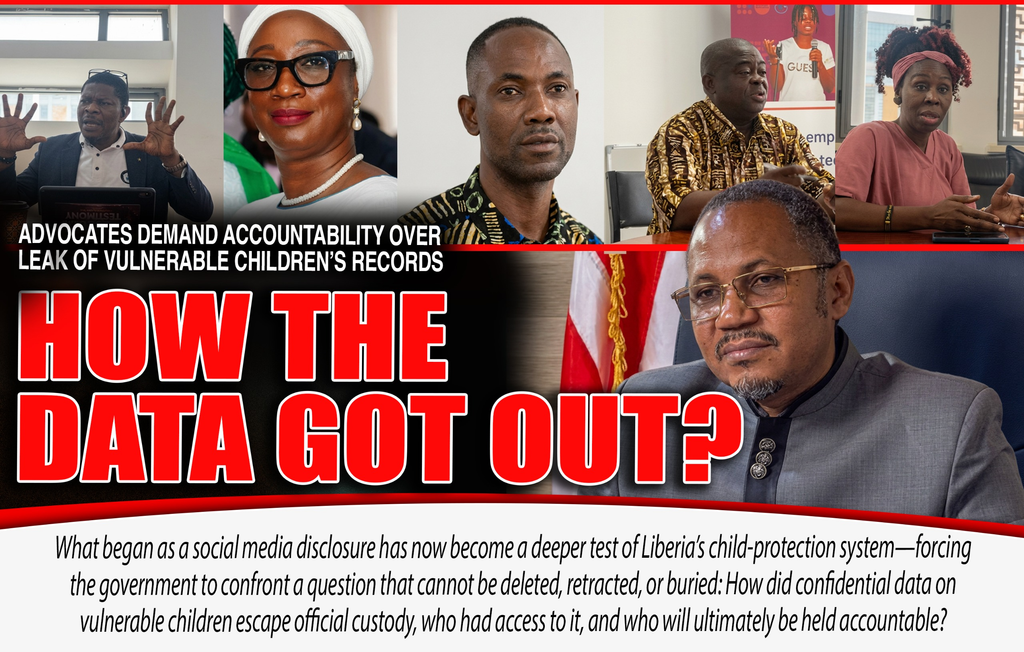
Monrovia — A controversy that began with a single Facebook post has widened into a pointed question for the Liberian government: how did confidential records on some of the country’s most vulnerable children end up in the public domain?
The post, published by Mo Ali, Managing Director of the Liberia Water and Sewer Corporation, was meant to showcase results from the government’s Save the Future Project. Instead, it disclosed names, ages, schools, home addresses, and family details of children enrolled in the program. Ali deleted the post soon after — but child-protection advocates say that response missed the point entirely.
“If he put it down, Mark Zuckerberg got it,” said Alex Destiny Newon, an executive member of the Child Protection Network, at a meeting with Ministry of Gender officials. Once information is posted online, he said, it can be copied and redistributed regardless of whether the original is removed.
What the Ministry Has Confirmed
In a statement issued September 13, the Ministry of Gender confirmed the records were authentic and belonged to the Save the Future Project. It clarified they were not a list of survivors of sexual or gender-based violence, but records of children removed from street begging or vending and enrolled in support services.
That clarification answered one question — but not the one advocates say matters most: how the records left government custody.
The Unanswered Question: Who Had Access?
The Ministry acknowledged sharing collated statistics and supporting data with funding partners for monitoring and accountability purposes. But advocates note a critical distinction: authorization to share aggregated data for program oversight is not the same as authorization to publish identifiable personal information.
That distinction is now central to calls for an investigation. Key unresolved questions include:
• Who collected, entered, and maintained the records, and who had access to the electronic files?
• Were copies shared with external partners, and under what safeguards?
• Was the information transmitted electronically, printed, or shared through messaging platforms?
• Could aggregated, non-identifying data have served the same purpose?
One advocate, who said he spent 10 months on child-protection work and had previously sought Save the Future data through official channels, said he was denied the same information now circulating publicly. “I couldn’t get it,” he said — a detail that raises its own questions about who could.
The Stakes for the Children Involved
Keifala Kromah, Chairperson of the Child Rights Advocacy Alliance and the Child Protection Network, warned the fallout could be “far-reaching,” particularly for children with disabilities, and for minors who may now feel unable to return to schools or communities where their circumstances have become public knowledge.
The National Association of Social Workers of Liberia (NASOWL) went further, framing the disclosure as a political act. In a statement issued Monday, the association said personal information obtained through government office “should not be treated as information that can be publicly disclosed to advance a political argument,” adding: “Children must never become political ammunition or pawns.”
NASOWL cited Liberia’s Children’s Law of 2011, which guarantees children’s rights to privacy, and called for comprehensive data-protection safeguards covering health, education, disability, and case-management records.
A Test for Liberia’s New Data Laws
The timing is notable: President Joseph Boakai recently signed the Cybercrime and Data Protection Acts into law, aimed at strengthening safeguards around personal information. Advocates argue this incident is an early test of whether that legislation translates into practice — through staff training, access controls, and clear disclosure procedures — or remains largely symbolic.
What Comes Next
The Ministry says it is investigating. But advocates are watching for two things beyond the inquiry itself: whether it identifies a breach of law or professional responsibility, and whether anyone is held accountable if it does.
The bigger risk, advocates say, is one of trust. If families believe information they share with government programs could later surface online, they may grow reluctant to seek help at all — undermining the very interventions meant to protect them.
As one advocate put it, the authenticity of the leaked records is no longer in question. What remains is simpler, and harder to answer: how did the data get out?
See more Liberia News Network stories in Google Search by adding LNN as one of your Preferred Sources.
★ Add LNN as a Preferred Source