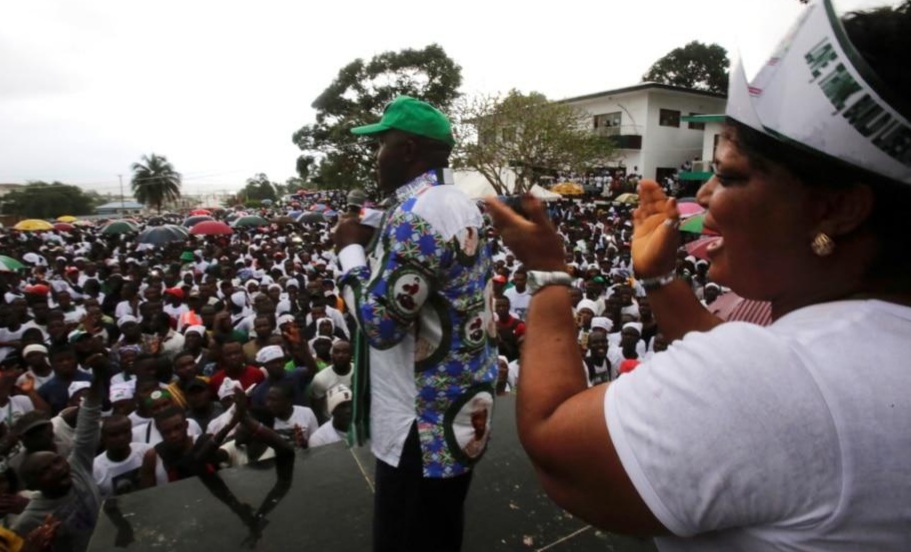
Three years ago, many braved a heavy downpour in Monrovia to kick off the Unity Party’s “Rescue Mission.” Now, the rain has stopped, the campaign banners have disappeared, and the justifications are becoming harder to maintain.
By September 17, 2023, the Unity Party had already made its appeal to the people of Liberia. At the Antoinette Tubman Stadium, under a relentless Monrovia rain, thousands of supporters dressed in green gathered to launch what was touted as a national rescue initiative.
They marched through the rain, shouted, sang, and waved the Unity Party’s colors. They had faith. Importantly, they were not just supporting Joseph Nyuma Boakai; they were opposing what they viewed as six years of ineffective governance under George Weah.
The message was clear: Liberia needed saving, and the Unity Party was ready to deliver. However, three years later, those who stood in that rain face a stark question: Rescued from what—and rescued to what?
This is where political nostalgia must yield to accountability. The Boakai administration cannot continue to campaign against the shortcomings of its predecessor indefinitely. After nearly three years in power, it must increasingly be held accountable for its own record. And the record, when compared to the lofty promises of the Rescue Mission, presents a mixed picture.
One of the most troubling pieces of evidence comes from Naymote’s independent President Meter project. In 2024, Naymote monitored 126 promises made during and after the 2023 campaign. By the end of the first year, only five had been fulfilled. Eighty were still in progress, 22 had yet to begin, and 19 could not be assessed due to a lack of information.
The following year saw a significant expansion in the monitoring effort. Naymote’s 2025 President Meter report tracked 378 interventions across 52 programs and six pillars of the government’s ARREST Agenda.
The most striking finding was that only three interventions—0.8 percent—were fully completed during the twelve-month period covered by that report.
This statistic warrants serious public discussion. It doesn’t necessarily prove that the government has achieved nothing—it clearly has not.
Howbeit, it does raise a more uncomfortable question: How can a government that came to power with a promise of rescue justify such a slow pace of progress in its own development agenda?
The answer cannot always be “Rome was not built in a day.” Liberians were aware of their country’s issues when they cast their votes. They didn’t choose the Unity Party because Liberia was running smoothly; they did so because they were promised that the problems would be confronted with urgency
A government can rightfully claim that reforms require time. It can highlight increased domestic revenue, better fiscal management, infrastructure initiatives, agricultural programs, institutional changes, and economic growth.
Indeed, there are tangible improvements. The World Bank indicates that Liberia’s economy grew by 5.1 percent in 2025, with a reduction in the fiscal deficit and public debt decreasing from 57.2 percent of GDP in 2024 to 54.6 percent in 2025.
These accomplishments should be acknowledged, but they shouldn’t replace the more significant issue of actual delivery. Economic growth doesn’t necessarily mean that young Liberians without jobs are now employed. Higher government revenue doesn’t guarantee that a child in a rural area has access to a better education. A stronger fiscal position doesn’t automatically fix every damaged road. An audit doesn’t ensure that a family has food on the table. And announcing a government program is not the same as completing a project.
This is where the Rescue Mission faces challenges. The campaign promises were grand, and the expectations were high. Consequently, the level of accountability must also be substantial.
The Unity Party didn’t just urge Liberians to support a new administration; it positioned itself as the solution to a government it consistently labeled as incompetent, corrupt, and out of touch with the everyday lives of Liberians.
This narrative played a crucial role in its rise to power. Now, the same criteria must be used to evaluate the government it has established.
The opposition party of 2023 has transitioned into the government of 2026. It cannot claim both the moral high ground of a reform movement and the protection of a typical political party at the same time.
If, in three years, the Rescue Mission has truly managed to uplift Liberia, where are the clear changes? Where are the significant improvements that an average citizen can notice without relying on a government press release? What about the jobs that were promised to the youth? Where are the roads that were supposed to be built for communities? How about the revamped education system? Is there a health system that ordinary Liberians can trust? Where is the promised culture of accountability that would distinguish this government from its predecessors? And perhaps most crucially: where is the urgency that was so evident during the campaign? These are not opposition questions; they are citizens’ questions.
Naymote has recognized the government’s progress but has also pointed out significant gaps in implementation. In its 2026 assessment after the President’s State of the Nation Address, it noted advancements in areas like domestic revenue, audit compliance, payroll integrity, and service coverage, while stressing that many gaps still exist. This provides a more honest evaluation of the Rescue Mission.
It’s not intellectually sound to claim that “Boakai has done nothing,” nor is it fair to assert that “the Rescue Mission has succeeded” just because the government can list initiatives. The crucial issue lies in the gap between announcing plans and actually completing them, which is vital in a country that has faced decades of unfulfilled promises.
Moreover, there’s a risk in interpreting the size of the crowd on September 17, 2023, as proof of the mission’s impending success. While it demonstrated political enthusiasm, hope, and a desire for change among thousands of Liberians, a crowd does not equate to a development plan. A campaign rally isn’t a road, a slogan doesn’t create jobs, and a promise alone won’t build a hospital.
The term “Rescue Mission” does not inherently signify rescue. This is a tough lesson learned three years after the rain.
Those who gathered at ATS that day shouldn’t feel ashamed for their belief, but they must also not relinquish their right to demand results from those they elected.
In fact, they bear an even greater responsibility to be the government’s most vocal critics—not out of opposition to President Boakai, but because they chose to support him.
The young individual who marched through the rain deserves a response. The market vendor who supported the campaign deserves a response. The civil servant who had faith that the government would change deserves a response. The voter who turned away from the previous administration because the Unity Party promised something better deserves a response. And that response cannot simply be another speech; it must be action.
Three years ago, the rain tested the dedication of the Rescue Mission’s supporters. Today, something even more significant is being tested: the government’s performance.
The rain has ceased. The campaign music has quieted. The green flags have been taken down. Joseph Boakai is no longer asking Liberians for their support; he has it now.
The Unity Party is no longer just pledging to rescue Liberia; it is now in charge of governing it. Thus, September 17 should not just be remembered as the day when thousands of Liberians braved the rain for change.
It should be remembered as the day a political movement made grand promises to a nation—and as the anniversary against which those promises must ultimately be evaluated.
The question is no longer whether Liberians had faith in the Rescue Mission; they did. The question now is whether the Rescue Mission has delivered enough concrete results to validate that faith.
After three years, that is the question the rain-drenched crowd of September 17, 2023, deserves to ask. And no amount of political nostalgia should stop them from seeking an answer.
See more Liberia News Network stories in Google Search by adding LNN as one of your Preferred Sources.
★ Add LNN as a Preferred Source