
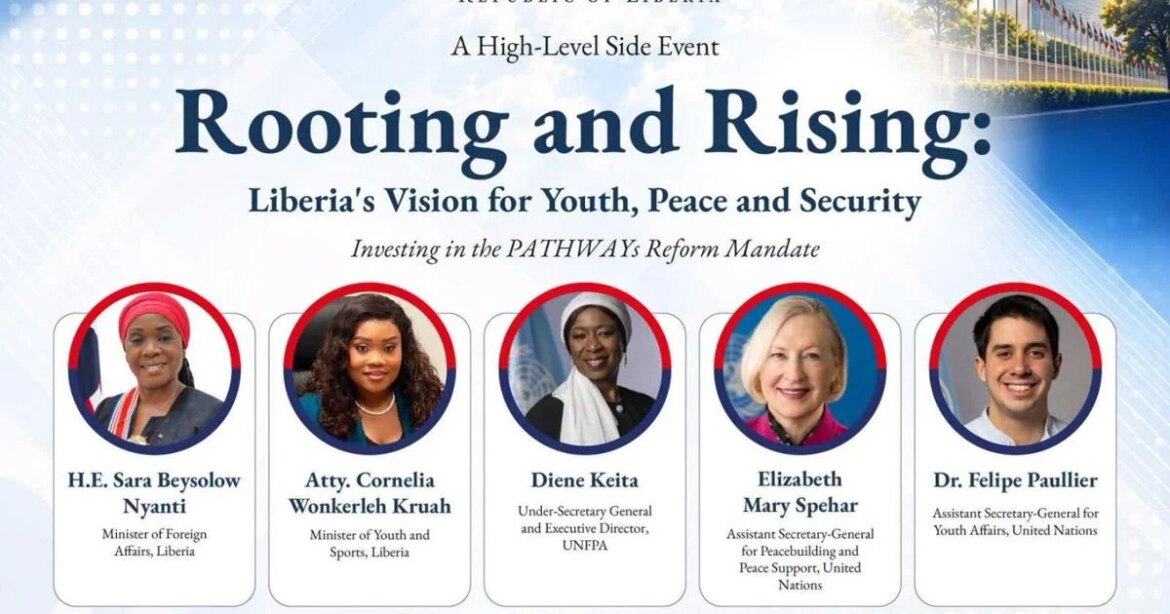
At the Rooting and Rising side event of the 81st UNGA, Foreign Minister Sara Beysolow Nyanti and Youth and Sports Minister Cornelia Wonkerleh Kruah are expected to be joined by senior United Nations officials, including UNFPA Executive Director Diene Keita, UN Assistant Secretary-General for Peacebuilding Support Elizabeth Spehar and UN Assistant Secretary-General for Youth Affairs Felipe Paullier.
NEW YORK — Liberia is opening its engagements at the 81st United Nations General Assembly with a message that reaches well beyond the conference rooms of New York: the country’s young people must become stakeholders in the peace they inherited.
That proposition will take center stage Friday as Liberia convenes a high-level side event on Youth, Peace and Security, the first in a series of engagements expected to showcase priorities the country carried into its successful campaign for a non-permanent seat on the United Nations Security Council.
But the gathering also raises a more difficult question for Liberia.
Can a country whose postwar transition has become an important part of its international identity translate that experience into policies that give its overwhelmingly young population a meaningful stake in peace?
The question assumes greater significance as Liberia settles into its 2026-2027 Security Council term and prepares to assume the presidency of the Council in December. The United Nations confirms that Liberia will hold the rotating presidency that month, placing the country temporarily at the center of the world’s principal body responsible for international peace and security.
Liberia’s current Council membership is itself historic. Before 2026, the country had served on the Security Council only once—in 1961.
Friday’s event, titled “Rooting and Rising: Liberia’s Vision for Youth, Peace and Security,” is therefore more than another UNGA side event. It provides an early opportunity to examine what Liberia intends to do with its growing diplomatic platform—and how closely its international advocacy corresponds with realities at home.
Foreign Minister Sara Beysolow Nyanti and Youth and Sports Minister Cornelia Wonkerleh Kruah are expected to be joined by senior United Nations officials, including UNFPA Executive Director Diene Keita, UN Assistant Secretary-General for Peacebuilding Support Elizabeth Spehar and UN Assistant Secretary-General for Youth Affairs Felipe Paullier.
At the center of the discussion will be Liberia’s efforts to expand young people’s participation in peacebuilding, security, development and national decision-making, including through the government’s PATHWAYs Reform Mandate.
The demographics make that discussion particularly consequential.
Liberia’s 2022 Population and Housing Census recorded a population of 5.25 million. Its thematic report on children, adolescents and youth found that people from birth through age 35 constituted 74.5 percent of the population. Those aged 15 to 35 alone accounted for 41.7 percent.
In other words, the future of Liberia’s peace is overwhelmingly a youth question.
The government itself acknowledges many of the pressures confronting that population.
Liberia’s National Youth Policy and Action Plan 2025-2029 identifies unemployment and underemployment, limited access to quality education and vocational training, gender disparities, substance abuse and the marginalization of young people from governance and decision-making among the country’s persistent challenges.
Those conditions provide an important domestic backdrop to the message Liberia will carry in New York.
More than two decades after the end of civil war, peace in Liberia can no longer be measured simply by the absence of armed conflict. Increasingly, the question is whether the country’s political and economic institutions can provide opportunities capable of sustaining that peace.
Liberia has already attempted to put that connection into policy.
Its National Action Plan on Youth, Peace and Security 2025-2030 commits the government to meaningful youth participation in conflict prevention, peacebuilding, security and sustaining peace. Significantly, the plan also places the rehabilitation and reintegration of at-risk youth—including those commonly referred to in Liberia as “zogos”—within the country’s broader peace and security framework.
The plan was formally launched in August 2025 and is intended to implement UN Security Council Resolutions 2250, 2419 and 2535 on Youth, Peace and Security.
That creates an important benchmark against which Liberia’s message at UNGA can be measured.
The issue is no longer whether Liberia recognizes youth inclusion as important. Its own policies say that it does.
The next questions concern implementation: How much is being invested? How many young people are benefiting? What opportunities are being created outside Monrovia? How are young women participating? What measurable progress has been made in rehabilitating vulnerable young people? And how effectively are education, employment, entrepreneurship and skills programs being connected to the country’s peace and security strategy?
Those questions matter because Liberia arrives at UNGA with an unusual diplomatic asset: experience.
The country moved from devastating civil conflict to successive peaceful transfers of political power, the departure of a major United Nations peacekeeping mission and, eventually, a seat at the very Security Council that once authorized international interventions to help stabilize it.
That trajectory gives Liberia a potentially distinctive voice on peacebuilding, particularly for countries attempting to move from conflict management toward durable peace.
But diplomatic prestige also brings scrutiny.
As Liberia advocates internationally for conflict prevention, youth participation, peacebuilding and stronger multilateral institutions, conditions at home become part of the credibility of that message.
The country’s December presidency of the Security Council will sharpen that test.
For one month, Liberia will help organize the Council’s work and will have an opportunity to give greater visibility to issues it considers important. The presidency rotates among Council members monthly and does not confer additional voting power, but it provides significant diplomatic convening and agenda-shaping opportunities within the Council’s rules.
The road to December therefore runs through engagements such as Friday’s gathering in New York.
For Liberia, the 81st General Assembly is an opportunity to demonstrate that winning a Security Council seat was not the culmination of a diplomatic campaign, but the beginning of a larger undertaking: translating the country’s history, experience and national priorities into meaningful international engagement.
Youth, Peace and Security is an appropriate place to begin.
Three out of every four Liberians are 35 or younger.
For them, peace cannot remain merely the story of a war that ended before many of them can remember.
The larger challenge for Liberia—in New York and at home—is determining what that peace will deliver next.
See more Liberia News Network stories in Google Search by adding LNN as one of your Preferred Sources.
★ Add LNN as a Preferred Source