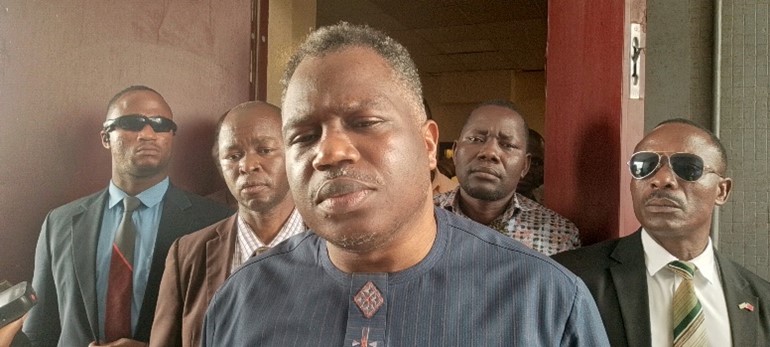
MONROVIA, Liberia, September 21, 2026 — Vice President Jeremiah Kpan Koung has requested the immediate release of Jerry Nyantee Wrotto, a young Liberian detained by police over allegedly AI-generated images and videos depicting the Vice President.
The arrest has fueled debate over free expression and enforcement of Liberia’s newly enacted Cybercrime Act.
The Liberia National Police confirmed over the weekend that Wrotto had been arrested in connection with manipulated content involving Koung that circulated widely on social media following controversy over reports about the Vice President’s security screening at Brussels Airport.
Koung has disputed reports that he was subjected to unusual scrutiny at the airport, saying he passed through the normal passenger security process and that neither his shoes nor jacket was removed.
Police said Wrotto’s alleged conduct fell under Liberia’s Cybercrime Act, which President Joseph Nyuma Boakai signed into law on August 19, 2026.
The arrest has since generated mixed reactions, with some officials defending enforcement of the law while critics question whether its application to manipulated political content could infringe on constitutionally protected expression.
Responding to the controversy, Vice President Koung said he had received several calls concerning Wrotto’s arrest over what he described as AI-generated images and videos targeting him.
Koung said criticism and ridicule are among the realities public officials must endure and disclosed that he had contacted Inspector General of Police Gregory Coleman about the detention.
“I contacted the Inspector General of Police, who confirmed that the arrest was made under Liberia’s Cybercrime Law,” Koung said.
“While I respect the law and the responsibility of the police to enforce it, I have made it clear that I have no desire to press charges against this young man, or anyone else, merely for creating or sharing such content about me. I have therefore requested his immediate release.”
The Vice President added that laws should protect citizens while public officials exercise restraint in responding to criticism.
“Our laws must protect citizens, but leadership must also exercise tolerance, restraint and compassion. Again, this is part of the package,” Koung said.
President Boakai signed the Cybercrime Act and Data Protection Act into law on August 19 as part of efforts to establish legal frameworks governing cyber offenses and the handling of personal information.
The Cybercrime Act provides a framework for preventing, investigating and prosecuting offenses committed through or involving computers, electronic systems and digital networks. Among the areas covered are unauthorized access, digital fraud, identity theft and illegal interception of electronic data.
The Ministry of Posts and Telecommunications has subsequently published the approved Cybercrime Act of 2025.
The Wrotto controversy, however, has brought attention to how provisions of the new law relating to online conduct may interact with constitutional protections for freedom of expression, particularly when the content involves criticism, satire or ridicule of public officials.
No court has yet determined, based on the information available, whether Wrotto’s alleged conduct violated the Act.
Executive Protection Service Director Sam Gaye defended the police action, arguing that manipulating and distributing digital content to humiliate or harass another person could constitute an offense under the new law.
“To those making noise about why the police arrested the individual who created the fake, humiliating video footage of the VP at Brussels airport—it is a crime under the new Cybercrime Act of 2025/2026,” Gaye wrote on social media.
He warned that people creating or circulating AI-manipulated material could face investigation and prosecution where their conduct violates the law. Gaye’s comments followed controversy surrounding manipulated images purporting to show Koung undergoing airport security scrutiny.
Montserrado County Senator Abraham Darius Dillon also urged Liberians to familiarize themselves with the new legislation, noting that it had been enacted by the 55th Legislature and signed by President Boakai.
Dillon warned that the use of artificial intelligence to manipulate content about other people could potentially result in criminal liability under the Act.
But the arrest also drew criticism from lawyer Jefferson Chesson, who questioned whether Koung had filed a complaint with police before Wrotto was detained.
Chesson challenged the circumstances surrounding the arrest and questioned whether law enforcement authorities had acted independently or in response to the Vice President.
Former Finance and Development Planning Minister Samuel D. Tweah Jr. also welcomed Koung’s request for Wrotto’s release but argued that the young man should not have been detained in the first place.
“That you have to call for his release is the problem. He should not be behind bars for free speech in the first place,” Tweah said.
Tweah further criticized provisions of the new Cybercrime Act dealing with cyberbullying, describing them as inconsistent with Liberia’s previous efforts to strengthen freedom of expression.
He referenced the Table Mountain Declaration and the Kamara Abdullah Kamara Act of Press Freedom, arguing that political leaders should tolerate harsh public criticism.
The competing reactions have made Wrotto’s detention one of the first prominent public controversies over enforcement of Liberia’s new Cybercrime Act, raising questions about how authorities and the courts will distinguish potentially unlawful online harassment from political criticism, satire, and other forms of protected expression.
See more Liberia News Network stories in Google Search by adding LNN as one of your Preferred Sources.
★ Add LNN as a Preferred Source