MONROVIA – The Government of Liberia has defeated the heart of Solway Mining’s claim over the disputed Blei and Detton iron ore area in Nimba County. An international arbitration tribunal ruled that Solway had no right to compensation for the exploration licence that later went to ArcelorMittal, according to a copy of the award obtained by FrontPageAfrica.
\n
By Rodney D. Sieh
\n
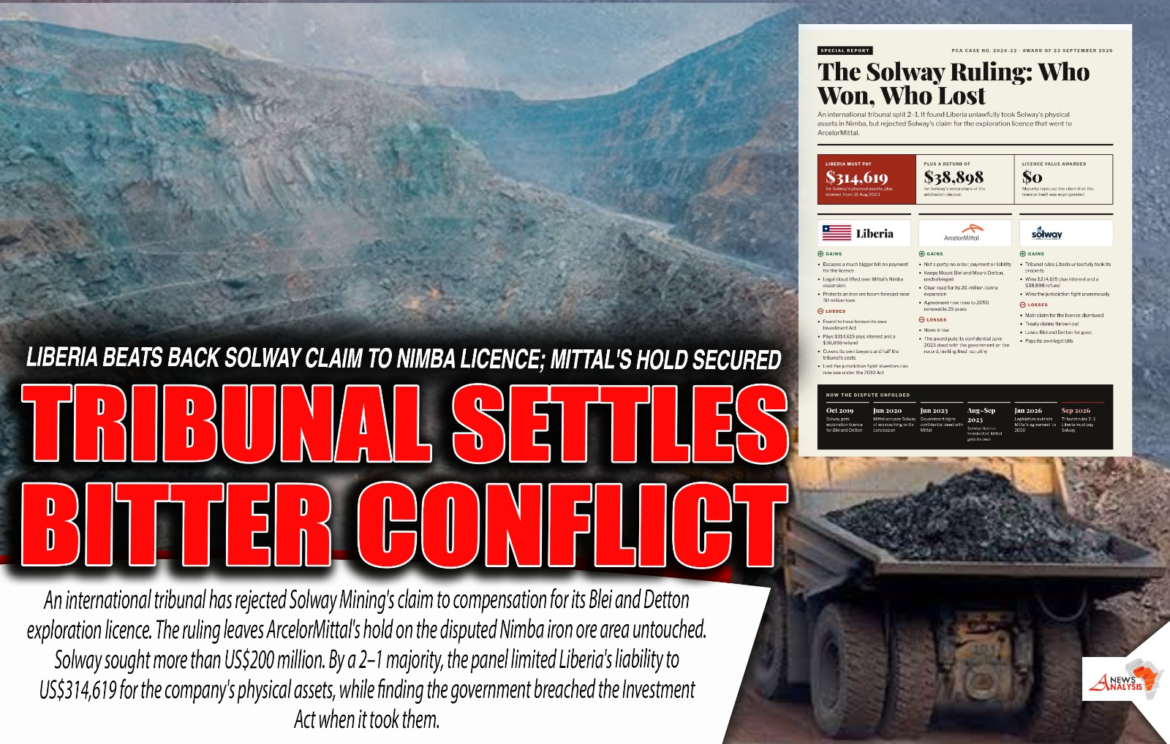
The award, dated September 23, 2026, was handed down under the Permanent Court of Arbitration in PCA Case No. 2024-22. Three Solway companies, two Swiss and one Liberian, brought the case against the Republic of Liberia. The tribunal did find that the government broke its own Investment Act when it seized Solway’s physical assets. It ordered Liberia to pay US$314,619.47 for them, a fraction of the more than US$200 million Solway had claimed.
\n
Justice Minister Betty Lamin Blamo confirmed the ruling when contacted by FrontPageAfrica. “We can disclose the existence of the award but technically not its content,” she said.
\n
Cllr. Blamo confirmed that Solway was awarded US$314,619.47, against its claim of more than US$200 million.
\n
Two of the three arbitrators found that Liberia expropriated Solway Mining’s physical assets in breach of Section 7 of the Investment Act of 2010, and set their value at US$314,619.47. Interest runs from August 31, 2023 at SOFR plus two percent, compounded quarterly, until the debt is settled. The same majority dismissed all of Solway’s other claims, including its claim for the licence itself.
\n
On one point the tribunal was unanimous, and it may prove the most consequential. Liberia had argued that it never agreed to international arbitration and that the dispute belonged in Liberian courts. The panel disagreed and held that it could hear claims under the Investment Act. It declined, however, to hear claims Solway brought under an investment treaty.
\n
Each side will pay its own lawyers and split the tribunal’s costs equally. Liberia must also refund Solway US$38,898.24, because the company put up more than its share of the deposit.
\n
A sharp dissent
\n
Professor John Y. Gotanda, one of the three arbitrators, broke with his colleagues on the central question. The panel was chaired by Cavinder Bull SC and also included Judith Levine.
\n
In his view, the government’s own paperwork told the story. He pointed to the June 2023 Deed of Settlement with ArcelorMittal and the July 2023 Release and Settlement Agreement with Solway. He also cited ArcelorMittal’s September 5, 2023 letter acknowledging that Solway’s licence had been terminated on August 16. All three documents, he wrote, show that Liberia treated Solway as holding real and valuable rights that had to be formally cancelled before they could be handed to ArcelorMittal.
\n
He also rejected the majority’s reasoning that Solway had nothing to be compensated for because it was never guaranteed a Mineral Development Agreement. “The uncertainty surrounding the ultimate development of the project affects the valuation of those rights, not their existence,” he wrote. He would have found that Liberia unlawfully took Solway’s entire investment.
\n
Six years of conflict
\n
The trouble began in 2019, when the Ministry of Mines and Energy awarded Solway an exploration licence for Mt. Detton and Mt. Blei. ArcelorMittal protested that the land was already its own. In a June 26, 2020 letter, it accused Solway of illegally exploring inside the concession granted under its 2005 Mineral Development Agreement.
\n
The standoff soon reached the Executive Mansion. Then-President George Weah said he had pressed both companies to sit down and resolve their differences, and told ArcelorMittal that “Liberians would not be spectators in their own country.”
\n
By mid-2023, the government had chosen a side. Solway’s licence was terminated, and on September 4, 2023, ArcelorMittal received its own exploration licence over the same ground. Anger spilled over in Nimba. On October 28, 2023, traditional “country devils” moved onto the site, drove workers away and took control of the area.
\n
What Mittal gains
\n
ArcelorMittal was not a party to the arbitration and walks away without a scratch. The majority found Solway held no compensable rights to the licence, so no one is paying for what ArcelorMittal received. The company’s hold on Blei and Detton, granted by the government in September 2023, comes out of the ruling unchallenged.
\n
That certainty comes at a crucial moment. In January 2026, the Legislature ratified an amended agreement extending ArcelorMittal’s mining rights to 2050, with an option to renew for another 25 years. The company paid the government $200 million for the extension and reserved rail access, bringing its total investment in Liberia to $3.5 billion. It is ramping up shipments from about five million tonnes a year to 20 million tonnes in 2026, and is studying further expansion.
\n
With the Solway case closed, ArcelorMittal can plan that growth in northern Nimba without a court fight hanging over the ground.
\n
What Liberia gains
\n
For the government, the ruling is an embarrassment it can afford. Solway came to the tribunal seeking more than US$200 million; it leaves with less than two cents on every dollar it claimed. The tribunal has recorded that the state broke its own investment law when it took Solway’s property. But by refusing to value the licence itself, the majority kept the bill to a little over $314,000 plus interest. Had the dissent carried the day, Liberia would have faced a claim for the full market value of an iron ore exploration licence, a far heavier burden on the treasury.
\n
The ruling also removes a cloud over the country’s biggest foreign investment. ArcelorMittal expects that quadrupling its output will lift Liberia’s GDP and increase royalties and tax revenue over the next 25 years. Liberia’s Mines Minister has said the country could produce around 30 million tons of iron ore this year, up from about 10 million last year. Settling the Solway dispute clears one more obstacle to that boom.
\n
The price of the lesson
\n
Neither side should read the ruling as a clean win. The unanimous finding on jurisdiction means foreign investors can take Liberia before an international tribunal under the 2010 Investment Act, with or without a signed arbitration clause. And Professor Gotanda’s dissent shows that the government’s own settlement papers came close to costing it far more.
\n
For a government courting new mining money, the message is plain. Licences must be granted carefully and taken away lawfully, or the next bill may not be so small.
See more Liberia News Network stories in Google Search by adding LNN as one of your Preferred Sources.
★ Add LNN as a Preferred Source