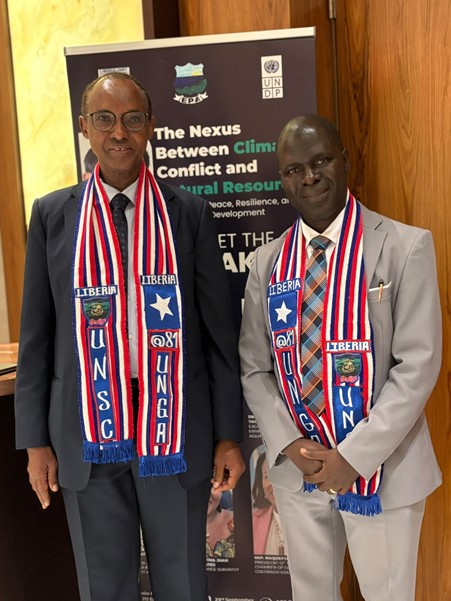
MONROVIA – Liberia has used its Security Council seat to argue that climate change is a security threat, not merely an environmental one. At a side event in New York, the Environmental Protection Agency said a warming world multiplies the pressures that fuel conflict. Poverty, displacement and disputes over land, forests and minerals top that list. For a country whose civil war fed on timber and diamonds, the argument is personal. The harder test is at home. Illegal mining, deforestation and coastal erosion already strain Liberian communities. The EPA’s central demand was pointed: climate finance must reach the people who guard the forests. It now promises an outcome summary to guide partnerships. THE ANALYST reports.
The Environmental Protection Agency (EPA) of Liberia on Wednesday, September 23, hosted a high-level side event in New York on the links between climate change, conflict and natural resources, as the country uses its 2026–2027 seat on the United Nations Security Council to widen the Council’s security agenda.
The dialogue, held under the theme “The Nexus between Climate, Conflict, and Natural Resources: Pathways to Peace, Resilience, and Sustainable Development,” took place at the Westin New York Grand Central on the sidelines of the 81st Session of the UN General Assembly.
EPA Executive Director Dr. Emmanuel K. Urey Yarkpawolo welcomed participants and closed the event. Foreign Minister Sara Beysolow Nyanti, who is also Dean of the Cabinet, was invited to formally open it and set out its objectives, while UN Under-Secretary-General and United Nations Development Programme (UNDP) Associate Administrator Haoliang Xu delivered the keynote address. It was the third major Security Council-focused event Liberia has organized on the sidelines of this year’s General Assembly.
A Threat Multiplier
“Climate change does not automatically cause conflict,” Yarkpawolo said in his welcome remarks. “However, it acts as a threat multiplier by worsening poverty, food insecurity, displacement, inequality, and competition over essential resources.” Where institutions are weak or communities are excluded from decisions, he said, those pressures can contribute to tension and instability.
He said Liberia understands these challenges from both its history and its development experience. Peace, he said, is one of the country’s greatest achievements, but sustaining it requires Liberia to address emerging environmental and economic risks.
The country’s forests, minerals, wetlands, rivers, fisheries and coastal ecosystems, he added, also offer enormous opportunities for national development.
When Resources Become Grievances
The EPA chief warned that mismanaged resources carry a price. “When natural resources are poorly governed, illegally exploited, or unfairly distributed, they can become sources of grievance,” he said, citing illegal mining, deforestation, coastal erosion, pollution and land disputes as problems that affect communities and can undermine social cohesion.
Liberia therefore convened the event to promote an integrated approach, he said. “Climate action cannot be separated from peacebuilding,” Yarkpawolo said.
Natural resource management, he added, cannot be separated from justice, transparency, community participation and sustainable livelihoods, and climate finance must reach the communities that protect forests, biodiversity, water resources and other natural assets.
Liberia’s own history gives the argument weight. The country’s civil wars were partly sustained by the exploitation of timber and diamonds, which drew UN sanctions, and questions of land rights, concession management and the sharing of resource wealth remain live more than two decades after the fighting ended.
Liberia’s Council Agenda
Yarkpawolo tied the dialogue directly to Liberia’s Council tenure. “As Liberia serves on the United Nations Security Council, we believe climate-related security risks deserve serious and balanced attention,” he said.
The aim, he said, was to identify practical solutions, mobilize partnerships and advance recommendations that governments, partners, investors and communities can implement.
He said Liberia hoped the dialogue would strengthen support for adaptation, forest and biodiversity conservation, resilient livelihoods, transparent resource governance and locally led peacebuilding.
Women, young people, local communities, climate survivors and other vulnerable groups, he said, must help shape those solutions and share in their benefits.
The climate-security agenda remains contested at the Council itself. In December 2021, Russia vetoed a draft resolution that would have integrated climate-related security risks into the Council’s work, and India voted against it.
What the Panel Said
In his closing remarks, Yarkpawolo said the discussion had confirmed that climate change is also a matter of human security, justice, social stability and sustainable peace. It may not directly cause conflict, he said, but it can deepen poverty, displacement, inequality and competition over natural resources.
According to the text of his closing statement, he credited Minister Nyanti with placing the dialogue within Liberia’s commitment to multilateralism, conflict prevention and climate justice.
He said Xu had emphasized climate change as a threat multiplier requiring coordinated action and strong institutions, while Daniel Kandy, a board member of Mighty Earth, had presented financing for forests and biodiversity as an investment in livelihoods, resilience and peace.
Kenya’s Special Envoy for Climate Change, Ambassador Dr. Ali Daud Mohamed, stressed that climate policy, natural resource governance, development planning and peacebuilding must reinforce one another, Yarkpawolo said.
Jeanine Milly Cooper, Chief Executive Officer of the Liberia Carbon Market Authority, argued that carbon markets and climate finance must produce measurable community benefits while protecting environmental integrity and public confidence.
Dr. Antwi-Boasiako Amoah, chair of the African Group of Negotiators and a director at Ghana’s Environmental Protection Authority, drew attention to climate-security risks in the Sahel and West Africa. He called for regional cooperation, adaptation finance and preventive action.
Colorado State Representative Naquetta Ricks highlighted how responsible resource management can create opportunity and sustain peace, with the diaspora contributing investment, knowledge and partnerships.
Oretha Juah Bestman-Yates, presented by organizers as a climate-change survivor, gave the discussion what Yarkpawolo called its “human face.”
Her testimony, he said, showed that climate change already affects families, homes and livelihoods, and that policy must improve the lives of vulnerable communities.
The discussion was moderated by Francine Pickup, UNDP Deputy Assistant Administrator.
From Dialogue to Action
“The way forward is clear,” Yarkpawolo said. Climate action, he said, must be conflict-sensitive and locally informed, natural resource governance must be transparent and equitable, and climate finance must reach frontline communities, with women, young people, climate survivors, local communities and the diaspora as active partners.
He announced that the EPA, working with the Ministry of Foreign Affairs, the Liberia Carbon Market Authority, the Forestry Development Authority (FDA) and other partners, will prepare a brief outcome summary capturing the event’s principal recommendations. The summary, he said, will be shared with participants and used to guide follow-up discussions, partnerships and potential investments.
Yarkpawolo invited organizations interested in forest conservation, biodiversity, resilient livelihoods, climate security and sustainable natural resource governance to support practical initiatives in Liberia. He urged participants to use the occasion to build the partnerships needed “to move from dialogue to action.” No date was given for the release of the outcome summary.
See more Liberia News Network stories in Google Search by adding LNN as one of your Preferred Sources.
★ Add LNN as a Preferred Source