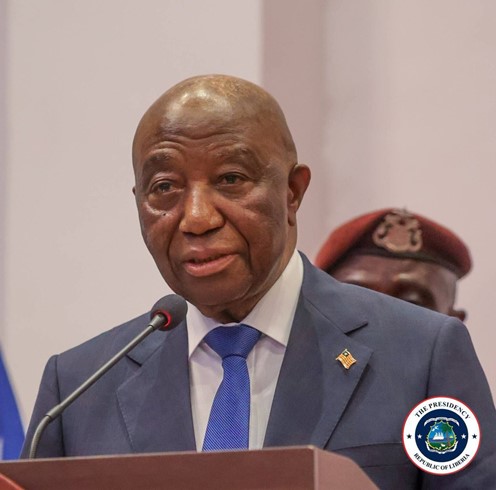
MONROVIA – President Joseph Nyuma Boakai, Sr. mounts the General Assembly rostrum on Thursday, he will speak for two Liberias. One is the Liberia of the brochure. It sits on the Security Council, has crossed a billion dollars in revenue and has made record cocaine seizures. The other is the Liberia of the market stall, where the billion is not yet felt and war-era justice still waits. Last year he promised the world a war crimes court and a louder voice for Africa. This year the world can finally check the receipts. What he says, and what he leaves out, will show which Liberia he chooses to present to the world. THE ANALYST reports.
Last Year’s Promises
Boakai’s address to the 80th Session last September offers the clearest guide to what he will say this time. He told the Assembly then that although the nameplate for Liberia’s 2026–2027 Council term would read “Liberia,” the seat “belongs to Africa,” and he pledged that the country’s contribution would be shaped by its hard-earned experience in conflict resolution, peacebuilding and political transition.
He renewed Liberia’s appeal for international support for a War and Economic Crimes Court, told world leaders that public officials were now required to declare their assets, and argued that “using 1945 solutions to tackle 2025 challenges is neither reasonable nor realistic.”
He also promised that Liberia would present its next Voluntary National Review on the Sustainable Development Goals (SDGs) in 2026.
Those pledges now come due. The General Debate of the 81st Session opened on Tuesday under the theme “Restoring trust, managing transformation: a United Nations that delivers for all,” and Liberia arrives nine months into its Council term and three months before it takes the Council’s rotating presidency in December.
Africa’s Seat, Liberia’s Gavel
Expect the Council seat to be the spine of the speech. Liberia has built its week around the issues it plans to carry into its December presidency. Youth and Sports Minister Atty. Cornelia Wonkerleh Kruah told a side event on September 18 that UN representatives had pledged support for bringing Youth, Peace and Security before the Council that month.
Boakai is likely to repeat Liberia’s call for permanent African representation on the Council under the Common African Position, and to press again for reform of the international financial system. The government has said its agenda at this session covers peace and security, climate action, global health, digital governance, humanitarian response and rebuilding confidence in multilateral institutions.
From Battlefield to Blueprint
The President’s strongest card is Liberia’s own passage from war to peace. His program for Monday, September 21, placed him at the launch of the country’s third National Action Plan on Women, Peace and Security at UN Headquarters, with Nobel laureate Leymah Gbowee among the featured voices. On September 18, the government unveiled its PATHWAYs Framework, a plan to give every young Liberian a pathway to opportunity by 2035.
A speech built on that record lets Liberia present itself as a country with lessons to share, not only needs to declare. Sweden’s Ambassador Nicola Clase, who chairs the Liberia Configuration of the UN Peacebuilding Commission, has described the country as a global role model for peacebuilding and post-conflict transition. Boakai can be expected to invoke the women of the Peace Huts, the end of the peacekeeping era and two peaceful transfers of power, in 2018 and 2024, as proof.
The weak point in that story is money. Monday’s program included a panel on financing the new action plan, with Finance Minister Augustine Kpehe Ngafuan and development partners at the table. Who pays for the plan remains an open question, and Gbowee has separately urged the government to finance at least half of its youth agenda.
The War Crimes Court Test
No promise from last year will be read more closely than the court. Boakai has moved further on it than any of his predecessors. Earlier this year, he signed an executive order releasing US$2 million (L$364.72 million) to the Office of the War and Economic Crimes Court and extending its mandate to April 30, 2027, and on May 20 he transmitted draft statutes for the War and Economic Crimes Court and a National Anti-Corruption Court to the Legislature.
The bills then stalled. On May 21, the Senate sent them to its Judiciary Committee, citing a joint resolution that requires a security plan, a financial mobilization plan with donor commitments and, notably, a commitment from the UN Security Council endorsing the court. The court itself is not projected to begin operations until November 2027, and civil society groups have warned that the timeline risks colliding with the 2029 elections while victims and alleged perpetrators grow old.
That places an unusual request within the President’s reach. Liberia now sits on the very body whose endorsement its own Senate demands. Expect Boakai to renew his call for international backing, and watch whether he asks the Council, in plain words, for the endorsement the Senate says it needs.
Funding is the other pressure point. Sweden, one of the few donors to have backed the court effort, has ended its bilateral aid to Liberia and is closing its embassy in Monrovia. The European Union and the UN human rights office are running a modest US$724,000 transitional justice program for 2026 and 2027.
The Billion-Dollar Boast
On the economy, the President has a number he will not want to leave in Monrovia. For the first time in Liberia’s history, domestic revenue has crossed US$1 billion in a single year, a milestone Boakai marked on September 15 with a special national address titled “One Billion, One Liberia,” describing the money as earned, not borrowed. Revenue has climbed from about US$612 million in 2023 to about US$848 million in 2025, and the government is targeting US$1.3 billion by the end of this year.
The wider figures support the story he is likely to tell. In his State of the Nation Address in January, he reported 5.1 percent growth in 2025, inflation down to 4 percent, its lowest in more than two decades, and gross international reserves up to US$576 million. A self-financing Liberia is an attractive message in a hall where aid budgets are shrinking.
The counter-narrative is already in print. Public debt stood at about US$2.8 billion at the start of the year. When FrontPage Africa reporters sampled market vendors and commuters from Paynesville to Gbarnga, most described a billion dollars they could neither see nor spend.
Nurses are demanding that no public salary fall below US$500, and opposition leader Alexander B. Cummings has warned that ordinary Liberians “will not feel the benefit of that billion dollars” if spending patterns do not change. The President may celebrate the billion in New York, but the budget debate in Monrovia will decide what it is worth.
Cocaine and the Rule of Law
Boakai is also likely to offer Liberia’s drug crackdown as evidence that a small state can confront transnational crime. Authorities intercepted about 237.6 kilograms of cocaine at Roberts International Airport in June and, in July, announced the seizure of nearly four tonnes valued at about US$317 million, the largest in the country’s history. Several police officers were implicated in the July case.
The same file carries political risk. Former Vice President Jewel Howard-Taylor was charged on August 19 with drug trafficking, money laundering and related offenses and is in custody awaiting trial. Her lawyers call the case politically motivated, and official accounts of whether it is tied to the July seizure have differed. With the matter before the courts, the President is more likely to speak of cooperation against trafficking networks than of any individual case.
Climate, Forests and Ships
Climate will give Liberia its most distinctive argument. At a side event on Wednesday, the Environmental Protection Agency (EPA) described climate change as a threat multiplier that worsens poverty, displacement and competition over land, forests and minerals. Expect the President to tie climate finance to peace and to insist that the money reach the communities that guard the forests.
A quieter maritime thread runs beside it. Liberia operates the world’s largest ship registry, and this week it presented an alternative to the International Maritime Organization (IMO) Net-Zero Framework, arguing that the shipping transition must not burden developing countries. If Boakai raises it, he will frame it as climate justice, while environmental groups and Pacific island states, which say the proposal weakens the framework, will hear it differently.
What May Go Unsaid
Some of the season’s most contested subjects are unlikely to reach the rostrum. Liberia has agreed to accept up to 1,200 third-country deportees from the United States within a year, and the first 20 landed at Roberts International Airport on August 20. The government calls the arrangement humanitarian, while immigration lawyers have raised concerns about the rights of people sent to countries they do not call home.
At home, the Cybercrime Act of 2025 faces its first major test in the case of Jerry Nyantee Wrato, who is due in court over AI-generated content depicting Vice President Jeremiah Kpan Koung. Senator Amara M. Konneh, who voted for the law, has warned that it must never be used to silence critics. The opposition, meanwhile, continues to accuse the government of a witch-hunt against former officials, a charge the government rejects.
A President who speaks of restoring trust in institutions abroad will be judged by how those institutions behave at home. Former Foreign Minister Dee-Maxwell Saah Kemayah, Sr. made that very argument to an international peace summit on Monday, warning that prosecutions perceived as political could endanger Liberia’s peace.
The President’s case for Liberia as a peacemaker will be tested closest to home, on the Makona River. Trouble started on February 9, when reports of Guinean incursions into Lofa County surfaced. It escalated the next day, when troop reinforcements and aerial support sent residents fleeing.
In early March, local officials said Guinean soldiers had crossed near Sarlumba in Foya District, halted road construction near the Makona, seized equipment and removed a Liberian flag. Guinea then deployed troops to the frontier on Sunday, March 15.
The next day, March 16, Boakai joined talks in Conakry led by Guinea’s Mamady Doumbouya, with Sierra Leone’s Julius Maada Bio also attending and Côte d’Ivoire acting as witness. The three leaders agreed to keep the status quo ante in disputed areas while negotiations continue toward a lasting and mutually acceptable solution.
They also announced joint technical commissions on border delimitation and management. Yet barely a day after the summit, armed Guinean soldiers crossed the Makona again at Sarlumba.
Expect Boakai to cite the Conakry process as proof that Liberia settles disputes through diplomacy rather than force. His government has framed the summit in terms of Article 33 of the UN Charter, which calls for disputes to be settled through negotiation. A Council member that keeps its own border quiet makes a stronger case for conflict prevention elsewhere.
Yet the dispute is not settled. Liberia’s own human rights commission, after a fact-finding mission to the Sarlumba area in April, said the alleged incursions had displaced thousands and disrupted livelihoods. It warned that Guinea’s intentions remain unclear. For the displaced farmers of Foya, the test of the President’s words in New York is whether they can safely return to their fields.
The Real Measure
Liberia’s record gives Boakai more to say than most of the leaders who will speak this week. A nation that once hosted UN peacekeepers now votes on UN peacekeeping mandates, and a government long dependent on donors now boasts a billion dollars of its own revenue.
Yet speeches at the General Assembly cost little, and the delegation knows it. The New Dawn has urged the President to turn his meetings into jobs, electricity, roads and better schools, and the Liberian Observer has argued that the country’s next chapters must be written in visible progress at home rather than in declarations in New York.
The farmer in Lofa and the market woman at Red Light will not hear the speech live. They will measure it by what reaches them after the delegation comes home.
See more Liberia News Network stories in Google Search by adding LNN as one of your Preferred Sources.
★ Add LNN as a Preferred Source