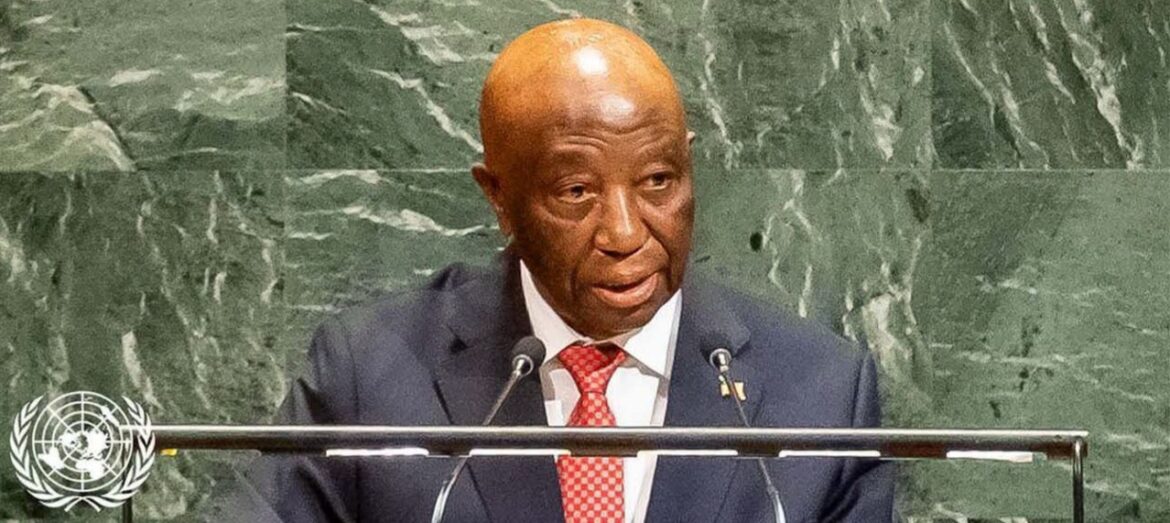
NEW YORK, USA – President Joseph Nyuma Boakai Sr. has placed Liberia at the center of one of Africa’s biggest diplomatic demands, calling for sweeping reforms of the United Nations Security Council and the international financial system while insisting that eighty years of waiting for equal representation can no longer continue.
Addressing world leaders during the 81st Session of the United Nations General Assembly on Thursday, September 24, President Boakai declared that the credibility of multilateral institutions depends on correcting long-standing global inequalities that continue to exclude developing nations from meaningful decision-making.
Standing before representatives from nearly every country in the world, Boakai argued that the current international system reflects the realities of 1945 instead of today’s world, where Africa has become home to approximately 1.5 billion people and represents nearly one-third of the UN’s membership.
“Eighty years of patience is enough. The time for structural reform is now,” Boakai declared, receiving attention for one of the strongest African reform messages delivered during this year’s General Assembly.
The Liberian leader reaffirmed his country’s support for the Common African Position on Security Council reform, insisting that Africa deserves no fewer than two permanent seats carrying the same rights and responsibilities enjoyed by existing permanent members, including veto powers as long as such privileges remain part of the Council’s structure.
Boakai emphasized what he described as a glaring contradiction within the UN system, noting that roughly eighty percent of Security Council mandates concern African peace and security, yet no African nation occupies a permanent seat on the body responsible for making many of those decisions.
He welcomed recent progress during Intergovernmental Negotiations, where the African Model was presented as an important step toward formal text-based negotiations, describing the development as an encouraging sign that decades of advocacy are beginning to gain momentum.
Beyond Security Council reform, Boakai expanded Liberia’s diplomatic push to include fundamental changes within the Bretton Woods institutions, particularly the World Bank and the International Monetary Fund.
He argued that developing countries continue to suffer under financial structures that no longer reflect modern economic realities, warning that rising interest rates, shrinking fiscal space, and unsustainable debt burdens threaten the ability of poorer nations to achieve the Sustainable Development Goals before 2030.
According to Boakai, reforming the international financial architecture is not merely a technical discussion among economists but a necessary condition for restoring trust between wealthy and developing nations.
The President called for expanded concessional financing, stronger debt sustainability measures, and more predictable development financing while demanding greater voting power for developing countries inside the institutions that influence billions of lives.
His address also framed Liberia’s international message within its own historical experience.
Boakai reminded delegates that Liberia was among only four African countries that signed the UN Charter in San Francisco in 1945, arguing that his country’s journey from civil conflict to constitutional democracy demonstrates the enduring value of dialogue, institution-building, and international cooperation.
He warned that global trust in multilateralism has weakened because international principles have been applied inconsistently and selectively, creating deeper fragmentation across the world.
Rather than abandoning multilateral cooperation, Boakai urged member states to strengthen it through reforms that deliver fairness, accountability, and equal participation.
As Liberia currently serves on the United Nations Security Council, Boakai said his government is putting those principles into practice by confronting emerging threats across West Africa, including organized crime, cyber warfare, and illicit narcotics trafficking along the Gulf of Guinea.
He appealed for stronger international partnerships to improve coast guard surveillance, intelligence sharing, and modern port security technologies to combat transnational criminal networks.
Concluding his address, Boakai called on world leaders to choose decisive action over institutional stagnation, arguing that the United Nations must evolve into an organization that not only debates global crises but also resolves them through credible, inclusive, and effective leadership.
See more Liberia News Network stories in Google Search by adding LNN as one of your Preferred Sources.
★ Add LNN as a Preferred Source