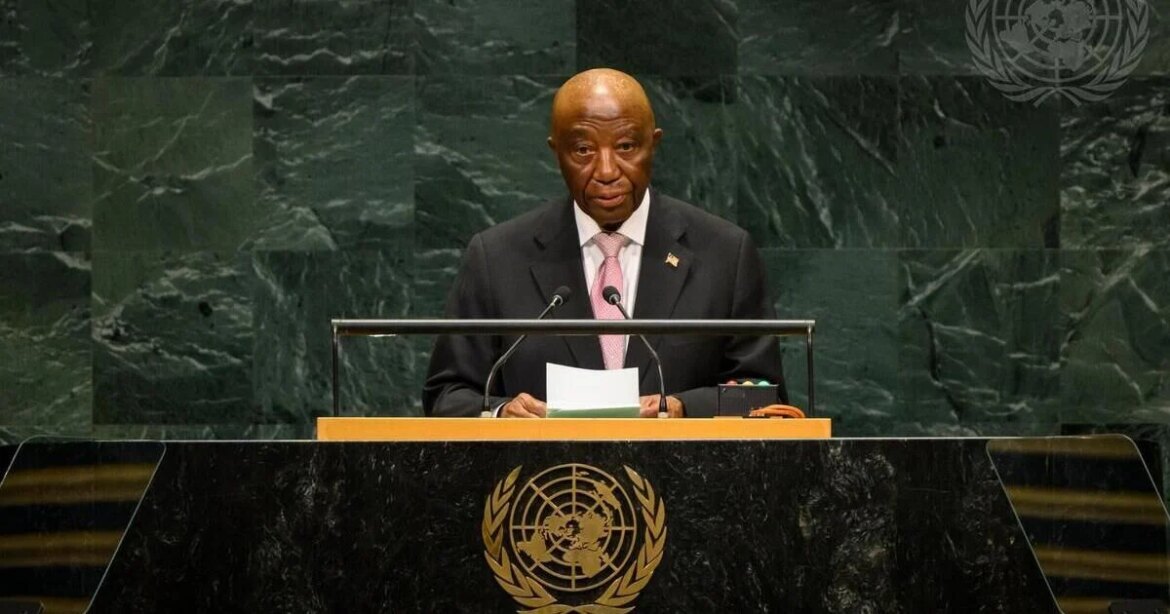
President Joseph Nyuma Boakai has delivered a forceful call for a fundamental restructuring of the international system, declaring that “80 years of patience is enough” and demanding permanent African representation on the United Nations Security Council as a necessary step toward restoring confidence in global governance.
Addressing the General Debate of the 81st Session of the United Nations General Assembly in New York on Thursday, September 24, 2026, President Boakai said the credibility of the multilateral system is increasingly threatened by what he described as the inconsistent and selective application of international principles.
Speaking under the Assembly’s theme, “Restoring Trust, Managing Transformation: A United Nations That Delivers for All,” President Boakai argued that the world does not need less multilateralism in response to growing geopolitical fragmentation, but rather a more representative and effective system capable of responding to the challenges confronting nations.
“In our view, a lingering crisis of legitimacy and relevance demands urgent attention,” Boakai told world leaders and delegates. “Trust in multilateralism is broken and needs to be restored, not because the principles of the Charter are no longer relevant, but because we have applied them inconsistently and selectively.”
His address placed Liberia squarely behind calls for major reforms to the global political, financial and security architecture, with particular emphasis on correcting Africa’s longstanding exclusion from permanent membership of the Security Council.
President Boakai said Liberia’s position is informed by its own history as one of the original signatories of the United Nations Charter in 1945 and by the country’s experience of moving from civil conflict toward constitutional democracy.
“80 years of patience is enough. The time for structural reform is now,” he declared.
Africa’s Security Council Exclusion
The President’s strongest demand came on reform of the UN Security Council, where he said Africa’s absence from the permanent membership structure represents a historic imbalance that can no longer be justified.
Boakai pointed to Africa’s population of about 1.5 billion people and its 54 UN member states, while noting that a disproportionate share of the Security Council’s work concerns peace and security issues on the continent.
“Africa remains without a single permanent seat on the organ responsible for global peace,” he said. “This historical injustice is no longer tenable.”
Liberia, he said, continues to support the Common African Position on Security Council reform and welcomed progress in the intergovernmental negotiations toward text-based negotiations.
Under Liberia’s position, Africa should receive no fewer than two permanent seats, with the full rights and responsibilities attached to permanent membership, including veto rights for as long as the veto continues to exist.
The proposal also calls for additional non-permanent African seats.
“Correcting the imbalance is not a favour for Africa,” Boakai declared. “It is necessary to restore United Nations trust, credibility and legitimacy.”
The call places Liberia alongside broader African efforts to secure permanent representation on the Council, a reform question that has remained unresolved for decades. The President of the 81st General Assembly, Khalilur Rahman, has himself identified Africa’s underrepresentation as a priority, saying the continent must have a greater role in the Council.
‘Without Peace, Development Is Impossible’
President Boakai also used his address to warn that development cannot be sustained in an environment of war, instability and humanitarian crises.
“Without peace, development is impossible and without inclusive development, peace is an illusion,” he said.
He called for an immediate end to hostilities in conflict zones, unhindered humanitarian access and full respect for international humanitarian law, while urging the international community to place greater emphasis on preventing conflicts before they escalate.
According to Boakai, investment in preventive diplomacy, mediation and early-warning mechanisms is not only a moral responsibility but also an economically sensible approach because preventing wars costs less than rebuilding societies after conflicts.
The President spoke from Liberia’s current position as an elected member of the UN Security Council, saying the country is applying its peace and security principles while confronting emerging threats across West Africa.
Among those threats, he identified transnational organized crime, cyber warfare and illicit narcotics trafficking along maritime routes in the Gulf of Guinea.
Liberia, he said, is working through its joint security forces to tighten pressure on international drug trafficking networks.
But Boakai warned that such threats cannot be effectively addressed by individual countries acting alone.
“No nation can police global criminal networks alone,” he said, calling for international support for Coast Guard surveillance, intelligence sharing and port-security technologies.
Boakai Takes Aim at Global Financial System
Beyond security, President Boakai mounted a strong case for reform of the international financial architecture, arguing that developing countries are being squeezed by debt, limited fiscal space and repeated external shocks.
As the world approaches the deadline for achieving the Sustainable Development Goals under the 2030 Agenda, Boakai said developing countries require greater access to affordable and predictable development financing rather than financial conditions that further restrict their ability to invest in development.
“At the core, this is a crisis of an international financial system designed for a different era,” he said.
Liberia is therefore calling for urgent structural changes to the global financial system, including concessional financing, debt sustainability and predictable development capital.
Boakai also demanded greater representation for developing countries within the institutions that shape global financial policy, particularly the World Bank and International Monetary Fund.
He argued that the governance structures of the Bretton Woods institutions continue to reflect the realities of 1945 more than those of the contemporary global economy.
“A financial system that decides the fate of billions cannot continue to be governed by the few,” he said.
For Liberia, he added, reform of the international financial architecture is not simply a technical matter but a necessary condition for achieving the Sustainable Development Goals and rebuilding confidence in multilateral institutions.
Defends Liberia’s Domestic Transformation
While pressing for international reforms, President Boakai also used his UN address to highlight what he described as ongoing reforms within Liberia.
He said his administration is working to strengthen public accountability, improve financial management, intensify the fight against corruption and support the judiciary as part of efforts to rebuild citizens’ confidence in public institutions.
At the center of the government’s domestic transformation agenda, he cited Liberia’s ARREST Agenda for Inclusive Development, which focuses on agriculture, roads, the rule of law, education, sanitation and tourism.
Boakai said the government has made progress in revenue administration and infrastructure development, including rural roads intended to improve links between farms and markets.
The President presented Liberia’s post-war recovery as evidence that countries can rebuild institutions and democratic systems when sustained political commitment is applied.
“Having risen from the ashes of conflict to become a resilient democracy, Liberia is living proof that dialogue can overcome division, that institutions can be built,” he said.
He linked that experience to Liberia’s broader argument for a stronger multilateral system capable of preventing conflict and supporting countries emerging from crisis.
Climate Justice for Liberia
President Boakai also pressed the case for greater international support for countries that contribute relatively little to global emissions but face serious consequences from climate change.
He said Liberia contributes virtually nothing to global emissions while its communities are increasingly affected by coastal erosion, flooding and disruptions to agricultural cycles.
At the same time, Liberia is home to a significant portion of the remaining Upper Guinean rainforest, which the President described as a vital global carbon sink maintained for the benefit of humanity.
“Climate responsibility must be paired with climate justice,” Boakai said.
He called on industrialized nations to honour their climate-finance commitments and support mechanisms addressing loss and damage suffered by vulnerable countries.
His remarks framed Liberia’s environmental position around the principle that countries contributing least to climate change should not be left to bear disproportionate costs from its effects.
Youth, Women and the Digital Future
President Boakai also placed young people at the center of Liberia’s development aspirations, pointing out that approximately 60 percent of the country’s population is under 25.
He described Africa’s youthful population as a major source of potential innovation and economic transformation, but warned that governments must invest in the skills required to convert that demographic advantage into productive economic participation.
Liberia, he said, must equip its young people with science, technology, engineering and mathematics education, digital literacy and technical training.
The objective, he argued, should be to ensure that African youth become “co-creators in the global digital economy, not just consumers.”
Boakai also reaffirmed Liberia’s commitment to political, economic and social equality for women and girls.
“Gender equality remains essential,” he said, linking women’s participation to stronger peace agreements, economic growth and accountable governance.
Calls for Global Rules on Artificial Intelligence
Artificial intelligence and emerging technologies also featured prominently in Boakai’s address.
Liberia welcomed international efforts to establish stronger governance frameworks for new technologies, including the UN Secretary-General’s Independent International Scientific Panel on Artificial Intelligence.
But Boakai warned that developing countries must not be relegated to the role of consumers of technologies designed and controlled elsewhere.
“Developing nations must not be left behind as mere consumers of algorithms designed elsewhere,” he said.
He called for support to enable developing countries to build what he termed genuine digital sovereignty, while backing binding ethical standards and stronger regulation of artificial intelligence, particularly its application in warfare.
His warning was direct: technological innovation must serve human development rather than increase the capacity for destruction.
“Innovation must protect human development, not automate human destruction,” Boakai said.
Liberia’s Founding UN Role
Throughout his address, Boakai repeatedly connected Liberia’s contemporary diplomatic position to its historic role in the creation of the United Nations.
Liberia was among the countries that signed the UN Charter in San Francisco in 1945, helping establish the international organization after the devastation of the Second World War.
Boakai said Liberia’s continued support for international law, human rights, dignity and development is rooted in that founding commitment.
He also used Liberia’s own history of civil conflict and democratic recovery to argue that international institutions can regain public confidence when they deliver tangible results.
The President’s intervention comes as the UN confronts renewed questions over the effectiveness of multilateral institutions amid wars, geopolitical divisions, climate pressures, economic instability and rapid advances in artificial intelligence.
The 81st General Assembly is being held under the theme “Restoring Trust, Managing Transformation: A United Nations That Delivers for All.” Bangladesh’s Khalilur Rahman was elected president of the session on June 2, 2026, and the session opened on September 8.
‘Liberia Is Ready’
In his closing appeal, President Boakai warned that the international community faces a choice between allowing multilateralism to weaken further or undertaking meaningful reforms to restore confidence in the UN system.
“The choices before the 83rd General Assembly are stark,” he said, before calling on member states to act decisively.
Boakai invoked Liberia’s experience at the founding of the United Nations, saying the country is prepared to again participate actively in efforts to strengthen the international system.
“As we did in San Francisco in 1945, Liberia is ready,” he declared.
He urged member states to recommit themselves to the founding purpose of the United Nations: preventing war, protecting human dignity and ensuring that vulnerable populations are not abandoned.
“Let us leave this Assembly committed to a United Nations that is not deliberate on crisis, but also resolve them and restore trust through results,” Boakai said.
See more Liberia News Network stories in Google Search by adding LNN as one of your Preferred Sources.
★ Add LNN as a Preferred Source