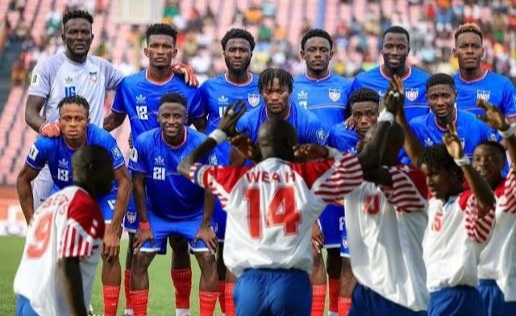
Today in Kigali, Liberia embarks on another AFCON journey, carrying the weight of history, expectations, and a nation’s unfulfilled football dream.
Some football matches last just 90 minutes, but others echo through decades. For Liberia, today’s Africa Cup of Nations qualifier against Rwanda in Kigali is not merely the start of another qualifying campaign; it represents another chapter in a story that has remained painfully unfinished for nearly 25 years.
The Lone Star has only participated in the Africa Cup of Nations twice. Not five times, not ten, and certainly not as a regular contender in Africa’s premier football tournament.
Just twice—in 1996 and 2002. Both appearances were linked to an extraordinary generation led by Africa’s greatest football icon, George Weah. Then, the door closed.
Year after year, qualification campaigns came and went. New players emerged, coaches came and went, and administrations shifted. Promises were made, and hope was rekindled. Yet, the Lone Star remained on the outside looking in.
The last time Liberia stood among Africa’s footballing nations at the AFCON finals, George Weah was still donning the national colors, and the tournament was hosted in Mali. That was back in 2002. Now, 24 years later, Liberia is once again pursuing the same goal. That is why Kigali holds such significance.
THE WEIGHT OF 24 YEARS
The Confederation of African Football (CAF) currently recognizes Liberia as one of the nation’s facing a long wait to return to the continental finals. The CAF’s summary of Liberia’s AFCON history is quite succinct: the nation made its debut in 1996, had a second appearance in 2002, and has not returned since then.
These two appearances created memories that are now part of Liberian football folklore. In 1996, Liberia marked its AFCON debut with a 2-1 victory over Gabon. Six years later, the Lone Star made a return to the finals, managing draws against hosts Mali and Algeria before narrowly losing to Nigeria.
Then came a prolonged drought. This drought has lasted so long that an entire generation of Liberians has grown up experiencing AFCON mainly through television, rather than witnessing their national team compete live.
This is the painful irony of Liberian football: a nation that produced George Weah—the only African to ever win the Ballon d’Or—has struggled to establish its national team as a regular contender on the continent’s grandest stage. Today, another generation has the chance to rewrite that story.
KIGALI IS WHERE THE NEW STORY BEGINS
The setting couldn’t be more fitting. Rwanda isn’t just Liberia’s first opponent; the Amavubi also know the agony of waiting.
Rwanda’s last appearance in the AFCON was back in 2004, and they narrowly missed out on qualifying for the 2025 tournament, finishing level on points with Benin but losing the head-to-head tiebreaker.
This isn’t just a clash between two nations that are strangers to disappointment; it’s a matchup of two footballing countries eager to transform another qualifying campaign into a success.
For Liberia, though, the stakes are even higher. The Lone Star can’t afford to play just for the present. Every pass, tackle, chance, and goal will be weighed against their 24-year absence from the tournament. The players may be new, the coach may be new, but the weight of expectation remains unchanged.
A NEW ERA, A FAMILIAR DREAM
Moroccan coach Mohammed Adil Erradi is stepping into his first competitive campaign with Liberia, facing the kind of pressure that has weighed heavily on previous generations of Lone Star teams. His initial official competitive match will be against Rwanda, followed by a home game against Mali on September 29.
The team is also benefiting from increased institutional and financial support. The Ministry of Youth and Sports has announced that the government is ramping up its backing for the qualification campaign, with player appearance fees rising from US$1,000 to US$2,500, along with extra incentives for wins.
This support is crucial because qualification isn’t achieved through speeches, patriotism, or nostalgia; it demands thorough preparation, adequate resources, and players who can perform under pressure. Most importantly, it requires results over six qualifying matches.
Liberia’s Group K campaign features Rwanda, Mali, and Cape Verde, with the top two teams earning a spot in the 2027 AFCON finals.
Ultimately, the numbers will decide who heads to Kenya, Uganda, and Tanzania, but before the calculations come into play, the emotions are running high, especially in Kigali today.
THIS IS NOT ABOUT GEORGE WEAH ANYMORE
One of the toughest realities facing Liberian football is that the nation can no longer rely on the legacy of the Weah generation. Those memories are invaluable, but they won’t help score goals today, defend corners, or win the current battles. The players stepping onto the pitch in Kigali need to create their own legacy.
For over twenty years, Liberia has been on the lookout for the next generation that can lead the Lone Star back to the top tier of African football. This quest is still ongoing. The pressure is immense, but so is the potential.
Beyond the fundraising events, government commitments, tactical discussions, and endless debates about Liberian football, there is one clear goal: return to AFCON. Not tomorrow, not someday, but right now.
THE QUESTION THAT HAS HAUNTED LIBERIA
How long will Liberia have to wait? How many more qualifying campaigns will come and go? How many more generations of talented Liberian footballers will retire without ever stepping onto the continental stage?
And how many more times will Liberians watch other African nations celebrate their qualifications, all the while wondering when their own national colors will once again be on display?
These questions remain unanswered in Monrovia today. They are not addressed by the government, the Liberia Football Association, or the coach. The answers lie on the football pitch; in Kigali. For the Lone Star, the journey back to AFCON starts there.
It has been twenty-four years since Liberia last competed among Africa’s elite. Twenty-four years of waiting, hoping, and questioning whether the glory of 1996 and 2002 can ever be revisited.
Today, the wait meets a chance for change. The past will observe from the stands, while the future unfolds on the pitch. For 90 minutes in Kigali, Liberia’s football dream will once again pulse with life.
The Lone Star is knocking on Africa’s door once more. This time, Liberia hopes that the door will finally swing open.
See more Liberia News Network stories in Google Search by adding LNN as one of your Preferred Sources.
★ Add LNN as a Preferred Source