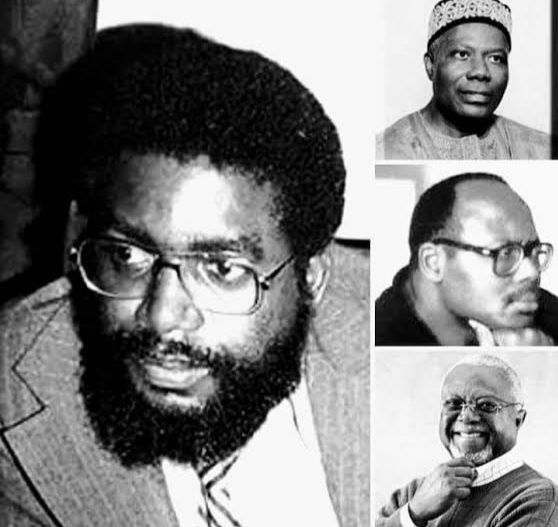
How a Generation of Young Liberian Intellectuals Began Challenging the Old Political Order
Liberia’s Progressive Movement did not emerge overnight, nor was it born from the military barracks.
Its origins can be traced to a generation of young Liberian intellectuals, university students, academics and political activists who, during the 1970s, began questioning the country’s longstanding political, economic and social order.
Some were in Liberia.
Others were studying, working or living in the United States.
From university classrooms in Monrovia to the Liberian diaspora in America, a new political consciousness was taking shape.
Liberian Journalist, Lyndon Ponnie, Sr., leafs through historical documents, declassified reports and Liberia’s Truth and Reconciliation Commission records to examine the beginnings of the Progressive Movement and the young intellectuals who stood at its heart.
The story begins in the early 1970s, when Liberia was still firmly dominated by the True Whig Party, which had controlled national politics for generations.
But beneath the appearance of political stability, a younger generation was increasingly questioning the country’s distribution of political power, economic opportunity and social resources.
The intellectual ferment was particularly visible among students and academics.
The Liberian Truth and Reconciliation Commission describes the early 1970s as the period in which two pivotal opposition movements emerged: the Movement for Justice in Africa (MOJA) and the Progressive Alliance of Liberia (PAL). The Commission describes MOJA as emerging in Liberia in 1973 and PAL as being founded in the United States in 1975.
These were not initially mass political parties in the conventional sense.
They were movements of ideas.
And behind those ideas was a new generation of Liberians who were increasingly asking an uncomfortable question:
Why should political power, economic opportunity and national decision-making remain concentrated in the hands of a small political establishment?
THE UNIVERSITY BECOMES A POLITICAL ARENA
One of the most important centers of this intellectual awakening was the University of Liberia.
Among the figures associated with the emerging movement was Dr. Togba-Nah Tipoteh, an economist and professor who helped establish MOJA in 1973 among students at the University of Liberia. Historical accounts identify Dr. Amos Sawyer and Dr. Henry Boimah Fahnbulleh Jr. among the early figures associated with the movement.
These were not merely young men seeking government positions.
They were intellectuals debating the fundamental question of what Liberia should become.
They discussed African nationalism, Pan-Africanism, economic inequality, political participation, labor rights and the role of the state in national development.
MOJA’s politics were strongly Pan-Africanist and focused on social and political change. Historical sources describe it as advocating labor rights, electoral reform and changes in income distribution.
And then there was another center of the emerging movement—the United States.
THE LIBERIAN DIASPORA ENTERS THE STRUGGLE
While MOJA was developing around Liberia’s intellectual community, another group of young Liberians abroad was becoming increasingly political.
In the United States, Liberian students and scholars were discussing the political conditions back home.
The result was the formation of the Progressive Alliance of Liberia.
Historical sources place PAL’s organization in the United States in the mid-1970s, led by Gabriel Baccus Matthews and supported by Liberian students and members of the diaspora.
The significance of PAL was enormous.
It meant that the Liberian political opposition was no longer confined to Monrovia.
Liberians living and studying abroad were becoming part of an organized political conversation about the future of their country.
A U.S. State Department telegram from May 1979 provides a remarkable contemporary account of how the Tolbert administration viewed this development. It states that PAL had been founded in New York in 1974, that it subsequently established an office in Monrovia, and that the organization attracted disaffected students and critics of the government. The document also records the government’s concern about the radicalization of university students.
The official account, however, must be read carefully.
It represents the Tolbert government’s characterization of PAL and the political crisis, including its assertion of foreign or “alien” influence. The same U.S. document acknowledges that the Liberian government could not document a specific Soviet connection to the 1979 demonstrations.
That distinction is important when reconstructing history.
THE MEN AT THE HEART OF THE MOVEMENT
At the center of this emerging political awakening were personalities who would later occupy some of the most important positions in Liberia’s history.
Togba-Nah Tipoteh became one of the principal intellectual architects of MOJA.
Amos Sawyer became one of its most prominent political thinkers and would later head Liberia’s Interim Government of National Unity during the civil war.
Henry Boimah Fahnbulleh Jr. became another important MOJA figure and later served in senior government positions.
Dew Tuan-Wreh Mason was another intellectual associated with the movement.
And in the diaspora, Gabriel Baccus Matthews emerged as the principal figure behind PAL.
Liberia’s TRC specifically identifies Tipoteh, Sawyer, Fahnbulleh, Dew Mayson and Baccus Matthews among the prominent figures of the progressive movement.
These men did not necessarily agree on everything.
MOJA and PAL had different organizational cultures and political emphases.
But they shared a fundamental challenge to the political status quo.
FROM IDEAS TO ORGANIZATION
The Progressive Movement gradually moved beyond intellectual discussion.
MOJA organized political education and awareness activities.
PAL pursued a more confrontational strategy and sought to mobilize ordinary Liberians, particularly in urban communities.
An academic study of Liberia’s political economy describes the difference this way: MOJA emphasized labor rights, electoral and income-distribution reforms, while PAL emphasized direct action and the political mobilization of the urban masses.
That difference would become crucial.
For years, Liberia’s political opposition had been weak and fragmented.
But now a generation of young intellectuals was attempting something different:
to turn political ideas into organized public action.
And eventually, those ideas would leave the university campuses and diaspora meeting rooms and enter the streets of Monrovia.
THE ROAD TO APRIL 14
The most dramatic test would come with the 1979 rice crisis.
The government’s proposal to increase the price of rice became a catalyst for mass opposition.
By then, the Progressive Movement had helped create a political environment in which economic grievances could quickly become political demands.
The April 1979 demonstrations would expose the depth of public anger and fundamentally change Liberia’s political trajectory.
The U.S. State Department’s contemporary records described the growing radicalization of university students and their disaffection with the government in the context of the crisis.
The Liberian TRC later characterized MOJA and PAL as the first formidable opposition to the True Whig Party and its political order.
What began as an intellectual challenge had become a national political force.
And within a year, Liberia’s old political order would collapse.
On April 12, 1980, soldiers led by Master Sergeant Samuel K. Doe overthrew President William R. Tolbert Jr.
The Progressive Movement did not itself carry out the military coup.
But the intellectual and political environment created during the preceding decade had fundamentally changed Liberia.
The young intellectuals who had once been dismissed by elements of the establishment as idealistic students and scholars had helped make political change part of the national conversation.
The question that followed would be far more difficult:
What happens when intellectual revolution meets military power?
That is where the next chapter of Liberia’s Progressive Movement begins.
Part Two: “MOJA vs PAL — The Rival Progressive Forces That Challenged the True Whig Order. ”
See more Liberia News Network stories in Google Search by adding LNN as one of your Preferred Sources.
★ Add LNN as a Preferred Source