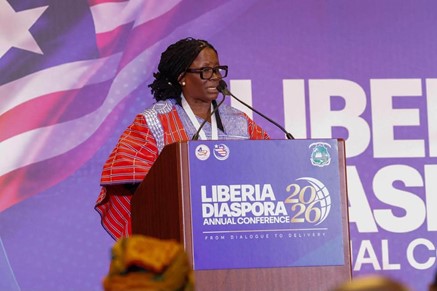
MONROVIA – year ago, Senate President Pro Tempore Nyonblee Karnga-Lawrence made eight pledges to Liberians abroad. This weekend, she returned to the same platform to answer for them. She framed that return as accountability itself. Visa-free travel to about 36 countries is on the credit side. So are a reopened embassy in India and funding for the Office of Diaspora Affairs. The Diaspora Engagement Act, diaspora voting and investment incentives remain unfinished. Karnga-Lawrence said so herself, plainly and without spin. That candor sets a test for next year. The diaspora now holds a dated record against which the Senate can be measured. THE ANALYST reports.
Senate President Pro Tempore Nyonblee Karnga-Lawrence has told the Liberian diaspora that the Senate’s work over the past year helped secure visa-free access for Liberian passport holders to about 36 countries, the reopening of Liberia’s embassy in India, and a budgetary appropriation for the Office of Diaspora Affairs. She conceded, however, that the Diaspora Engagement Act she pledged to champion has not yet become law, declaring that she “shall not represent otherwise.”
Karnga-Lawrence made the disclosures in a policy statement delivered at the Liberia Diaspora Annual Conference 2026, held September 25–27, 2026, in Alexandria, Virginia, United States of America, under the theme “From Dialogue to Delivery.”
She addressed delegates of the Liberian diaspora, representatives of the Government of the Republic of Liberia, officials of the Office of Diaspora Affairs and the Diaspora Engagement Task Force, development partners and honored guests, speaking in the name of the 55th Legislature and on behalf of the Liberian Senate.
Returning To Account For Pledges
The Pro Tempore recalled that she had delivered a policy statement from the same platform one year earlier, setting forth the commitments of the Senate to the Liberian diaspora. Those commitments, she noted, were rooted in legislation, in oversight, and in the conviction that “our nation’s unity is incomplete so long as it excludes those of our people who reside beyond our borders.”
“I return to you today not to repeat that statement, but to render an account of it,” Karnga-Lawrence declared. She added that “a government that speaks and does not report back to its people has not yet learned the meaning of accountability, and a Senate that pledges without returning to answer for its pledge has not yet earned the trust it seeks.”
She reminded the conference that in 2025 she had set out eight undertakings. These were the passage of a Diaspora Engagement Act; the establishment of fiscal incentives for diaspora investment; the institution of accountability mechanisms for diaspora-funded programs; the advancement of education and skills-transfer partnerships; the strengthening of legal protections for returning Liberians; the establishment of a Senate-led Diaspora Affairs Caucus; the reform of electoral processes to enable diaspora voting; and, above all, a renewed national commitment to unity and reconciliation.
Karnga-Lawrence reaffirmed her position that the Liberian diaspora “is not a peripheral constituency of remittance alone, but a central reservoir of talent, of capital, of advocacy, and of patriotic devotion to the Liberian nation.” It is in that conviction, she stated, that the record of the past year must be understood.
Visa-Free Access, India Embassy
On the freedom of movement of Liberians, the Pro Tempore reported that sustained collaboration between the Legislature and the Ministry of Foreign Affairs (MOFA) has secured visa-free access for holders of the Liberian passport to approximately 36 nations of the world. She described the achievement as tangible evidence that “the dignity of Liberian citizenship, wherever it is carried, is being restored upon the international stage.”
On Liberia’s diplomatic presence abroad, she announced that the Embassy of the Republic of Liberia in the Republic of India has been reopened. The reopening, she noted, reestablishes a vital diplomatic and economic post in “one of the world’s most consequential economies” and restores to Liberians in South Asia an institutional home on foreign soil.
Diaspora Act Still Under Deliberation
On the Diaspora Engagement Act, Karnga-Lawrence acknowledged that the legislative instrument she pledged to champion remains under active and earnest deliberation before the Senate and has not yet ascended to the status of law. “I shall not represent otherwise,” she stated, while affirming that the bill proceeds with the seriousness its subject demands and that her commitment to its ultimate passage “remains undiminished.”
On the franchise of the diaspora, she disclosed that the Legislature has entered into formal engagement with the National Elections Commission (NEC) toward the enactment of diaspora participation in Liberia’s national elections. Because the undertaking touches matters of constitutional consequence and electoral architecture, she explained, it is being pursued with the deliberateness so weighty a reform requires, “for it is better to enact this right correctly than to enact it in haste.”
Budget Support For Diaspora Office
On institutional sustenance, the Pro Tempore reported that the Legislature has provided a budgetary appropriation for the Office of Diaspora Affairs of the Republic of Liberia. She argued that “an institution without resources is an aspiration without instrument,” and that the appropriation affirms diaspora engagement as “a standing and funded obligation of the Liberian state, not a seasonal courtesy extended at conferences such as this one.”
Beyond statute and appropriation, she noted, the Senate has maintained sustained and substantive engagement with the Office of Diaspora Affairs and the Diaspora Engagement Task Force throughout the year, with the establishment of the Senate’s Diaspora Legislative Caucus. That engagement, she stated, included the formal courtesy call and the presentation of the 2025 Annual Report before the 55th Legislature, which she called “the quiet labor of partnership, undertaken not for ceremony, but because the work does not pause between conferences.”
What Remains Unfinished
Karnga-Lawrence told the gathering that “it is not the custom of honest governance to claim completion where none yet exists,” and that she would not depart from that custom. She listed the matters still outstanding: the Diaspora Engagement Act awaits passage; diaspora suffrage awaits the legal and administrative architecture that will render it operable, “not merely declared”; the framework of fiscal incentives for diaspora investment remains in formation; and the protections owed to returning Liberians in matters of land, reintegration and dispute resolution remain a labor still ahead.
She stated that she set forth these unfinished matters not to diminish what has been achieved. Rather, she explained, the conference theme, “From Dialogue to Delivery,” demands “candor in equal measure to celebration.”
Pledge To Return Next Year
Addressing Liberians in the hall and across the diaspora, the Pro Tempore argued that the past year’s gains are “not the fulfillment of our undertaking, but the proof of its sincerity.” She declared: “Thirty-six nations did not open their doors of their own accord. An embassy did not reopen without deliberate resolve. An appropriation did not appear upon our national budget by happenstance.”
These, she stated, are the fruits of sustained legislative will and proof that when the Senate makes a pledge before the diaspora, it intends to be held to account for it. She named the passage of the Diaspora Engagement Act, the full enactment of diaspora suffrage and the establishment of a Diaspora Investment Fund as the principal unfinished business, and pledged to return to the platform in the year to come “bearing further record of delivery — not further declaration of intent.”
Karnga-Lawrence closed with the assurance that “Liberia is as much your Republic as it is ours.” The Senate, she declared, does not regard members of the diaspora as guests of the nation they were born to, but as citizens whose residence abroad diminishes neither their claim upon the country nor the state’s obligation to them. She thanked the delegates for their attention, their patience and their “enduring faith in the Liberian nation,” and prayed that the Republic of Liberia may “continue to rise through our collective labor and our common devotion.”
See more Liberia News Network stories in Google Search by adding LNN as one of your Preferred Sources.
★ Add LNN as a Preferred Source