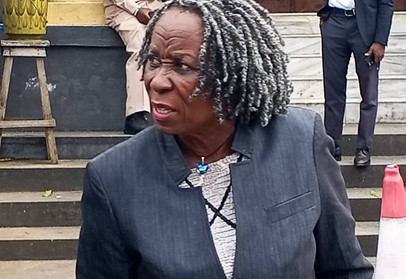
MONROVIA – Former General Services Agency (GSA) Director General Mary T. Broh has handed the Saudi rice trial defense a useful line. Testifying on Monday before Criminal Court “C,” she conceded that the rice moved between government agencies. She insisted the movement followed an inter-agency mandate, not personal gain. That testimony shifts the ground of the case. The question is no longer whether the rice moved. It is whether moving it, and redirecting some to the police and ministries, was lawful. Broh also set movement gate passes against the quantities cited in the indictment. Saudi Arabia donated 29,412 bags for disaster victims. The court must now separate poor record-keeping from criminal appropriation. THE ANALYST reports.
Former General Services Agency (GSA) Director General Mary T. Broh on Monday, September 28, testified before Criminal Court “C” that the movement of Saudi-donated rice to the GSA was carried out under an inter-agency mandate involving several government institutions. Appearing as a subpoenaed witness, Broh told the court that government officials involved in handling the humanitarian shipment were acting pursuant to government instructions and not for personal benefit.
Her testimony provided a detailed account of how thousands of bags of the Saudi-donated rice were transferred to the GSA and subsequently distributed to communities and government institutions. Broh acknowledged that the rice was moved between government agencies but argued that the movement of the rice, standing alone, did not establish theft, diversion or criminal intent.
“The people did a fantastic job,” Broh told the court while addressing the handling and distribution of the rice. She questioned how officials could be accused of stealing the donation when portions of the rice, according to her testimony, were ultimately distributed to communities and government institutions. Her testimony focused heavily on the distinction between the administrative movement of government property and proof of criminal appropriation.
Acting on Inter-Agency Instructions
Broh told the court that her involvement began after she received a call from then Foreign Affairs Minister Dee-Maxwell Saah Kemayah requesting assistance with warehousing the Saudi-donated rice at the GSA. “When I got the call from Ambassador Kemayah, he said he needed my assistance in terms of warehousing the Saudi-donated rice at the GSA,” she testified.
According to Broh, a subsequent meeting was held at the GSA involving the Ministry of Foreign Affairs, the Ministry of Internal Affairs, the National Disaster Management Agency (NDMA) and the GSA. She said Kemayah chaired the meeting but emphasized that the decision to move the rice resulted from an inter-agency discussion rather than a unilateral directive from the former minister.
The testimony is significant to the defense because the prosecution has alleged that Kemayah and former Deputy Foreign Minister Thelma D. Sawyer improperly became involved in the handling and distribution of rice donated by Saudi Arabia for humanitarian purposes. Broh, however, presented the process as one carried out through several government institutions.
She said she was not given a concept note detailing the broader operation and instead acted on instructions arising from the inter-agency meeting. Broh further testified that Kemayah did not provide her with a detailed explanation as to why the rice had to be moved from NDMA to GSA, but instructed that the transfer be made as quickly as possible.
Broh confirmed that 11,200 bags of the donated rice were stored at the GSA. She further testified that 13,895 additional bags were transferred from NDMA to the GSA. According to her account, approximately 25,000 bags therefore passed through the GSA.
Broh also questioned discrepancies between quantities contained in the indictment and figures reflected in the actual movement documents. She told the court that some gate passes showed quantities different from those cited in the indictment, suggesting that the actual movement records should be considered when determining the quantity of rice transferred. Her testimony raises a key issue in the trial: whether discrepancies in documentary records establish criminal conduct or reflect administrative and accounting inconsistencies in the handling of a large humanitarian shipment.
Distribution Never Halted
Broh testified that she was unaware of any decision stopping the general distribution of the rice while it was under GSA custody. “The general distribution was never halted under GSA,” she told the court.
She acknowledged that portions of the rice were distributed to government institutions, including the Liberia National Police, the Ministry of Justice and the Ministry of National Defense, although the original Saudi donation was intended primarily for disaster-affected persons. Broh explained that government institutions sometimes faced urgent food shortages requiring intervention.
She cited correctional facilities as an example, saying shortages of food in prisons could create serious problems, including confrontations among inmates. In her view, addressing such shortages could itself be considered part of responding to an emergency.
However, the issue leaves an important question for the court: whether the government had sufficient authority and documentation to redirect humanitarian rice from its intended beneficiaries to government institutions. That question could become significant in determining whether the transfers were legitimate administrative decisions or constituted unauthorized diversion, as alleged by the prosecution.
Broh denied having knowledge of any sale of the donated rice. She also testified that she was unaware of any investigative committee allegedly established by Kemayah to examine the rice matter.
Her testimony, she maintained, was primarily concerned with the movement of rice from NDMA to GSA and its subsequent administrative handling. She therefore sought to distinguish her role in receiving and warehousing the rice from allegations concerning what happened to the rice afterward.
Remarks Outside the Courtroom
Broh’s strongest expression of support for the defendants came after she left the courtroom. She was reportedly heard saying: “The people are innocent, the people didn’t do anything.”
The statement was not made while she was testifying under oath and therefore does not carry the same evidentiary status as her testimony before the court. However, it closely reflected the position she advanced from the witness stand — that officials involved in the rice operation were performing government functions and acting pursuant to instructions arising from an inter-agency arrangement.
Broh’s testimony followed that of defense witness Kpakolo Bonner, who previously testified about rice distributed in Norvling Town Community in Paynesville. Bonner told the court that the rice was distributed to residents affected by flooding and that he participated in the verification and distribution process.
However, when shown a waybill in court, Bonner disputed the signature appearing on the document, insisting that it was not his. His testimony has provided the defense with another basis to challenge the reliability and interpretation of some documentary evidence presented in the case. The defense appears to be advancing a broader argument that discrepancies in paperwork, transfers between government institutions and differences in recorded quantities should not automatically be equated with criminal appropriation.
The Question Before the Court
At the center of the trial is a fundamental question: What happened to the Saudi-donated rice after it arrived in Liberia? Saudi Arabia donated 29,412 bags of 25-kilogram rice to Liberia as humanitarian assistance.
The prosecution alleges that substantial quantities of the donation were subsequently misapplied, diverted or stolen. The defendants have denied the allegations.
Broh’s testimony does not dispute that rice was transferred between government agencies. Instead, it challenges the inference that such transfers, without additional evidence, establish criminal conduct. Her testimony also places the spotlight on whether the government maintained adequate documentation and controls over the rice as it moved through multiple institutions.
The issue could ultimately require the court to distinguish between poor record-keeping, administrative decisions and deliberate criminal appropriation. Broh’s appearance marks another significant development in the defense’s presentation of its case.
Rather than denying that the rice was transferred, she acknowledged the movement but maintained that the transfers were undertaken within the government structure and pursuant to instructions from an inter-agency arrangement. The prosecution, however, must establish its allegations through admissible evidence and prove the criminal elements of the charges against each defendant beyond a reasonable doubt.
For the defense, the central argument emerging from Broh’s testimony is that the movement of public property between government institutions does not, by itself, prove theft. For the prosecution, the critical question remains whether the defendants exceeded their lawful authority and whether the documentary evidence and other testimony establish criminal responsibility.
As the trial continues, Criminal Court “C” will ultimately have to assess the competing accounts and determine whether the disputed movements of the Saudi-donated rice were legitimate government actions or, as alleged by the prosecution, part of an unlawful scheme involving humanitarian property. For now, Broh’s testimony has strengthened the defense narrative that government officials were responding to institutional and humanitarian needs and that the physical movement of the rice should not, without more, be treated as proof that it was stolen.
See more Liberia News Network stories in Google Search by adding LNN as one of your Preferred Sources.
★ Add LNN as a Preferred Source