MONROVIA — For women and girls who have survived female genital mutilation (FGM) and other forms of gender-based violence, the road to recovery often extends far beyond the immediate trauma.
It can mean having access to basic hygiene supplies, clothing and personal-care items while receiving support—and, for some survivors, having the means to earn an income and rebuild their lives.
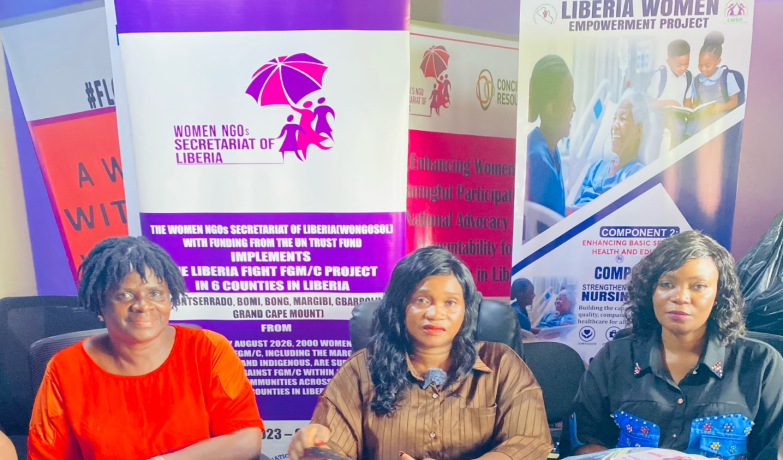
That is the focus of the Liberia Fight FGM Project, implemented by the Women NGOs Secretariat of Liberia (WONGOSOL) with support from the United Nations Trust Fund to End Violence Against Women.
As part of the project’s third consignment of support, WONGOSOL is distributing more than 600 dignity kits to FGM and gender-based violence (GBV) survivors through one-stop centers across six counties, while also preparing livelihood assistance for 365 women trained in vocational skills, business management and Village Savings and Loan Association (VSLA) approaches.
Speaking to journalists on Friday, WONGOSOL Executive Director Esther S. David Yango said the initiative is designed to address both the immediate needs of survivors and the economic challenges that can leave women vulnerable.
“The FGM project connects immediate survivor support with long-term economic empowerment, providing dignity today while helping women and communities build safer, more resilient and sustainable futures,” Yango said.
A Kit Designed to Restore Dignity
The dignity packages are intended to provide practical assistance to survivors during periods of vulnerability.
According to the project team, the packages include toothpaste and toothbrushes, sanitary pads, towels, grease, slippers, bath soap and lappa.
Separate packages are being prepared for younger survivors, with additional items such as snacks and toys intended to make their experience at one-stop centers less distressing.
Clothing, including blouses and dresses, will also be provided to survivors.
Jeneba M. Vessellie, Project Officer of the Liberia Fight FGM Project, explained that the materials are meant to respond to survivors’ immediate needs while they access health, psychosocial, legal and protection services.
The intervention, officials said, recognizes that recovery is not only about medical or legal assistance, but also about helping survivors maintain dignity during a difficult period.
From Training to Economic Independence
While the dignity kits address immediate needs, the livelihood component is intended to provide a longer-term pathway toward economic independence.
The project has trained 365 women in livelihood and vocational skills, business management and VSLA approaches. The beneficiaries include FGM practitioners, FGM survivors, single mothers, youth and women leaders.
Livelihood support will include materials for activities such as soap making, tailoring, pastry and baking, among other income-generating activities.
The project team said the assistance is intended to help trained women put their skills into practice, establish or strengthen businesses and build economic resilience after the project ends.
For women involved in agriculture, support will also include farm materials and tools.
The program team cited women survivors involved in agriculture in Bong County as among those expected to receive agricultural support.
The project also links livelihood support to savings.
Officials said beneficiaries trained in savings and loan approaches will be able to save from the income generated through their activities, helping them sustain their businesses beyond the life of the project.
Reaching Communities Across Six Counties
The Liberia Fight FGM Project is being implemented in 38 communities across Bomi, Bong, Gbarpolu, Grand Cape Mount, Margibi and Montserrado Counties, in partnership with local organizations.
The project has also established 40 community coalitions comprising 600 members who have been trained to advocate for the protection of women and girls against harmful practices, including FGM and sexual and gender-based violence.
The coalitions are also supporting advocacy for the passage of the Women and Girls Protection Act.
The implementing partners include Women Care Initiative (WOCI) in Bomi; Community Women Peace Initiative (CWPI) in Bong; Paramount Young Women Initiative (PAYWO) in Gbarpolu; Sister Hands Liberia (SHL) in Grand Cape Mount; Women Education and Development Organization of Liberia (WEDOL) in Margibi; and WEPS and INSURED in Montserrado.
Two Needs, One Intervention
For WONGOSOL, the distribution represents two connected sides of survivor support.
The dignity kits respond to immediate needs, helping survivors meet basic personal-care and hygiene needs and restore a measure of dignity during vulnerable periods.
The livelihood assistance, meanwhile, addresses longer-term economic vulnerability by helping women transform training into sustainable economic opportunities.
Together, the interventions form what WONGOSOL describes as an integrated approach to prevention, protection and women’s economic empowerment.
The project, which began in October 2023, was initially scheduled to end in September 2026. A five-month no-cost extension has now extended implementation through February 28, 2027.
For the women at the center of the intervention, the assistance is therefore about more than receiving a package or business materials.
It is about having something to meet a need today and, through skills and economic opportunities, something to build on tomorrow.
See more Liberia News Network stories in Google Search by adding LNN as one of your Preferred Sources.
★ Add LNN as a Preferred Source