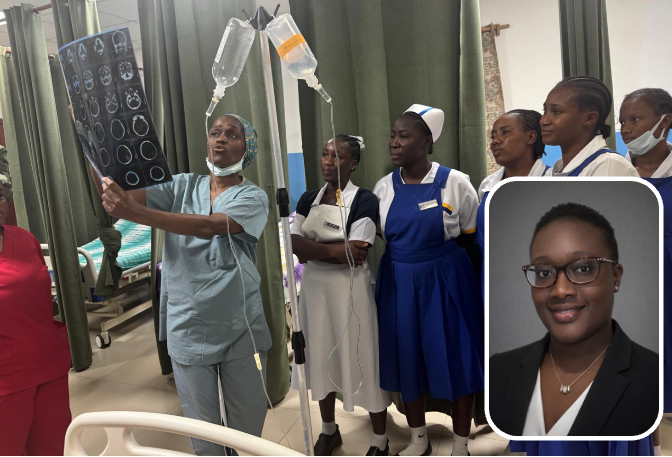
Monrovia – Dr. Carolyn Baindu Moore built her career in the United States as a robotic thoracic surgeon, operating on the chest with some of medicine’s most advanced tools. In December, she is bringing a team home to Liberia, where some counties have no specialist surgeon at all.
Moore is CEO and founder of the Liberia Global Health & Surgery Consortium (LGHSC), which officially launches in the country from December 1 to 15. Over two weeks, the group plans to operate on patients, train 250 people in emergency care, screen 100 market women for cancer and hold its first fundraising dinner in Monrovia.
She says she doesn’t want this to be a one-time trip.
“Our goal is to leave a lasting impact through compassionate care, practical training, and partnership with Liberian healthcare teams,” she said.
The gap
Liberians who have had to travel to Monrovia for an operation, or wait weeks for one, know the problem well. The civil war emptied hospitals and drove doctors and nurses abroad. Ebola came a decade later and killed health workers the country could not afford to lose. Liberia has been rebuilding ever since.
The most recent nationwide count of surgical staff, published in the World Journal of Surgery, found 286 surgical providers in Liberia in 2018. Only 67 were accredited specialists. That is 1.6 specialist surgeons, anaesthetists and obstetricians for every 100,000 people. The Lancet Commission on Global Surgery says a country needs at least 20. At the time, Liberia had three specialist anaesthesiologists for the whole country.
Most of those specialists work in Montserrado. In the poorest counties, the study counted 0.7 per 100,000 people.
Women pay much of the price. A UNFPA policy brief drawn from the 2022 national census puts Liberia’s maternal mortality ratio at 854 deaths per 100,000 live births, roughly one mother lost for every 117 babies born alive. The sub-Saharan African average is 536. The global target is under 70.
Then there is cervical cancer. The ICO/IARC Information Centre on HPV and Cancer estimates that 656 Liberian women are diagnosed with it each year and 469 die, about nine women every week. Most of those deaths can be prevented, because screening can catch the disease before it turns deadly. But many women are never screened, and by the time they reach a doctor, little can be done.
Who is coming
The visiting team is made up of five surgeons, six nurses, four global health partners and two medical students. On the ground, they will join five Liberian surgeons, 15 nurse volunteers and 17 Consortium volunteers. The Consortium says it works in partnership with the Ministry of Health, and that its plans were drawn up with Liberian hospital leaders, county health teams and community representatives.
In the operating room
From December 7 to 11, visiting and Liberian surgeons will operate side by side. Where equipment and facilities allow, that will include laparoscopic surgery, sometimes called “keyhole” surgery. Instead of one long cut, the surgeon works through a few small openings with a camera. Patients generally hurt less, heal faster and go home sooner. Few Liberian hospitals offer it now, and teaching it is one of the main reasons for the mission.
The hospital where the operations will take place, and how many patients will be treated, have not yet been confirmed. Local clinical teams will screen patients.
Learning to save a life
The same week, at the Liberian Learning Center at Paynesville Town Hall, the Consortium plans to train 250 people in Basic Life Support and Advanced Cardiovascular Life Support. The courses teach CPR and what to do when a heart stops, the kind of emergency where a few minutes decide whether someone lives.
Not all the trainees are medical workers. Doctors, nurses, residents and emergency medical staff will sit alongside ordinary citizens. Some will be trained to teach the course themselves, so the skills keep spreading after the visitors leave. The team is also donating automated external defibrillators, or AEDs, the portable machines that can shock a stopped heart back into rhythm. They are still hard to find in Liberia.
For the women who feed the city
On December 14 and 15, a mobile clinic will set up in the Rock Church community in Duazon for 100 market women. They will get health education, consultations, breast and reproductive health checks, and screening for cervical cancer and high-risk HPV. The Consortium’s pathology team will process the samples, and its OB/GYN workgroup will work with local health authorities to make sure women who need further care are referred.
The choice of market women is deliberate. They keep homes running and children in school, often on what they earn in a single day. Taking a day off to sit in a clinic queue means losing that money, so many simply don’t go. This time, the clinic is coming to them.
A dinner and a longer plan
On December 12, the Consortium will host its founding fundraiser banquet at Afro Beach, Thinker Village, from 6:00 to 10:30 p.m. Dr. Deddeh E. P. Supuwood will give the keynote address, and Mr. Leo Lekpele Nupolu-Johnson will be master of ceremonies. Money raised will go to patient care, training, equipment, and community outreach.
Medical missions to Africa have a mixed reputation. Too often, a team flies in, operates, takes pictures and flies out, leaving behind patients with no follow-up and local staff no better prepared than before. LGHSC, which now counts more than 120 members in more than 16 workgroups on four continents, says it is trying to do the opposite. It wants to work through Liberian teams, keep mentoring them, and keep checking on patients long after December.
Whether that works will only be clear after the visitors fly home. It will show in the nurse in Paynesville who can now run a resuscitation, the surgeon who can do a keyhole operation without help, and the market woman in Duazon whose results come back in time.
“Our measure of success,” Moore said, “is the quality of care we provide and the knowledge, confidence, and capacity that remain long after we leave.”
Those wishing to volunteer, partner, or support the launch can contact [email protected] or visit www.libghsc.org. Donations can be made at https://givebutter.com/XYetak.
See more Liberia News Network stories in Google Search by adding LNN as one of your Preferred Sources.
★ Add LNN as a Preferred Source