n
The International Monetary Fund (IMF) has unlocked approximately US$50.16 million in fresh financing for Liberia, citing continued progress under the country’s economic reform program and an economy that expanded by 5.1 percent in 2025, with growth projected to accelerate to 5.5 percent in 2026.
The financing follows the successful completion of the fourth review under Liberia’s 40-month Extended Credit Facility (ECF) arrangement and the first review under the 21-month Resilience and Sustainability Facility (RSF) arrangement.
The IMF Executive Board approved the disbursements on September 28, 2026, releasing SDR 19.3 million, equivalent to approximately US$26.2 million, under the ECF, and SDR 17.62 million, equivalent to approximately US$23.96 million, under the RSF.
The latest financing is not budget support. Instead, the resources will largely strengthen Liberia’s international reserves at the Central Bank of Liberia, providing additional buffers to support macroeconomic stability and the country’s capacity to withstand external shocks.
The IMF said the ECF and RSF arrangements are supporting Liberia’s efforts to preserve macroeconomic stability and debt sustainability, strengthen financial-sector resilience, advance governance reforms and build resilience against climate-related shocks.
The latest approval comes as Liberia’s economy continues to show resilience despite a more difficult external environment, including heightened global risks and elevated and volatile oil prices.
According to the IMF, real Gross Domestic Product (GDP) growth reached 5.1 percent in 2025, while growth is expected to rise to 5.5 percent in 2026, supported particularly by strong mining production, construction and manufacturing activity.
Following the Executive Board’s discussion, IMF Acting Chair and Deputy Managing Director Bo Li said Liberia had continued to implement sound economic policies, allowing the country to make significant progress under both financing arrangements.
“The authorities have continued to implement sound policies, allowing them to make significant progress under the Extended Credit Facility (ECF) and the Resilience and Sustainability Facility (RSF) arrangements,” Li said.
“Despite heightened global risks, primarily stemming from elevated and volatile oil prices, Liberia’s economic performance has remained satisfactory,” he added.
Li said Liberia’s fiscal consolidation has continued, supported by strong revenue performance that has helped reduce debt vulnerabilities, while capital expenditure has accelerated.
However, the IMF official stressed that further progress is required to rationalize unproductive expenditures and create additional fiscal space for priority infrastructure projects while preserving fiscal discipline.
The Fund also said a successful rollout of the Value Added Tax (VAT), combined with mining taxation reforms and the rationalization of tax exemptions, would help generate more predictable domestic revenues to finance priority investments.
The IMF noted that the government’s intention to phase the use of one-off mining windfall resources over 2026–27 is appropriate given existing implementation-capacity constraints.
It further stressed that stronger project selection, implementation and monitoring would be critical to improving the quality of public spending and raising Liberia’s growth potential.
Despite the positive growth outlook, the IMF cautioned that Liberia remains exposed to several downside risks.
Inflation remains contained, but the Fund identified higher fuel prices, declining donor support, commodity-price volatility and climate-related shocks as risks that could weigh on the economy.
The Central Bank of Liberia, according to the IMF, will continue monitoring price developments closely and remains prepared to tighten monetary policy if necessary to contain inflationary pressures arising from elevated global oil prices.
The Fund also raised financial-sector concerns, noting that bank recapitalization is progressing, although more slowly than planned. It called for an acceleration in the reduction of non-performing loans to strengthen bank balance sheets and support the expansion of credit to the private sector.
The IMF also identified the issuance of new banknotes as an immediate priority to help alleviate existing shortages.
On governance, the Fund said publication of the governance diagnostic report and implementation of a focused action plan would demonstrate the government’s commitment to addressing institutional weaknesses and combating corruption.
It also said removing legal barriers to publishing the asset declarations of all public officials would further strengthen transparency and accountability.
The IMF’s latest review highlighted several reforms that will remain central to Liberia’s economic program, including domestic revenue mobilization, particularly the implementation of VAT in 2027; prudent and transparent management of the government’s one-off mining concession payment; completion of bank restructuring; and efforts to address remaining vulnerabilities within the financial sector.
Governance and fiscal transparency reforms are also expected to remain at the center of the program, alongside climate-resilience measures supported by the RSF.
The IMF said initial progress on climate-related reforms is encouraging but stressed that continued technical assistance and close coordination with development partners will be important to ensure the reforms are implemented on schedule.
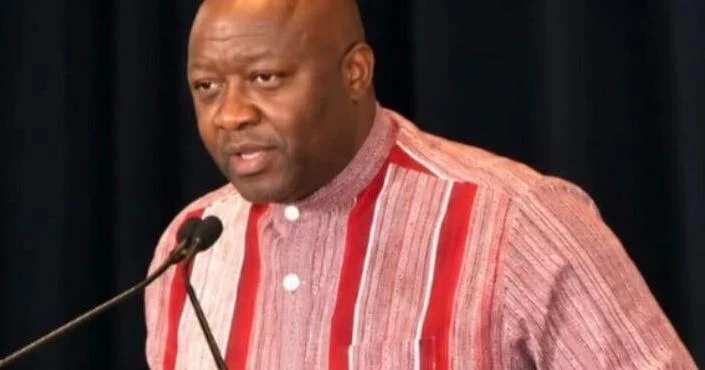
Reacting to the Executive Board’s decision, Minister of Finance and Development Planning Augustine Kpehe Ngafuan welcomed the additional financing, describing it as support for both development and macroeconomic stability.
“We are elated that our country has been approved to receive additional financing to support development and macroeconomic stability,” Ngafuan said.
“Let me express our gratitude to the IMF for its excellent partnership. This is a vote of confidence in the visionary leadership of President Joseph Nyumah Boakai,” he added.
Ngafuan also commended the Governor of the Central Bank of Liberia and his team, the Commissioner General of the Liberia Revenue Authority and his team, as well as other stakeholders involved in Liberia’s economic reform efforts.
“We also want to thank the Governor of the Central Bank of Liberia and his team, the Commissioner General of the Liberia Revenue Authority and his team, as well as all other stakeholders who continue to work together to advance Liberia’s economic progress,” he said.
The Finance Minister said the IMF approval reflects growing international confidence in Liberia’s reform trajectory and its commitment to sustainable development.
“We will make sure that there will be no reversals in the gains that have been made,” Ngafuan said.
Liberia’s current ECF arrangement was approved by the IMF Executive Board in September 2024, with total access of SDR 155 million, equivalent to 60 percent of Liberia’s IMF quota.
With the latest disbursement, total ECF disbursements have reached SDR 96.5 million, approximately US$131.67 million.
The RSF arrangement provides Liberia with total access of SDR 193.8 million, equivalent to approximately US$265 million. The facility is designed to support reforms that strengthen Liberia’s resilience to climate-related shocks and address long-term structural vulnerabilities.
The latest IMF decision adds to Liberia’s external financial buffers while reinforcing the reform program being implemented by the government.
The Fund’s assessment indicates that Liberia enters the next phase of its economic program with solid growth momentum but also faces pressure to maintain fiscal discipline, strengthen domestic revenue collection, address financial-sector vulnerabilities and improve governance.
With real GDP growth projected at 5.5 percent in 2026, the IMF expects mining, construction and manufacturing to remain important drivers of economic activity.
At the same time, the latest review underscores that sustaining growth will depend on the government’s ability to strengthen revenue mobilization, improve public investment, maintain financial-sector stability and advance structural reforms while protecting the economy against external and climate-related shocks.
See more Liberia News Network stories in Google Search by adding LNN as one of your Preferred Sources.
★ Add LNN as a Preferred Source