
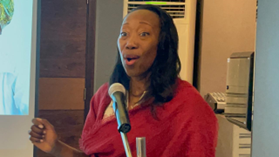
MONROVIA, October 5, 2026 — World Bank Liberia Country Manager Georgia Wallen has called on Liberia to increase domestic financing for social protection programs, warning that sustainable support for vulnerable citizens requires stronger national ownership rather than heavy dependence on short-term external funding.
Wallen made the call as Liberia launched its National Social Protection Policy and Strategy 2026–2030, which outlines the country’s approach to strengthening social assistance, resilience and economic opportunities for vulnerable populations over the next five years.
She described the strategy as an ambitious roadmap aligned with the government’s ARREST Agenda for Inclusive Development, but stressed that its long-term success will depend heavily on Liberia’s ability to build sustainable institutions and financing mechanisms.
“Resilient social protection systems depend on national ownership — both institutionally and financially,” Wallen said.
She urged Liberia to gradually move toward financing arrangements capable of sustaining social protection programs across generations instead of relying heavily on short-term, externally financed interventions.
According to Wallen, sustainable domestic financing will be critical to ensuring that programs remain effective and available to vulnerable Liberians over the long term.
She highlighted three areas of progress in Liberia’s social protection sector: the development of national systems, increased use of evidence to design programs, and the introduction of innovative mechanisms for delivering assistance.
“Social protection is no longer viewed as a temporary response to poverty or crisis, but increasingly as a core element of Liberia’s development agenda,” she said.
Wallen praised Liberia’s growing use of evidence in designing social protection interventions, saying lessons from existing programs have contributed to efforts to strengthen human capital, empower women, reduce poverty and expand economic opportunities.
She said feedback from beneficiaries indicates that social protection interventions have helped vulnerable households meet basic needs, keep children nourished and in school, and enable microentrepreneurs to withstand economic shocks.
Wallen also highlighted the Liberia Household Social Registry, digital payment systems and financial inclusion initiatives as important developments in improving the delivery of social protection programs.
“These mechanisms help to ensure scarce financing reaches the people who need it most while also promoting value for money, efficiently and transparently,” she said.
According to the World Bank official, social protection services are also expanding beyond direct financial assistance to include initiatives such as SMS weather advisories for farmers and financial-planning training for couples.
Looking ahead, Wallen identified three priorities for implementation of the new strategy: strengthening national ownership and domestic financing, developing shock-responsive social protection systems, and continuously improving delivery mechanisms and partnerships.
“The strategy’s vision of a shock-responsive social protection system is both timely and necessary,” she said.
She noted that Liberia remains vulnerable to overlapping economic, environmental and other shocks that can expose already vulnerable households to multiple risks.
Wallen reaffirmed the World Bank Group’s commitment to supporting Liberia’s social protection agenda, pointing to interventions ranging from the Youth Opportunities Project to the ongoing Recovery of Economic Activity for Liberian Informal Sector Employment (REALISE) Project.
She also recognized the roles of the Ministry of Gender, Children and Social Protection, Ministry of Finance and Development Planning, Ministry of Youth and Sports, Liberia Agency for Community Empowerment and development partners, including France and Sweden, in supporting the country’s social protection programs.
The National Social Protection Policy and Strategy 2026–2030 is expected to provide the framework for coordinating interventions aimed at protecting vulnerable households, strengthening resilience to shocks and expanding opportunities for economically disadvantaged Liberians.
See more Liberia News Network stories in Google Search by adding LNN as one of your Preferred Sources.
★ Add LNN as a Preferred Source